 Back
BackTranscription in Prokaryotes: Mechanisms and Gene Structure
Study Guide - Smart Notes
 Tailored notes based on your materials, expanded with key definitions, examples, and context.
Transcription in Prokaryotes
Central Dogma of Molecular Biology
The central dogma describes the flow of genetic information within a biological system: DNA is transcribed into RNA, which is then translated into protein. This process links genotype (genetic makeup) to phenotype (observable traits).
Replication: DNA is copied during the S phase of the cell cycle.
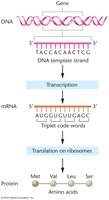
Transcription: DNA is used as a template to synthesize RNA.
Translation: mRNA is decoded to build a polypeptide (protein).
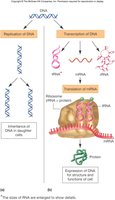
Gene Expression: Transcription and Translation
Gene expression involves two main processes: transcription and translation. In prokaryotes, these processes are tightly coupled, allowing for rapid adaptation to environmental changes.
mRNA (messenger RNA): Carries the genetic code from DNA to ribosomes.
tRNA (transfer RNA): Brings amino acids to the ribosome during translation.
rRNA (ribosomal RNA): Forms part of the ribosome's structure and catalyzes peptide bond formation.
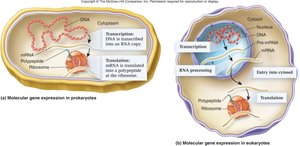
Gene Expression in Prokaryotes vs. Eukaryotes
In prokaryotes, transcription and translation occur simultaneously in the cytoplasm, whereas in eukaryotes, transcription occurs in the nucleus and translation in the cytoplasm. This spatial separation in eukaryotes allows for additional regulation.
Prokaryotic mRNA can be translated while it is still being transcribed.
This coupling enables rapid gene expression in response to environmental changes.
Structure of a Prokaryotic Gene
Key Regions of a Prokaryotic Gene
A typical prokaryotic gene contains several important regions that regulate and encode genetic information:
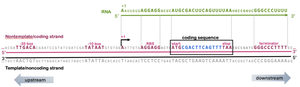
Promoter: DNA sequence where RNA polymerase binds to initiate transcription. Contains the –35 box (5′–TTGACA–3′) and –10 box (Pribnow box, 5′–TATAAT–3′).
+1 Site: The first nucleotide transcribed into RNA.
RNA-coding region: Sequence that is transcribed into RNA, including start and stop codons.
5′ UTR: Untranslated region upstream of the start codon; important for ribosome binding.
3′ UTR: Untranslated region downstream of the stop codon; influences mRNA stability and translation.
Termination region: Signals the end of transcription.
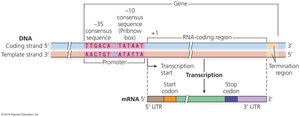
Coding vs. Template Strand
The coding strand (5′ → 3′) has the same sequence as the mRNA (except T is replaced by U). The template strand (3′ → 5′) is read by RNA polymerase to synthesize RNA.
Transcription proceeds 5′ → 3′ on the mRNA, using the template strand as a guide.
Mechanism of Transcription in Prokaryotes
Stages of Transcription
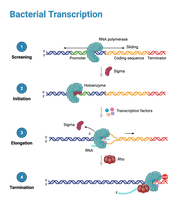
Transcription in prokaryotes occurs in three main stages: initiation, elongation, and termination.
Initiation
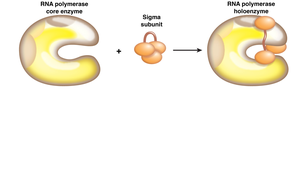
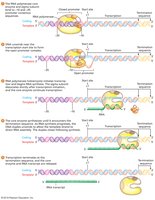
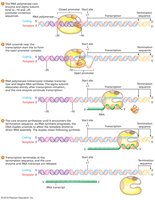
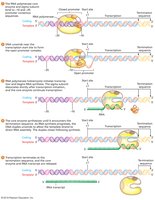
Initiation begins when RNA polymerase core enzyme associates with a σ (sigma) factor to form the holoenzyme. The holoenzyme recognizes and binds to the promoter region, spanning the –35 and –10 boxes, forming a closed complex. DNA unwinds at the –10 region, creating an open complex and exposing the template strand for RNA synthesis.
σ factor: Recognizes promoter sequences and positions RNA polymerase correctly.
RNA synthesis begins at the +1 site.
Elongation
During elongation, the σ factor is released, and the core RNA polymerase continues RNA synthesis. The enzyme moves downstream from the +1 site, synthesizing RNA in the 5′ → 3′ direction. A transcription bubble (~17 bp) forms and moves with the enzyme, allowing DNA to unwind ahead and rewind behind the polymerase. The newly synthesized RNA temporarily base-pairs with the DNA template before peeling away.
Termination
Transcription ends when RNA polymerase encounters a termination sequence. There are two main mechanisms:
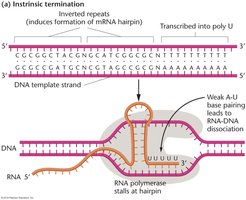
Rho-independent (intrinsic) termination: GC-rich inverted repeats in the RNA form a hairpin loop, followed by a string of U's. Weak A–U base pairing causes the RNA to detach from the DNA template.
Rho-dependent termination: The Rho (ρ) protein binds to a rut site on the RNA and moves 5′ → 3′. When RNA polymerase pauses at a hairpin, Rho catches up and unwinds the RNA–DNA hybrid, releasing the transcript.
Summary Table: Stages of Prokaryotic Transcription
Stage | Main Events | Key Proteins/Elements |
|---|---|---|
Initiation | Holoenzyme binds promoter, DNA unwinds, RNA synthesis begins at +1 | RNA polymerase, σ factor, –35 and –10 boxes |
Elongation | σ factor released, RNA synthesized 5′ → 3′, transcription bubble moves | RNA polymerase core enzyme |
Termination | RNA polymerase reaches termination sequence, transcript released | Intrinsic signals (hairpin + U's), Rho protein (if rho-dependent) |
Analyzing Prokaryotic Gene Structure
Steps to Identify Gene Features
When analyzing a prokaryotic gene sequence, follow these steps:
Identify the coding strand: Sequence matches mRNA (T → U).
Find the promoter region: Look for –35 (TTGACA) and –10 (TATAAT) consensus sequences upstream of the +1 site.
Locate the +1 site: Usually 5–9 bp downstream of the –10 box; marks the first base transcribed.
Mark the transcribed region: Starts at +1 and ends at the termination sequence.
Write the mRNA sequence: Use the coding strand, substituting U for T, or complement the template strand.
Locate termination signals: Look for inverted repeats (hairpin) and poly-A regions (→ poly-U in RNA).
Practice: Identifying Gene Structure Elements
Given a coding strand sequence, students should be able to identify:
The Pribnow box (–10 region)
The +1 transcription start site
The termination region (hairpin-forming inverted repeats and poly-A stretch)
Key Terms and Concepts
Promoter: DNA sequence where transcription begins; includes –35 and –10 boxes.
σ (sigma) factor: Protein that directs RNA polymerase to the promoter.
Transcription bubble: Region of unwound DNA where RNA synthesis occurs.
Rho protein: Helicase involved in rho-dependent termination.
Hairpin loop: Secondary structure in RNA that signals termination.
Equations and Notation
Direction of RNA synthesis:
Template strand read:
