 Back
BackChap 17 pt 1
Study Guide - Smart Notes
 Tailored notes based on your materials, expanded with key definitions, examples, and context.
Transcriptional Regulation in Eukaryotes & DNA Organization in Chromosomes
Overview of Eukaryotic Gene Regulation
Eukaryotic gene regulation is a complex, multi-level process that ensures genes are expressed at the right time, place, and amount. This complexity arises from the greater amount of DNA, its association with histones, and the compartmentalization of genetic material within the nucleus.
DNA Packaging: Eukaryotic DNA is tightly packed with histones into chromatin, affecting gene accessibility.
mRNA Processing: Eukaryotic mRNAs are spliced, capped, and polyadenylated before export from the nucleus.
Multiple Regulatory Levels: Regulation occurs at transcription, post-transcription, translation, and post-translation.
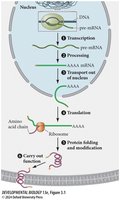
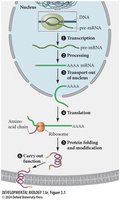
Levels of Gene Expression Regulation in Eukaryotes
Gene expression in eukaryotes is regulated at several key stages:
Chromatin Remodeling & Histone Modification: Alters DNA accessibility for transcription.
Transcriptional Regulation: Controls initiation and rate of mRNA synthesis.
Post-Transcriptional Regulation: Involves mRNA splicing, stability, and microRNAs.
Post-Translational Regulation: Modifies proteins after synthesis (e.g., phosphorylation).
DNA Organization in Chromosomes
Chromatin Structure and Function
In non-dividing cells, DNA exists as chromatin, a complex of DNA and proteins. Chromatin structure is dynamic, allowing for compaction during cell division and relaxation during interphase for gene expression.
Chromatin: Uncoiled during interphase, condensed into chromosomes during cell division.
Nucleosome: The basic unit of chromatin, consisting of DNA wrapped twice around a histone octamer (2x H2A, H2B, H3, H4).
Example: If all DNA in a human cell were stretched end to end, it would measure about 6 feet.
Nucleosome Structure
Nucleosomes appear as "beads on a string" under electron microscopy. Histones, which are rich in lysine and arginine, are positively charged and interact with negatively charged DNA, acting as gatekeepers for gene expression.
Chromatin Remodeling and Histone Modification
Chromatin remodeling is essential for gene expression and DNA replication. It involves the relaxation or condensation of chromatin to expose or hide DNA regions from regulatory proteins.
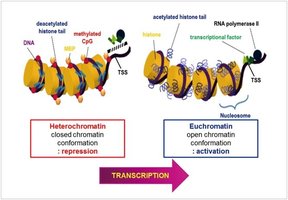
Acetylation: Addition of acetyl groups by histone acetyltransferases (HATs) loosens chromatin, promoting transcription.
Deacetylation: Removal of acetyl groups by histone deacetylases (HDACs) tightens chromatin, repressing transcription.
Methylation: Addition of methyl groups by histone methyltransferases generally represses transcription by tightening chromatin.
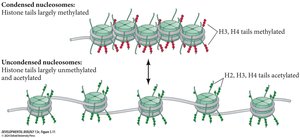
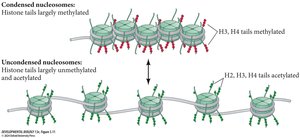
Euchromatin vs Heterochromatin
Euchromatin: Uncoiled, transcriptionally active regions of chromatin.
Heterochromatin: Condensed, transcriptionally inactive regions.
Chromatin Remodeling Complexes
Complexes such as SWI/SNF reposition or remove nucleosomes, making DNA accessible to transcription factors and RNA polymerase II. This process is crucial for regulating gene expression.
Transcription Initiation in Eukaryotes
Cis-Acting and Trans-Acting Elements
Gene regulation involves both DNA sequences (cis-acting) and diffusible factors (trans-acting):
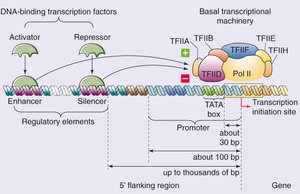
Cis-acting elements: DNA sequences on the same chromosome as the gene they regulate (e.g., promoters, enhancers, silencers).
Trans-acting factors: Proteins or RNAs that can regulate genes on any chromosome (e.g., activators, repressors).
Promoter Types and Structure
Focused Promoters: Direct transcription initiation at a single site; common in highly regulated genes.
Dispersed Promoters: Initiate transcription at multiple weak sites; common in housekeeping genes.
Core Promoter: Contains essential elements for transcription initiation, such as the TATA box, Initiator (Inr), TFIIB recognition element (BRE), and sometimes DPE/MTE.
Formation of the Pre-Initiation Complex (PIC)
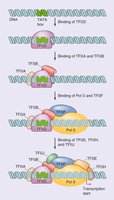
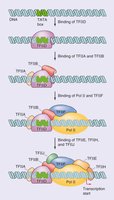
The assembly of the pre-initiation complex is a critical step for transcription initiation. It involves the sequential binding of general transcription factors and RNA polymerase II to the promoter region.
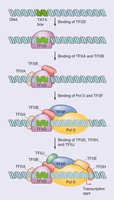
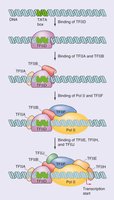
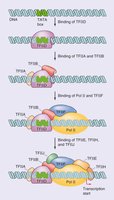
Basal Transcription Factors: TFIIA, TFIIB, TFIID, TFIIE, TFIIF, TFIIH are required for any transcription by RNA polymerase II.
Stepwise Assembly: TFIID binds the TATA box, followed by TFIIA and TFIIB, then RNA polymerase II with TFIIF, and finally TFIIE and TFIIH.
Role of Specific Transcription Factors
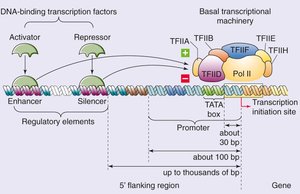
Beyond the basal transcription machinery, specific transcription factors bind to enhancers or silencers to fine-tune gene expression. Activators increase, while repressors decrease, the rate of transcription initiation.
Cis-Regulatory Regions: Enhancers and Silencers
Enhancers and silencers are cis-acting DNA sequences that can be located upstream, downstream, or within a gene. They interact with specific transcription factors to modulate transcription levels above or below the basal rate.
Mechanisms of Activators and Repressors
Activators and repressors function by interacting with the transcriptional machinery and modifying chromatin structure. DNA looping brings these factors into proximity with the promoter, facilitating or inhibiting the assembly of the transcription complex.
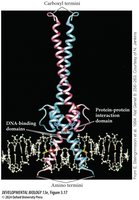
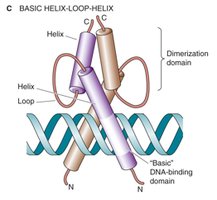
DNA-Binding Domain: Recognizes and binds specific DNA sequences in cis-regulatory regions.
Trans-Activating Domain: Interacts with other transcription factors or RNA polymerase to activate or repress transcription.
Summary Table: Chromatin Modifications and Their Effects
Modification | Enzyme | Effect on Chromatin | Effect on Transcription |
|---|---|---|---|
Acetylation | HATs | Loosens chromatin | Promotes transcription |
Deacetylation | HDACs | Tightens chromatin | Represses transcription |
Methylation | Histone methyltransferases | Tightens chromatin | Generally represses transcription |
Key Equations and Concepts
Gene Expression Pathway:
Chromatin Remodeling: Involves ATP-dependent repositioning or removal of nucleosomes to regulate DNA accessibility.
Additional info: The notes above integrate foundational textbook content with logical academic context to ensure completeness and clarity for genetics students.
