 Back
Transcriptional Regulation in Eukaryotes: Mechanisms and Model Systems
Study Guide - Smart Notes
 Tailored notes based on your materials, expanded with key definitions, examples, and context.
Transcriptional Regulation in Eukaryotes
Overview of Eukaryotic Gene Regulation
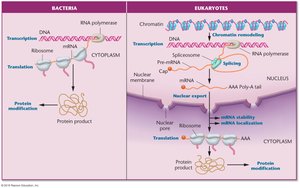
Eukaryotic gene regulation is a complex, multi-layered process that ensures genes are expressed at the right time, place, and amount. This regulation is essential for cellular differentiation, development, and response to environmental signals. Unlike prokaryotes, eukaryotic gene expression is influenced by chromatin structure, nuclear compartmentalization, and extensive post-transcriptional modifications.
Key differences from prokaryotes: Eukaryotic DNA is packaged with histones, mRNAs are processed (splicing, capping, polyadenylation), and genes are distributed across multiple chromosomes within a nucleus.
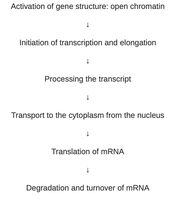
Regulation occurs at multiple levels: chromatin accessibility, transcription initiation, RNA processing, mRNA export, translation, and mRNA/protein stability.
Chromatin Structure and DNA Accessibility
Chromatin Organization
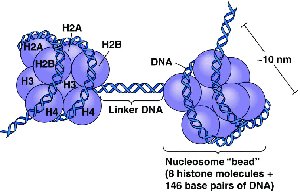
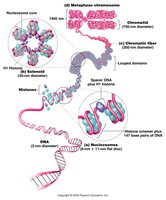
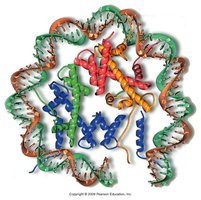
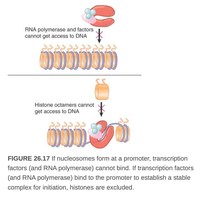
Chromatin is the complex of DNA and proteins (mainly histones) that packages eukaryotic genomes. The basic unit is the nucleosome, consisting of DNA wrapped around a histone octamer. Chromatin structure can be dynamically altered to regulate gene accessibility.
Nucleosome: 147 bp of DNA wrapped around a histone octamer (2x H2A, H2B, H3, H4); H1 binds linker DNA.
Higher-order structure: Nucleosomes fold into 30-nm fibers and higher-order loops, contributing to chromosome territories in the nucleus.
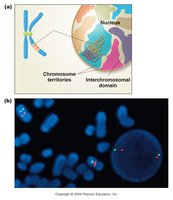
Chromatin States: Euchromatin vs. Heterochromatin
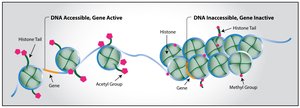
Euchromatin: Less condensed, transcriptionally active, accessible to transcription machinery.
Heterochromatin: Highly condensed, transcriptionally silent, restricts access to DNA.
Mechanisms Regulating DNA Accessibility
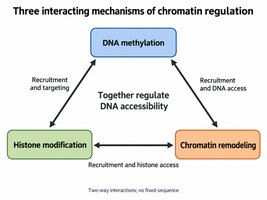
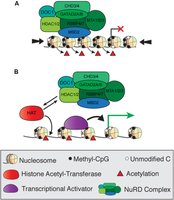
Histone Modifications: Acetylation (by HATs) generally activates transcription by reducing histone-DNA affinity; methylation can activate or repress depending on context.
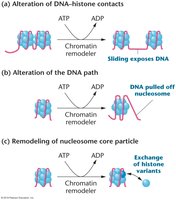
Chromatin Remodeling: ATP-dependent complexes (e.g., SWI/SNF) reposition or evict nucleosomes to expose regulatory DNA.
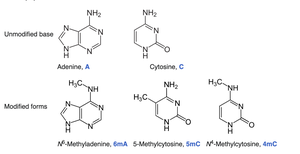
DNA Methylation: Addition of methyl groups (mainly at CpG sites) is associated with transcriptional repression.
Transcription Initiation in Eukaryotes
Core Promoter Elements
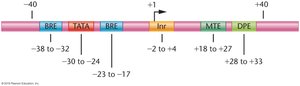
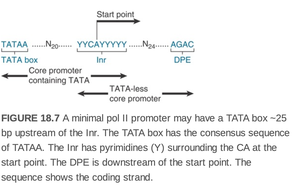
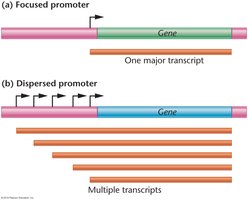
The core promoter is the DNA region surrounding the transcription start site (TSS) and contains sequence elements recognized by the basal transcription machinery.
TATA box: ~25–30 bp upstream of TSS; recognized by TBP (TATA-binding protein).
Initiator (Inr): Overlaps TSS; helps position the transcription machinery.
BRE, DPE, MTE: Additional elements that support initiation.
General Transcription Factors and RNA Polymerase II
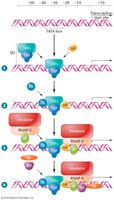
General transcription factors (GTFs): TFIIA, TFIIB, TFIID, TFIIE, TFIIF, TFIIH; required for accurate initiation by RNA polymerase II.
Pre-initiation complex (PIC): Sequential assembly of GTFs and Pol II at the core promoter.
Promoter escape: Pol II transitions from initiation to elongation after synthesizing the first RNA nucleotides.
Regulatory DNA Elements and Transcription Factors
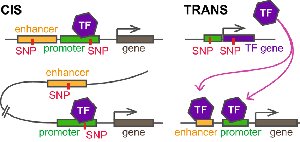
Cis-Acting Elements
Core promoter: Surrounds TSS; required for basal transcription.
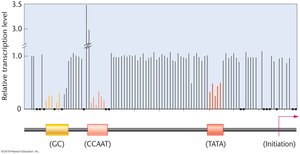
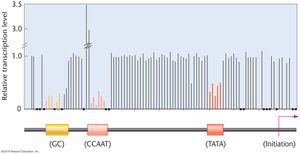
Proximal promoter elements: Located ~50–200 bp upstream; bind specific transcription factors (e.g., GC box, CCAAT box).
Enhancers: Distant elements that increase transcription; can function in any orientation or position relative to the gene.
Silencers: DNA elements that repress transcription.
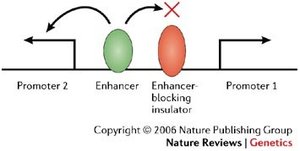
Insulators: Block enhancer-promoter interactions when positioned between them.
Trans-Acting Factors
General transcription factors: Required for all Pol II transcription; bind core promoter.
Specific transcription factors: Bind enhancers, silencers, or proximal elements; regulate when, where, and how much a gene is transcribed.
Activators: Increase transcription by recruiting coactivators, chromatin remodelers, or the Mediator complex.
Repressors: Decrease transcription by recruiting corepressors or promoting restrictive chromatin.
DNA-Binding Domains in Transcription Factors
Helix-turn-helix (HTH): Common in both prokaryotic and eukaryotic TFs; recognition helix contacts DNA major groove.
Zinc finger: Stabilized by zinc ion; recognizes specific DNA sequences.
Basic leucine zipper (bZIP): Dimerization and DNA binding via separate domains.
Combinatorial and Context-Dependent Regulation
Combinatorial Control
Gene expression is often regulated by the combined action of multiple transcription factors binding to various cis-regulatory elements. This allows for fine-tuned and context-specific gene expression.
Example: The human metallothionein IIA gene is regulated by several TFs in response to heavy metals and oxidative stress.
Model System: Transcriptional Regulation of the GAL Genes in Yeast
The GAL Gene System
The GAL gene system in Saccharomyces cerevisiae (yeast) is a classic model for studying eukaryotic gene regulation. It consists of structural genes (GAL1, GAL7, GAL10, GAL2) and regulatory genes (GAL4, GAL80, GAL3) that control galactose metabolism.
Inducible system: GAL genes are transcribed only when galactose is present and glucose is low.
Positive control: GAL4 is an activator that binds upstream activating sequences (UAS) to stimulate transcription.
Negative control: GAL80 binds GAL4 and blocks its activation domain in the absence of galactose.
Signal transduction: GAL3 senses galactose and relieves GAL80 inhibition, allowing GAL4 to activate transcription.
Mechanism of Regulation
In the absence of galactose, GAL80 binds GAL4, preventing activation of GAL genes.
When galactose is present, GAL3 binds galactose and ATP, interacts with GAL80, and releases GAL4's activation domain.
GAL4 then recruits chromatin remodelers (e.g., SWI/SNF), TFIID, and the Mediator complex to activate transcription.
When glucose is abundant, Mig1 protein represses GAL genes by recruiting corepressors and histone deacetylases, overriding GAL4 activation.
Functional Domains of Transcription Factors
DNA-binding domain (DBD): Recognizes specific DNA sequences (e.g., UAS for GAL4).
Activation domain (AD): Interacts with coactivators and the transcription machinery.
These domains are modular and can function independently, as demonstrated by the yeast two-hybrid system for studying protein-protein interactions.
Summary Table: Key Mechanisms of Eukaryotic Transcriptional Regulation
Mechanism | Effect | Key Proteins/Complexes | Example |
|---|---|---|---|
Histone Acetylation | Activates transcription | HATs, SWI/SNF | GAL4 recruits HATs |
DNA Methylation | Represses transcription | DNMTs, MBD proteins | CpG methylation in mammals |
Chromatin Remodeling | Activates or represses | SWI/SNF, ISWI | Exposure of promoter DNA |
Enhancers/Silencers | Increase/decrease transcription | Activators, repressors | UAS in yeast, enhancers in animals |
Insulators | Block enhancer action | CTCF | Enhancer-blocking insulator |
Key Concepts for Exam Preparation
Understand the differences between eukaryotic and prokaryotic gene regulation.
Know the roles of chromatin structure, histone modifications, and DNA methylation in gene regulation.
Be able to describe the assembly and function of the pre-initiation complex at the core promoter.
Distinguish between general and specific transcription factors, and their interactions with cis-regulatory elements.
Explain the modular structure of transcription factors and the significance of the GAL gene system in yeast as a model for inducible gene regulation.
