 Back
Transcriptional Regulation in Eukaryotes: Mechanisms, Chromatin, and the GAL Gene System
Study Guide - Smart Notes
 Tailored notes based on your materials, expanded with key definitions, examples, and context.
Transcriptional Regulation in Eukaryotes
Overview of Eukaryotic Gene Regulation
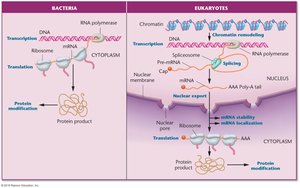
Eukaryotic gene regulation is a complex, multi-layered process that controls when, where, and how genes are expressed. Unlike prokaryotes, eukaryotic cells have greater DNA content, organized into chromatin, and gene expression is influenced by chromatin structure, transcription factors, and regulatory DNA elements.
Key differences: Eukaryotic genes are typically 'off' by default and require activation, while prokaryotic genes are often 'on' unless repressed.
Regulation occurs at multiple levels: chromatin modification, transcription initiation, RNA processing, translation, and protein modification.
Chromatin structure: DNA is packaged with histones into nucleosomes, affecting accessibility for transcription.
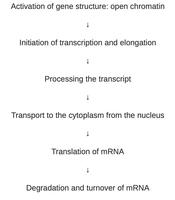
Stages of Eukaryotic Gene Expression Regulation
Gene expression can be regulated at several stages, from chromatin activation to mRNA degradation.
Activation of gene structure: Chromatin must be open for transcription to occur.
Transcription initiation and elongation: RNA polymerase and transcription factors assemble at the promoter.
Transcript processing: mRNA is spliced, capped, and polyadenylated.
Transport: Processed mRNA is exported from the nucleus to the cytoplasm.
Translation: mRNA is translated into protein.
Degradation: mRNA turnover regulates gene expression levels.
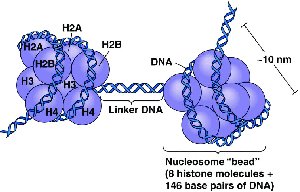
Chromatin Structure and DNA Accessibility
Chromatin Organization
Chromatin consists of DNA wrapped around histone proteins, forming nucleosomes. This packaging regulates DNA accessibility for transcription.
Nucleosome: The basic unit of chromatin, composed of eight histone proteins (H2A, H2B, H3, H4) and ~146 base pairs of DNA.
Linker histone (H1): Stabilizes chromatin structure.
Chromatin condensation: Chromatin becomes highly condensed during mitosis.
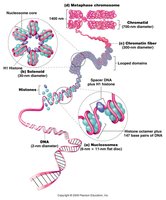
Levels of DNA Packaging
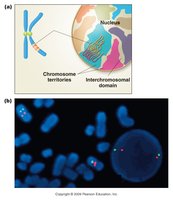
DNA is organized into higher-order structures, from nucleosomes to chromatin fibers and chromosome territories.
30-nm fiber: Classical model of chromatin packing.
Chromosome territories: Each chromosome occupies a distinct domain within the nucleus.
Chromatin Accessibility and Transcription
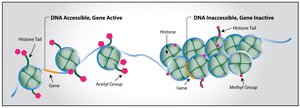
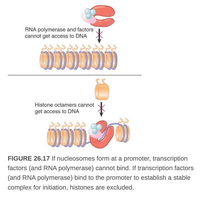
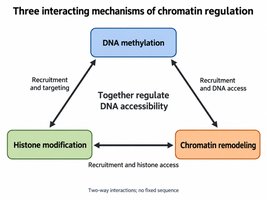
Chromatin restricts access to DNA, influencing transcription, replication, and repair. Open chromatin (euchromatin) is accessible and transcriptionally active, while closed chromatin (heterochromatin) is condensed and repressive.
Open chromatin: Permits access for transcription factors and RNA polymerase.
Closed chromatin: Limits access, reducing transcription.
Mechanisms Regulating DNA Accessibility
Histone Modifications
Histone tails can be modified by acetylation, methylation, or phosphorylation, affecting chromatin structure and gene expression.
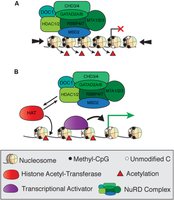
Acetylation: Added by histone acetyltransferases (HATs), reduces positive charge, increases transcription.
Methylation: Can activate or repress transcription depending on context.
ATP-Dependent Chromatin Remodeling
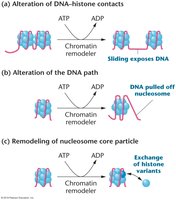
Chromatin remodeling complexes use ATP to reposition or remove nucleosomes, making DNA accessible for transcription.
SWI/SNF complex: Alters histone-DNA contacts, slides nucleosomes, exposes regulatory DNA.
Remodeling mechanisms: Sliding, pulling DNA off nucleosomes, exchanging histone variants.
DNA Methylation
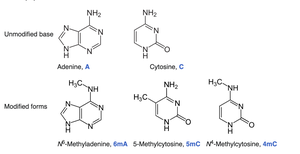
DNA methylation adds methyl groups to cytosine bases, mainly at CpG sites, and is associated with transcriptional repression.
CpG methylation: Recruits methyl-CpG-binding proteins and repressor complexes.
Interaction with histone modification: Methylation can recruit histone deacetylases, linking DNA methylation to repressive chromatin.
Transcription Initiation in Eukaryotes
Core Promoter Elements
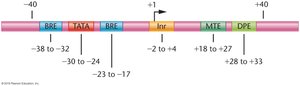
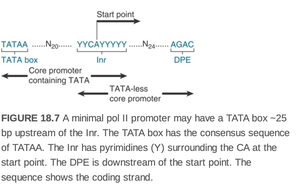
The core promoter surrounds the transcription start site (TSS) and contains sequence elements recognized by the transcription machinery.
TATA box: ~25–30 bp upstream of TSS, binds TBP.
Initiator (Inr): Overlaps TSS, recruits machinery.
BRE, DPE, MTE: Additional elements supporting initiation.
General Transcription Factors and Basal Initiation
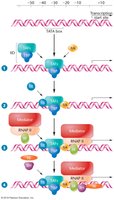
RNA polymerase II requires general transcription factors (TFIIA, TFIIB, TFIID, TFIIE, TFIIF, TFIIH) to initiate transcription at the core promoter.
Assembly: TFIID binds TATA, TFIIA stabilizes, TFIIB positions Pol II, TFIIE recruits TFIIH.
TFIIH: Opens DNA, phosphorylates Pol II, initiates RNA synthesis.
Cis- and Trans-Acting Regulatory Elements
Proximal Promoter Elements
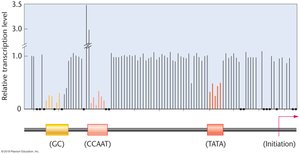
Proximal elements are located near the core promoter and bind specific transcription factors to regulate transcription efficiency.
Examples: GC boxes, CCAAT boxes.
Location: Typically 50–200 bp upstream of TSS.
Enhancers, Silencers, and Insulators
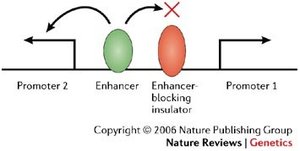
Enhancers increase transcription from a target promoter, silencers reduce transcription, and insulators block enhancer-promoter interactions.
Enhancers: Can act at a distance, bind activators.
Silencers: Recruit repressors.
Insulators: Restrict enhancer activity to specific promoters.
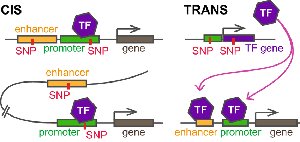
Cis vs. Trans Regulation
Cis elements are DNA sequences on the same molecule as the gene they regulate; trans elements are proteins encoded elsewhere that bind to cis sites.
Cis: Promoters, enhancers, silencers.
Trans: Transcription factors, cofactors.
Transcription Factors: Structure and Function
DNA-Binding Domains
Transcription factors contain modular domains for DNA binding and transcription activation/repression.
Helix-turn-helix: Recognizes DNA major groove.
Zinc finger: Stabilized by zinc ion, recognizes extended sequences.
Basic leucine zipper (bZIP): Dimerizes and binds DNA.
Gene Regulation in Yeast: The GAL Gene System
GAL Gene System Overview
The GAL gene system in yeast is a model for inducible gene regulation. It consists of structural genes for galactose metabolism and regulatory genes controlling their expression.
Inducible system: Activated when galactose is present and glucose is low.
Positive control: Requires activator protein (GAL4) for transcription.
Regulatory Proteins: GAL4, GAL80, GAL3
GAL4 is an activator, GAL80 is a repressor, and GAL3 is a sensor that relieves repression in the presence of galactose.
GAL4: Binds upstream activating sequences (UAS), recruits chromatin remodelers and transcription machinery.
GAL80: Binds GAL4, blocks activation domain, represses transcription.
GAL3: Binds galactose and ATP, interacts with GAL80, releases GAL4 for activation.
Upstream Activating Sequences (UAS)
UAS elements are functionally similar to enhancers, providing binding sites for GAL4 and enabling modular promoter architecture.
Position- and orientation-independent: Can activate transcription from a distance.
Modular promoters: Core promoter plus UAS elements.
Repression by Glucose
When glucose is abundant, Mig1 protein accumulates and represses GAL genes by recruiting corepressors and histone deacetylases, overriding GAL4 activation.
Mig1: Binds Mig1 site, works with Cyc8–Tup1, recruits HDA1.
Dominant repression: GAL genes are repressed even if galactose is present.
Yeast Two-Hybrid System
The yeast two-hybrid system demonstrates the modularity of transcription factors, separating DNA-binding and activation domains to study protein-protein interactions.
Reporter gene: Used to detect interaction.
Applications: Mapping protein networks.
Summary Table: Key Mechanisms of Eukaryotic Transcriptional Regulation
Mechanism | Effect | Example |
|---|---|---|
Histone Acetylation | Increases transcription | HATs add acetyl groups |
Histone Methylation | Activates or represses | Depends on residue/context |
Chromatin Remodeling | Exposes regulatory DNA | SWI/SNF complex |
DNA Methylation | Represses transcription | CpG methylation |
Enhancers | Increase transcription | UAS in yeast |
Silencers | Decrease transcription | Mig1 site in GAL genes |
Insulators | Block enhancer activity | CTCF-bound insulators |
