 Back
Transcriptional Regulation in Eukaryotes: Mechanisms, Chromatin Structure, and Model Systems
Study Guide - Smart Notes
 Tailored notes based on your materials, expanded with key definitions, examples, and context.
Transcriptional Regulation in Eukaryotes
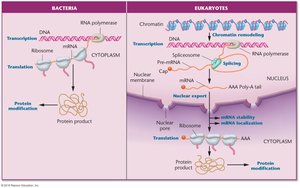
Levels of Gene Expression Regulation
Gene expression in eukaryotes is regulated at multiple levels, allowing for precise control of cellular function and differentiation. The main levels include:
Chromatin structure and modification: DNA packaging into chromatin affects accessibility for transcription.
Transcriptional regulation: Control of RNA synthesis from DNA.
RNA processing: Includes splicing, capping, and polyadenylation.
RNA export and stability: Determines mRNA availability in the cytoplasm.
Translational regulation: Control of protein synthesis from mRNA.
Post-translational modification: Modifications of proteins after translation.
Example: Skin cells express keratins, while muscle cells express myosin II, demonstrating cell-type specific gene expression.
Comparison of Prokaryotic and Eukaryotic Gene Regulation
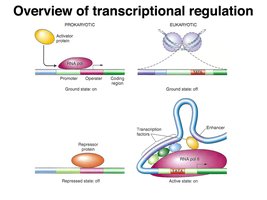
Eukaryotic gene regulation is more complex than prokaryotic regulation due to chromatin structure and multiple regulatory layers.
Eukaryotes: Chromatin is packed into nucleosomes; default state is 'off'; positive regulation predominates.
Prokaryotes: DNA is essentially naked; default state is 'on'; negative regulation is common.
Transcriptional Regulation Mechanisms
Trp Attenuator in Prokaryotes (Model for Regulation)
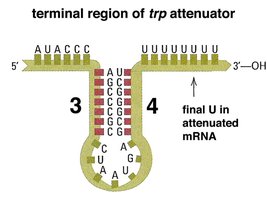
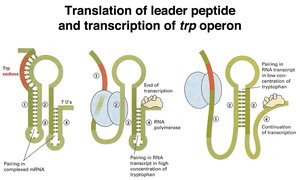
The trp operon in E. coli is regulated by attenuation, a mechanism involving secondary structures in mRNA that influence transcription termination.
Stem-loop structure: The terminal region of the trp attenuator forms a stem-loop (sequences 3:4) followed by oligoU, resembling rho-independent termination.
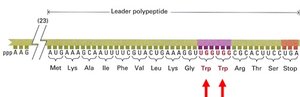
Leader peptide: Contains two consecutive tryptophan codons; translation of this peptide is key to attenuation.
High trp-tRNA: Ribosome proceeds, 3:4 stem-loop forms, transcription terminates (operon off).
Low trp-tRNA: Ribosome stalls, 2:3 stem-loop forms, transcription continues (operon on).
Eukaryotic Transcriptional Regulation
Transcription in eukaryotes occurs in the nucleus and is not coupled to translation. Chromatin remodeling is required for transcription, and RNA polymerases rely on transcription factors to bind DNA.
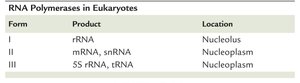
Three RNA polymerases: Each transcribes different gene types and recognizes distinct promoters.
Regulatory elements: Promoters, enhancers, silencers, and transcription factors influence transcription.
RNA processing: Eukaryotic transcripts are extensively processed before translation.
mRNA Stability and Regulation
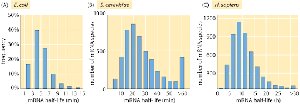
mRNA half-lives vary widely among organisms and genes, affecting gene expression levels.
Humans: Median mRNA half-life is 7.1 hours.
Yeast: 1 minute to 1 hour.
E. coli: 10 seconds to 20 minutes.
Chromatin Structure and Modifications
Chromatin Organization
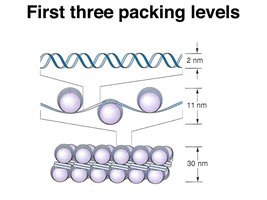
Eukaryotic DNA is packaged into chromatin, which inhibits transcription, replication, and DNA repair when compacted.
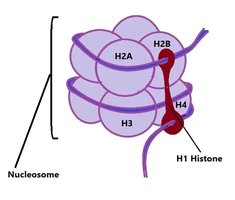
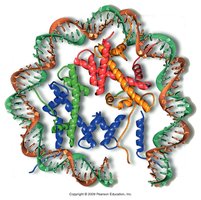
Nucleosomes: Basic unit of chromatin, consisting of histone octamers.
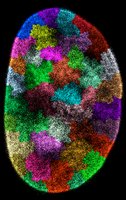
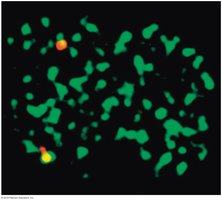
Chromosome territory: Each chromosome occupies a distinct domain in the interphase nucleus.
Transcription factories: Nuclear sites with active RNA polymerase and regulatory molecules, often at chromosome territory edges.
Euchromatin vs. Heterochromatin
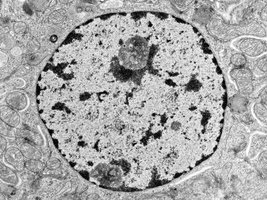
Chromatin exists in two main forms:
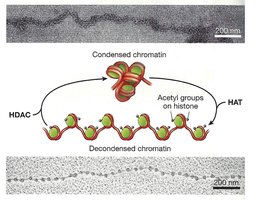
Heterochromatin: Condensed, transcriptionally inactive, stains during interphase.
Euchromatin: Uncoiled, transcriptionally active, appears unstained.
Histone Composition and Modifications
Histones H2A, H2B, H3, and H4 form octamers in nucleosomes. Histone tails are subject to modifications that regulate chromatin structure and gene expression.
Acetylation: Decreases positive charge, reduces histone-DNA affinity, opens chromatin.
Methylation: Can repress or activate transcription depending on context.
Phosphorylation: Alters chromatin structure and function.
Mechanisms of Chromatin Alteration
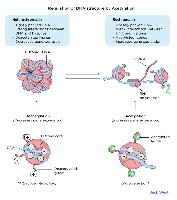
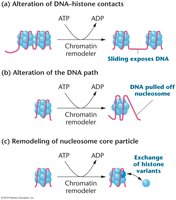
Chromatin can be altered by changing histone composition, histone modification, and chromatin remodeling.
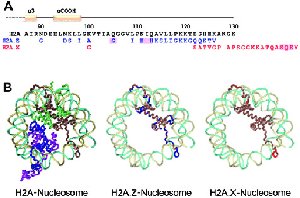
Histone composition change: Variant histones (e.g., H2A.Z) affect nucleosome stability and positioning.
Histone modification: Acetylation by HATs opens chromatin; deacetylation by HDACs closes chromatin.
Chromatin remodeling: SWI/SNF complex repositions or removes nucleosomes using ATP.
DNA Methylation
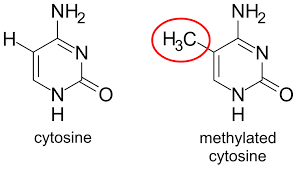
DNA methylation is associated with decreased gene expression and typically occurs at CpG sites (cytosine-phosphate-guanine dinucleotides).
Mechanism: Methylation of cytosine changes transcription factor binding and represses transcription.
Distribution: 70% of human genes have CpG islands in their promoters.
Cis-Acting Regulatory Elements
Promoters, Enhancers, and Silencers
Cis-acting sequences are located on the same chromosome as the gene they regulate and are essential for accurate transcription.
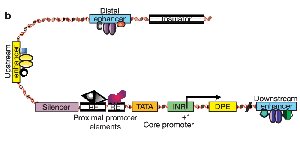
Promoters: Recognition sites for transcription machinery; include core and proximal elements.
Enhancers: Increase transcription, can be located far from the gene.
Silencers: Repress transcription initiation.
Core Promoter Structure and Diversity
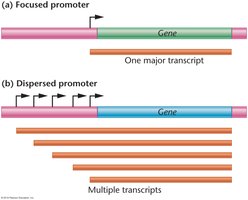
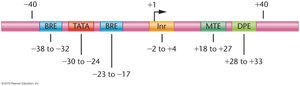
Core promoters are minimal regions required for transcription initiation and contain several sequence elements:
Initiator (Inr): Transcription start site.
TATA box: Consensus sequence TATAA/TAAR.
TFIIB recognition element (BRE): Upstream or downstream of TATA box.
Downstream promoter element (DPE) and Motif ten element (MTE): Found in some promoters.
Proximal-Promoter Elements
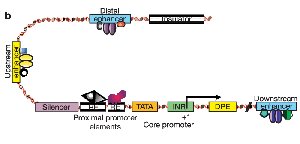
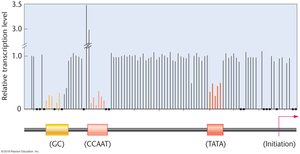
Located upstream of core promoter elements, these sequences enhance basal transcription levels.
CAAT box: Consensus sequence CAAT or CCAAT, located -70 to -80.
GC box: Consensus sequence GGGCGG, located -110.
Enhancers and Insulators
Enhancers and insulators are cis-acting elements that regulate transcription from a distance.
Enhancers: Can be upstream, downstream, or within a gene; required for maximal transcription.
Insulators: Block enhancer-promoter interactions for non-target genes.
Transcription Factors and Pre-Initiation Complex
Transcription Factors
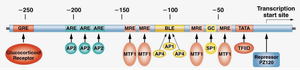
Transcription factors are proteins that bind to cis-acting sites and regulate gene expression.
Activators: Increase transcription initiation.
Repressors: Decrease transcription initiation.
Multiple factors: Bind to enhancers and promoter elements to fine-tune transcription.
Transcription Factor Functional Domains
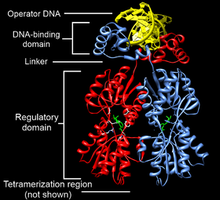
Transcription factors typically have two functional domains:
DNA-binding domain: Binds specific DNA sequences.
Trans-activating domain: Activates or represses transcription by interacting with other proteins.
Common DNA-Binding Motifs
DNA-binding proteins often contain characteristic motifs:
Helix-turn-helix (HTH): Found in both prokaryotic and eukaryotic transcription factors.
Zinc-finger: Present in many transcription factors.
Basic leucine zipper (bZIP): Facilitates protein dimerization.
Pre-Initiation Complex (PIC) Formation
The formation of the PIC is a critical step in transcription initiation:
Components: Core promoter, RNAP II, general transcription factors (TFIIA, TFIIB, TFIID, TFIIE, TFIIF, TFIIH), and Mediator complex.
TFIID: Contains TBP (TATA Binding Protein) and TAFs (TBP Associated Factors); binds to TATA box and other promoter elements.
Recruitment: Other GTFs and Mediator help recruit RNAP II to the promoter.
Mechanisms of Transcription Activation and Repression
DNA Looping and Recruitment Model
Transcription activators and repressors can bring changes to RNAP II transcription by DNA looping, which delivers regulatory proteins to the promoter vicinity. Enhancers and silencers act as donors, affecting regulatory proteins at gene promoters.
Model System: GAL Genes in Yeast
GAL Gene System
The GAL gene system in yeast is a classic example of positive regulation. It includes four structural genes (Gal1, Gal10) and three regulatory genes (Gal4, Gal3, Gal80).
Positive regulation: Activator protein (Gal4p) must be present to turn on transcription.
Inducible control: Transcription is regulated by the presence or absence of galactose.
Gal4p: Functions as a homodimer with DNA-binding and activation domains; binds to UASG (upstream activating sequence of GAL genes).
Gal80p: Inhibitor of Gal4; Gal3p inhibits Gal80 in the presence of galactose, relieving Gal4 inhibition.
Mutational analysis: Loss-of-function in GAL4 prevents transcription; loss-of-function in GAL80 leads to overexpression.
Summary Table: RNA Polymerases in Eukaryotes
Form | Product | Location |
|---|---|---|
I | rRNA | Nucleolus |
II | mRNA, snRNA | Nucleoplasm |
III | 5S rRNA, tRNA | Nucleoplasm |
Summary
Gene expression in eukaryotes is regulated at many steps, including chromatin structure, transcription, RNA processing, and translation. Chromatin remodeling and DNA modifications are crucial for regulation. The assembly of the pre-initiation complex is required for transcription initiation, and the GAL system in yeast exemplifies positive regulation.
