 Back
BackTranslation and the Genetic Code: From DNA to Protein
Study Guide - Smart Notes
 Tailored notes based on your materials, expanded with key definitions, examples, and context.
Translation and the Genetic Code
Overview of Gene Expression
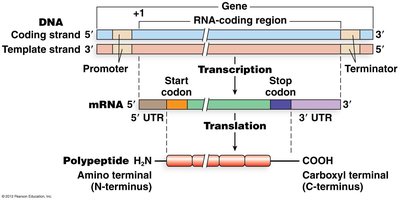
Gene expression is the process by which information encoded in DNA is used to direct the synthesis of proteins, which perform most cellular functions. This process involves two main steps: transcription (DNA to RNA) and translation (RNA to protein).
Transcription: The DNA sequence of a gene is transcribed to produce messenger RNA (mRNA).
Translation: The mRNA sequence is decoded by ribosomes to synthesize a specific polypeptide (protein).
Central Dogma: DNA → RNA → Protein.
The Structure and Properties of Amino Acids
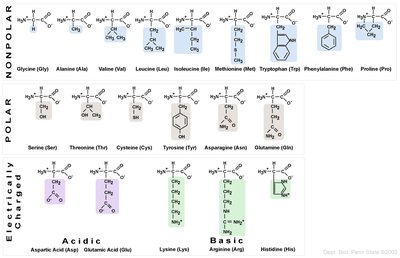
The 20 Common Amino Acids
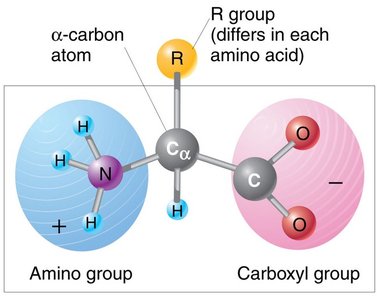
Proteins are polymers of amino acids. Each amino acid has a central carbon (the α-carbon) bonded to an amino group, a carboxyl group, a hydrogen atom, and a variable R group (side chain) that determines its properties.
Amino Group (NH2): Basic group.
Carboxyl Group (COOH): Acidic group.
R Group: Unique for each amino acid; determines chemical nature (nonpolar, polar, acidic, or basic).
Peptide Bond Formation
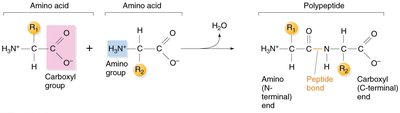
Amino acids are joined by peptide bonds, forming polypeptide chains. The peptide bond is a covalent bond between the carboxyl group of one amino acid and the amino group of the next.
Polypeptide Directionality: Free amino group at the N-terminus (start), free carboxyl group at the C-terminus (end).
Protein Structure: The sequence and chemical properties of amino acids determine the protein's 3D structure and function.
The Genetic Code
Codons and the Triplet Code
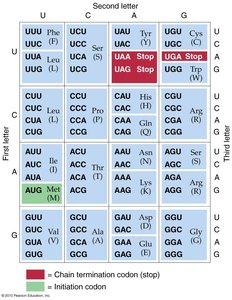
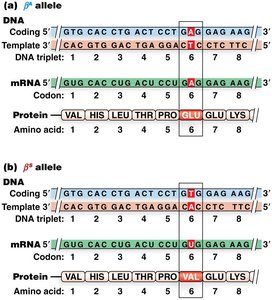
The genetic code is read in groups of three nucleotides, called codons, on the mRNA. Each codon specifies one amino acid. With four possible RNA bases (A, U, G, C), there are 64 possible codons, which is sufficient to encode all 20 amino acids.
Triplet Code: Each codon consists of three bases.
Non-overlapping: Codons are read one after another without overlap.
Degeneracy: Most amino acids are encoded by more than one codon.
Start Codon: AUG (methionine) signals the start of translation.
Stop Codons: UAA, UAG, UGA signal termination of translation.
Experimental Evidence for the Triplet Code
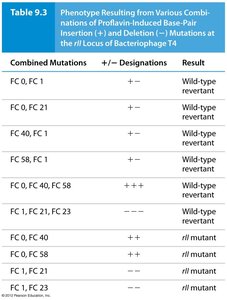
Crick and Brenner's experiments with bacteriophage T4 mutants demonstrated that the genetic code is read in triplets. Insertions or deletions of one or two bases disrupted protein function, but insertions or deletions of three bases restored function, supporting the triplet nature of the code.
Mutagenesis: Proflavin-induced insertions (+) or deletions (-) in DNA.
Revertants: Combinations of three insertions or deletions restored the reading frame and wild-type function.
Combined Mutations | +/- Designations | Result |
|---|---|---|
FC 0, FC 21 | + – | Wild-type revertant |
FC 40, FC 1 | + – | Wild-type revertant |
FC 58, FC 1 | + – | Wild-type revertant |
FC 0, FC 40, FC 58 | + + + | Wild-type revertant |
FC 1, FC 21, FC 23 | – – – | Wild-type revertant |
FC 0, FC 40 | + + | rII mutant |
FC 1, FC 21 | – – | rII mutant |
Deciphering the Genetic Code
The genetic code was deciphered using synthetic RNAs and cell-free translation systems. Nirenberg and Khorana synthesized RNAs of known sequences and observed which amino acids were incorporated into polypeptides, allowing them to assign codons to amino acids.
Poly-U Experiment: Poly-U RNA directed synthesis of polyphenylalanine, showing UUU codes for phenylalanine.
Repeating Copolymers: Used to determine codons for other amino acids.
Final Assignment: All 64 codons were assigned to specific amino acids or stop signals.
Properties of the Genetic Code
Triplet: Each codon is three bases.
Non-overlapping: Each base is part of only one codon.
No punctuation: The code is read continuously.
Start/Stop Codons: Specific codons signal initiation and termination.
Degenerate: Multiple codons for most amino acids.
Nearly Universal: The code is conserved across almost all organisms.
Translation: From mRNA to Protein
The Role of tRNA
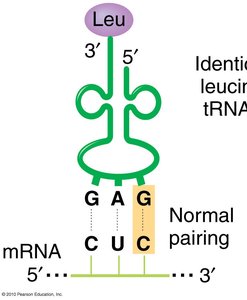
Transfer RNAs (tRNAs) are adapter molecules that match codons in mRNA with the correct amino acids during translation. Each tRNA has an anticodon that base-pairs with a codon in the mRNA and an acceptor stem that attaches to a specific amino acid.
Anticodon: Three-nucleotide sequence complementary to the mRNA codon.
Charging: Aminoacyl-tRNA synthetases attach the correct amino acid to the tRNA.
Wobble: The third base of the codon allows for flexible pairing, enabling one tRNA to recognize multiple codons.
The Ribosome and Translation
The ribosome is the molecular machine that synthesizes proteins by reading the mRNA and catalyzing peptide bond formation. It has three binding sites for tRNA: the A (aminoacyl), P (peptidyl), and E (exit) sites.
Initiation: Ribosome assembles at the start codon (AUG) on the mRNA.
Elongation: Amino acids are added one by one as the ribosome moves along the mRNA.
Termination: When a stop codon is reached, the completed polypeptide is released.
Directionality of Translation
Translation proceeds from the 5' to 3' end of the mRNA, synthesizing the polypeptide from the N-terminus to the C-terminus.
Summary Table: Key Features of the Genetic Code
Feature | Description |
|---|---|
Triplet | Each codon is three nucleotides |
Non-overlapping | Codons are read sequentially, without overlap |
Degenerate | Most amino acids have more than one codon |
Start Codon | AUG (methionine) |
Stop Codons | UAA, UAG, UGA |
Universal | Code is nearly universal among organisms |
Additional info: The Nobel Prize in Physiology or Medicine 1968 was awarded to Holley, Khorana, and Nirenberg for their work on deciphering the genetic code.
