 Back
BackTranslation and the Genetic Code: From DNA to Protein
Study Guide - Smart Notes
 Tailored notes based on your materials, expanded with key definitions, examples, and context.
Translation and the Genetic Code
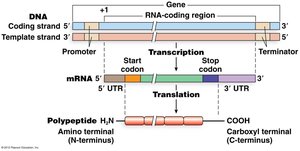
Overview of Gene Expression
Gene expression is the process by which information encoded in DNA is used to synthesize functional gene products, primarily proteins. This process involves two main steps: transcription (DNA to RNA) and translation (RNA to protein).
Transcription: The DNA sequence of a gene is transcribed to produce messenger RNA (mRNA).
Translation: The mRNA sequence is decoded by the ribosome to synthesize a polypeptide (protein).
The 20 Amino Acids and Their Properties
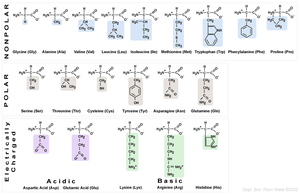
Proteins are polymers of amino acids. There are 20 standard amino acids, each with distinct chemical properties that influence protein structure and function.
Nonpolar (hydrophobic): e.g., Glycine, Alanine, Valine
Polar (hydrophilic): e.g., Serine, Threonine, Cysteine
Electrically charged: Acidic (Aspartic acid, Glutamic acid), Basic (Lysine, Arginine, Histidine)
Peptide Bond Formation and Protein Structure
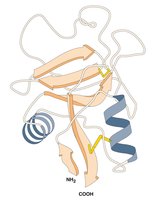
Amino acids are joined by peptide bonds, forming linear polypeptide chains. Each chain has an amino (N) terminus and a carboxyl (C) terminus. The sequence and chemical properties of amino acids determine the protein's three-dimensional structure, which is essential for its function.
Primary structure: Linear sequence of amino acids
Secondary, tertiary, and quaternary structures: Higher-order folding driven by interactions among amino acid side chains
The Genetic Code
From DNA to Protein: The Central Dogma
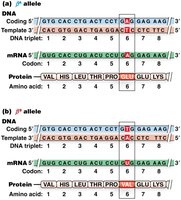
The sequence of bases in DNA encodes the information for protein synthesis. This information is transcribed into mRNA, which is then translated into a specific sequence of amino acids.
Codon: A sequence of three nucleotides in mRNA that specifies a particular amino acid.
The order of codons in mRNA determines the order of amino acids in the protein.
Triplet Nature of the Genetic Code
Each amino acid is encoded by a group of three nucleotides (a codon). With four possible nucleotides, there are 64 possible codons, which is sufficient to encode all 20 amino acids.
Triplet code: 4^3 = 64 codons
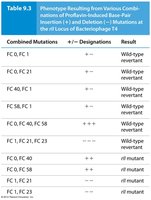
Genetic experiments (e.g., Crick and Brenner, 1961) demonstrated the triplet nature of the code using mutations in bacteriophage T4.
Deciphering the Genetic Code
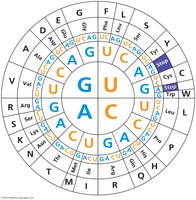
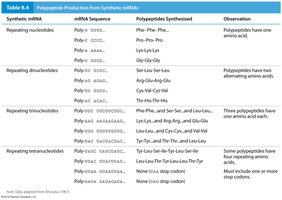
The correspondence between codons and amino acids was determined through biochemical experiments using synthetic mRNAs and cell-free translation systems (Nirenberg and Khorana, Nobel Prize 1968).
Poly-U mRNA codes for phenylalanine (UUU = Phe)
Poly-A mRNA codes for lysine (AAA = Lys)
Poly-C mRNA codes for proline (CCC = Pro)
Repeating dinucleotides and trinucleotides revealed codon assignments for other amino acids.
Properties of the Genetic Code
Triplet: Each codon consists of three nucleotides.
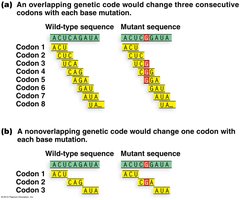
Non-overlapping: Codons are read one after another without overlap.
No punctuation: The code is read continuously from a fixed starting point.
Start and stop codons: AUG (Met) is the start codon; UAA, UAG, and UGA are stop codons.
Degenerate: Most amino acids are encoded by more than one codon.
Nearly universal: The code is conserved across almost all organisms.
Translation: Protein Synthesis
The Ribosome and Translation Machinery
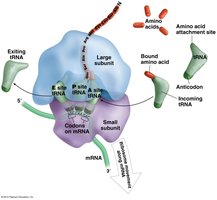
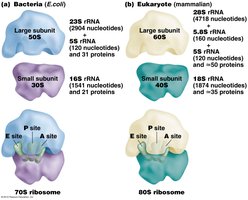
Translation is carried out by the ribosome, a complex molecular machine composed of proteins and ribosomal RNAs (rRNAs). The ribosome reads the mRNA and catalyzes peptide bond formation between amino acids.
Components required: Ribosome, mRNA, charged tRNAs, accessory proteins, and GTP (energy source)
tRNA: Adapter molecules that match codons in mRNA with the correct amino acid
tRNA Structure and Charging
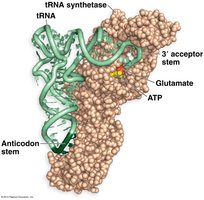
tRNAs are small RNAs (~75-90 nucleotides) with a cloverleaf structure. Each tRNA has an anticodon that base-pairs with a codon in mRNA and a 3' end where the corresponding amino acid is attached by an aminoacyl-tRNA synthetase.
Charging: The process of attaching an amino acid to its tRNA, catalyzed by a specific aminoacyl-tRNA synthetase for each amino acid.
Wobble position: The third base of the codon allows for flexible pairing, enabling one tRNA to recognize multiple codons.
Stages of Translation
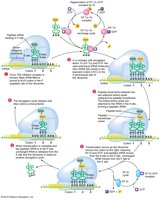
Translation occurs in three main stages: initiation, elongation, and termination.
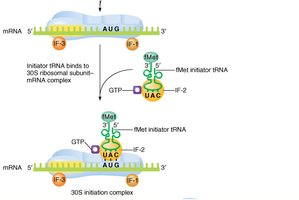
1. Initiation
Ribosome assembly at the start codon (AUG) on the mRNA.
In bacteria, the Shine-Dalgarno sequence helps position the ribosome; in eukaryotes, the ribosome binds the 5' cap and scans for the first AUG.
2. Elongation
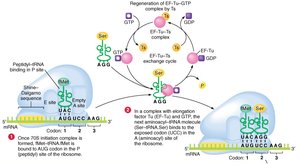
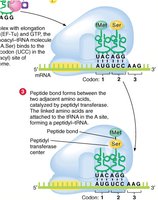
Charged tRNAs enter the A site of the ribosome, matching their anticodon to the mRNA codon.
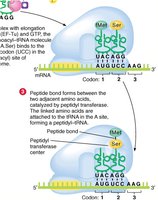
Peptide bonds are formed between amino acids, catalyzed by the ribosomal RNA (ribozyme activity).
The ribosome translocates along the mRNA, moving the growing peptide to the P site and freeing the A site for the next tRNA.
3. Termination
When a stop codon is encountered, release factors bind to the ribosome, triggering the release of the completed polypeptide and disassembly of the translation complex.
Summary Table: Key Properties of the Genetic Code
Property | Description |
|---|---|
Triplet | Each codon consists of three nucleotides |
Non-overlapping | Codons are read sequentially, one after another |
No punctuation | The code is read continuously from a fixed start point |
Start/Stop codons | AUG (start), UAA/UAG/UGA (stop) |
Degenerate | Most amino acids are encoded by more than one codon |
Nearly universal | Shared by almost all organisms |
Key Equations and Concepts
Number of possible codons:
Peptide bond formation:
Additional info: This guide covers the molecular biology of translation, the genetic code, and the experimental evidence supporting the triplet nature of codons, as well as the structure and function of tRNAs and ribosomes. It is suitable for exam preparation in a college-level genetics course.
