 Back
BackCh 13 Translation of mRNA and the Genetic Basis of Protein Synthesis
Study Guide - Smart Notes
 Tailored notes based on your materials, expanded with key definitions, examples, and context.
Translation of mRNA: The Genetic Basis of Protein Synthesis
Introduction to Translation
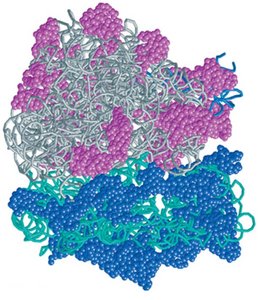
Translation is the process by which the genetic code carried by messenger RNA (mRNA) is decoded to produce a specific sequence of amino acids, resulting in the synthesis of proteins. The sequence of amino acids determines the three-dimensional structure and function of the resulting polypeptide. Multiple cellular components, including proteins, RNAs, and small molecules, are involved in this complex process.
The Genetic Basis for Protein Synthesis
Genes and Proteins
Proteins are essential for cell structure and function. Genes that encode polypeptides are called protein-encoding genes or structural genes. These genes are transcribed into mRNA, which is then translated into proteins. The main function of genetic material is to ensure the correct production of proteins in the right cell, at the right time, and in appropriate amounts.
Archibald Garrod and Inborn Errors of Metabolism
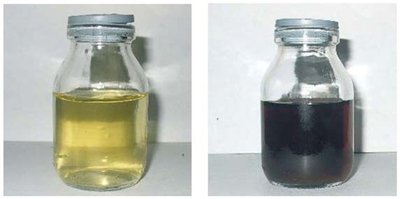
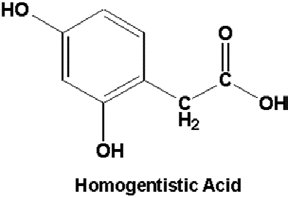
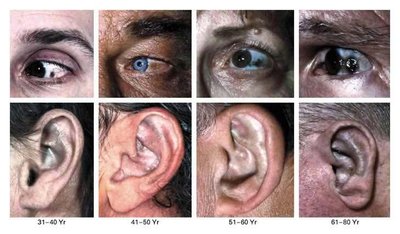
Archibald Garrod was the first to propose a relationship between genes and protein production. He studied patients with metabolic defects, particularly those with alkaptonuria, a disease characterized by the accumulation of homogentisic acid, leading to black urine and bluish-black discoloration of cartilage and skin.
Inborn error of metabolism: A genetic disorder resulting from a missing or defective enzyme in a metabolic pathway.
Garrod hypothesized that alkaptonuria was due to a missing enzyme, homogentisic acid oxidase, and that the disease followed a recessive inheritance pattern.
Beadle and Tatum: The One Gene–One Enzyme Hypothesis
Experimental Design and Findings
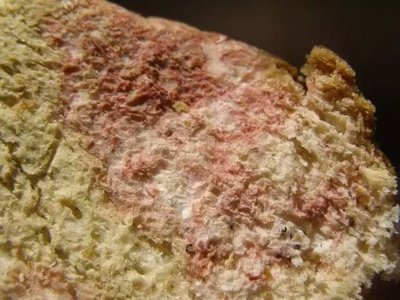
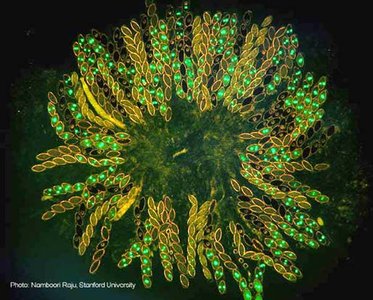
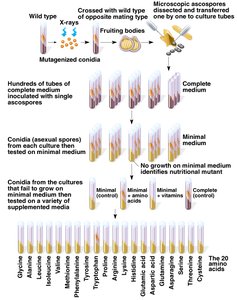
George Beadle and Edward Tatum used the fungus Neurospora crassa to investigate the relationship between genes and enzymes. They irradiated spores to induce mutations and isolated mutants (auxotrophs) that required specific nutritional supplements to grow, in contrast to wild-type (prototrophs) that could grow on minimal media.
Each auxotrophic mutant was defective in a single gene required for a specific step in a metabolic pathway.
They concluded that each gene controls the synthesis of a single enzyme, leading to the "one gene–one enzyme" hypothesis.

Mutant Strain | Nothing | O-Acetyl Homoserine | Cystathionine | Homocysteine | Methionine |
|---|---|---|---|---|---|
Wild type | + | + | + | + | + |
met-5 | - | + | + | + | + |
met-3 | - | - | + | + | + |
met-2 | - | - | - | + | + |
met-8 | - | - | - | - | + |
Modern Modifications to the Hypothesis
It is now understood that:
Some enzymes are composed of multiple polypeptides, each encoded by a different gene.
Not all proteins are enzymes; some have structural or regulatory roles.
One gene can encode multiple polypeptides through alternative splicing.

Protein Structure and Amino Acids
Amino Acids: Building Blocks of Proteins
Proteins are polymers of amino acids linked by peptide bonds. The sequence of amino acids determines the protein's structure and function. There are 20 standard amino acids, each with unique properties.
Nonpolar, aliphatic: Hydrophobic, often buried inside proteins.
Aromatic: Contain aromatic rings, can participate in stacking interactions.
Polar, uncharged: Hydrophilic, often found on protein surfaces.
Polar, acidic: Negatively charged at physiological pH.
Polar, basic: Positively charged at physiological pH.
Peptide Bond Formation and Protein Structure
A peptide bond forms between the carboxyl group of one amino acid and the amino group of another. Proteins have four levels of structure:
Primary: Sequence of amino acids
Secondary: Local folding (α-helices, β-sheets)
Tertiary: Overall 3D shape
Quaternary: Association of multiple polypeptides
The Genetic Code
Triplet Code and Codons
The genetic code is a triplet code, meaning each amino acid is specified by a sequence of three nucleotides (codon) in mRNA. The code is:
Continuous (comma-free)
Non-overlapping
Degenerate (multiple codons for most amino acids)
Nearly universal (with minor exceptions)
Has start (AUG) and stop (UAG, UAA, UGA) codons
Exceptions and Special Codons
Selenocysteine and pyrrolysine are rare amino acids encoded by stop codons (UGA and UAG) in specific contexts, requiring specialized tRNAs and mRNA sequences.
Transfer RNA (tRNA) and Translation
tRNA Structure and Function
tRNAs are adaptor molecules that recognize codons in mRNA and carry the corresponding amino acid. Each tRNA has an anticodon that base-pairs with the mRNA codon and a 3'-CCA sequence for amino acid attachment. The process of attaching an amino acid to tRNA is called charging, catalyzed by aminoacyl-tRNA synthetases (one for each amino acid).
Wobble Hypothesis
The third base of the codon (wobble position) allows for some flexibility in base pairing, enabling one tRNA to recognize multiple codons for the same amino acid.
Mechanism of Translation
Ribosome Structure and Function
Ribosomes are the molecular machines that synthesize proteins. They consist of a large and a small subunit, each composed of rRNA and proteins. Ribosomes have three functional sites:
A site (aminoacyl): Binds incoming charged tRNA
P site (peptidyl): Holds the tRNA with the growing polypeptide
E site (exit): Releases uncharged tRNA
Stages of Translation
Initiation: Assembly of ribosome, mRNA, and initiator tRNA at the start codon (AUG). In prokaryotes, the Shine-Dalgarno sequence helps position the ribosome. In eukaryotes, the ribosome scans from the 5' cap to the first AUG in a Kozak sequence.
Elongation: Sequential addition of amino acids as tRNAs bring them to the ribosome, peptide bonds form, and the ribosome translocates along the mRNA.
Termination: Occurs when a stop codon is reached; release factors promote the release of the polypeptide and disassembly of the translation complex.
Polysomes and Protein Sorting
Multiple ribosomes can translate a single mRNA simultaneously, forming a polysome. In eukaryotes, proteins are sorted to specific cellular compartments based on signal sequences.
Summary Table: Key Features of the Genetic Code
Feature | Description |
|---|---|
Triplet Code | Three nucleotides (codon) specify one amino acid |
Degeneracy | Multiple codons can code for the same amino acid |
Start Codon | AUG (methionine) |
Stop Codons | UAG, UAA, UGA |
Universality | Nearly universal across organisms |
Non-overlapping | Codons are read one after another, without overlap |
Conclusion
The translation of mRNA into protein is a central process in molecular genetics, linking the information in genes to the structure and function of proteins. Understanding the genetic code, the role of tRNA, and the mechanism of translation is fundamental to the study of genetics and molecular biology.
