 Back
BackTranslation: The Molecular Biology of Protein Synthesis
Study Guide - Smart Notes
 Tailored notes based on your materials, expanded with key definitions, examples, and context.
Translation: The Molecular Biology of Protein Synthesis
Introduction to Translation
Translation is the cellular process by which ribosomes synthesize polypeptides (proteins) using the sequence information encoded in messenger RNA (mRNA). This process is fundamental to gene expression and is highly conserved across all domains of life. Translation occurs in three main phases: initiation, elongation, and termination.
Polypeptides and Amino Acids
Importance of Polypeptides
Polypeptides are chains of amino acids that fold into functional proteins.
Proteins serve as enzymes, structural components, transporters, signaling molecules, and hormones.
Each cell expresses thousands of different polypeptides, all synthesized by translation.
Amino Acid Structure
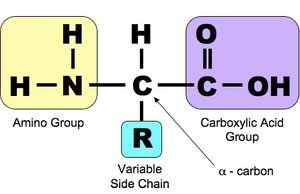
All amino acids share a common structure: a central (alpha) carbon atom bonded to an amino group, a carboxyl group, a hydrogen atom, and a variable side chain (R group). The R group determines the chemical properties and reactivity of each amino acid.
Peptide Bond Formation
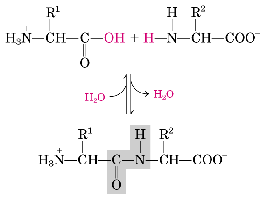
Amino acids are linked by peptide bonds, which form between the carboxyl group of one amino acid and the amino group of the next. This reaction is catalyzed by the ribosome and results in the release of water (a condensation reaction).

Polypeptide Structure
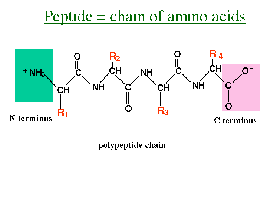
Polypeptides have directionality, with an amino (N) terminus and a carboxyl (C) terminus. The sequence of amino acids determines the protein's structure and function.
mRNA and the Genetic Code
mRNA Structure and Translation Boundaries
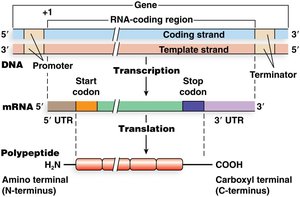
The mRNA sequence dictates the amino acid sequence of the resulting polypeptide.
Translation begins at a start codon (AUG) and ends at a stop codon (UAA, UAG, UGA).
mRNAs contain untranslated regions (5' UTR and 3' UTR) that regulate translation but are not themselves translated into protein.
The Genetic Code
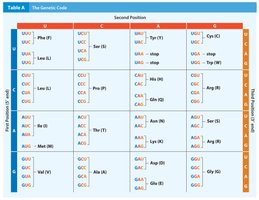
The genetic code is a set of rules by which the sequence of nucleotides in mRNA is translated into the sequence of amino acids in a protein.
It is a triplet code: each codon (three nucleotides) specifies one amino acid.
There are 64 possible codons but only 20 amino acids, resulting in redundancy (synonymous codons).
The code is nearly universal and unambiguous.
Ribosomes: Structure and Function
Ribosome Composition
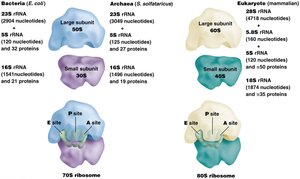
Ribosomes are ribonucleoprotein complexes composed of large and small subunits, each containing ribosomal RNA (rRNA) and proteins.
Bacterial ribosomes are 70S (30S small + 50S large), while eukaryotic ribosomes are 80S (40S small + 60S large).
Functional Sites of the Ribosome
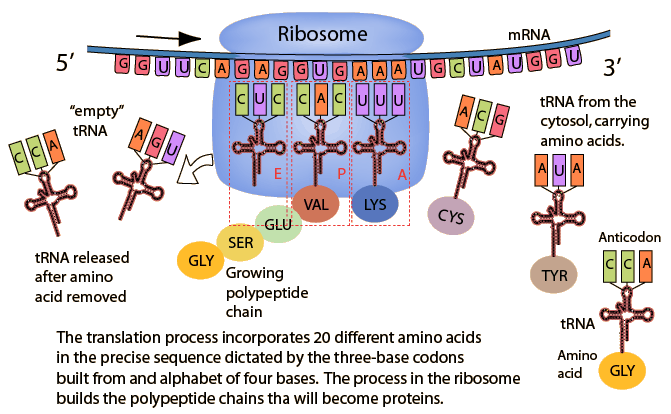
P site (Peptidyl site): Holds the tRNA with the growing polypeptide chain.
A site (Aminoacyl site): Binds incoming charged tRNA carrying the next amino acid.
E site (Exit site): Where uncharged tRNAs exit the ribosome after their amino acid is added.
Phases of Translation
Initiation
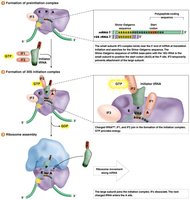
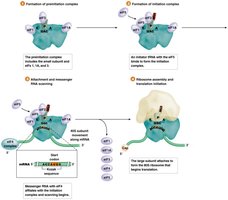
Initiation involves the assembly of the ribosome on the mRNA, recognition of the start codon, and recruitment of the initiator tRNA. This process differs between bacteria and eukaryotes, particularly in how the start codon is identified.
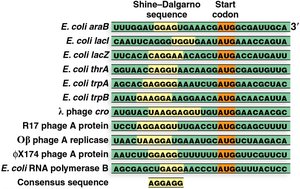
In bacteria, the Shine–Dalgarno sequence helps position the ribosome at the start codon.
In eukaryotes, the Kozak sequence surrounds the start codon and is recognized by the ribosome.
Elongation
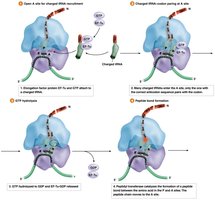
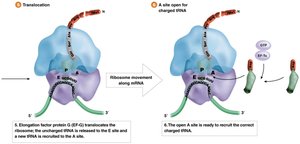
During elongation, amino acids are sequentially added to the growing polypeptide chain. Elongation factors (EFs) facilitate the entry of charged tRNAs, peptide bond formation, and translocation of the ribosome along the mRNA.
Peptidyl transferase activity (a ribozyme) catalyzes peptide bond formation.
GTP hydrolysis provides energy for tRNA selection and ribosome movement.
Termination
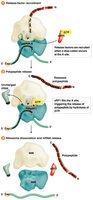
Termination occurs when a stop codon enters the A site. Release factors (RFs) recognize stop codons, prompting the release of the completed polypeptide and dissociation of the ribosomal subunits.
Special Features of Translation
Polyribosomes (Polysomes)
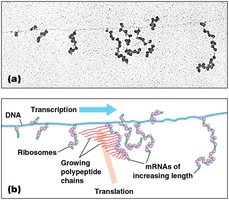
Multiple ribosomes can simultaneously translate a single mRNA molecule, forming a structure called a polyribosome or polysome. This increases the efficiency of protein synthesis.
Monocistronic vs. Polycistronic mRNA
Monocistronic mRNA (eukaryotes): Encodes a single polypeptide.
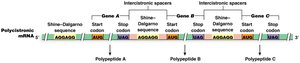
Polycistronic mRNA (bacteria): Encodes multiple polypeptides, each with its own translation initiation region.
tRNA and the Wobble Hypothesis
tRNA Structure and Function
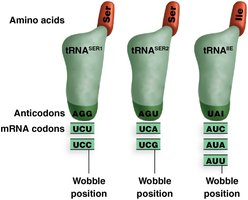
Transfer RNAs (tRNAs) are adaptor molecules that match amino acids to codons in the mRNA via their anticodon loop.
Each tRNA is charged with its specific amino acid by an enzyme called aminoacyl-tRNA synthetase.
Third-Base Wobble
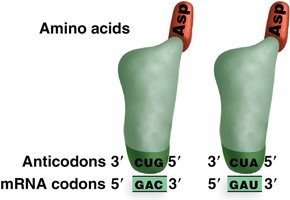
The third position of the codon (3' end) and the first position of the anticodon (5' end) can exhibit non-standard base pairing, allowing some tRNAs to recognize multiple codons. This flexibility is known as the wobble hypothesis and explains why cells have fewer tRNAs than codons.
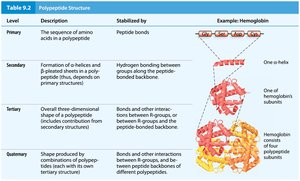
Summary Table: Levels of Polypeptide Structure
Level | Description | Stabilized By | Example |
|---|---|---|---|
Primary | Sequence of amino acids in a polypeptide | Peptide bonds | One α helix of hemoglobin |
Secondary | Formation of α-helices and β-sheets | Hydrogen bonding | One α helix of hemoglobin |
Tertiary | Three-dimensional shape of a polypeptide | Bonds and interactions between R groups | Hemoglobin subunit |
Quaternary | Shape produced by combinations of polypeptides | Bonds and interactions between different polypeptides | Hemoglobin complex |
Essential Ideas
Translation is the process by which ribosomes synthesize polypeptides using mRNA as a template.
Ribosomes assemble at the start codon and proceed codon by codon, adding amino acids via tRNAs.
The genetic code is nearly universal, redundant, and read in triplets.
Polypeptides undergo folding and processing after translation to become functional proteins.
