 Back
BackTransmission Genetics and Modifications to Mendelian Inheritance
Study Guide - Smart Notes
 Tailored notes based on your materials, expanded with key definitions, examples, and context.
Gregor Mendel and the Foundations of Genetics
Mendel’s Experiments and Laws
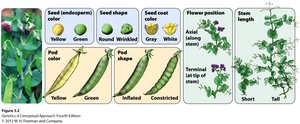
Gregor Mendel’s work with pea plants established the basic principles of heredity, now known as Mendelian genetics. He studied seven traits, each controlled by a single gene with two alleles, and observed predictable inheritance patterns.
Law of Segregation: Each individual has two factors (alleles) for each trait, which segregate during gamete formation so each gamete receives one allele.
Law of Independent Assortment: Alleles of different genes assort independently during gamete formation, leading to genetic variation.
Dominant and Recessive Traits: In F1 hybrids, one trait may mask the other (dominant vs. recessive). In the F2 generation, the recessive trait reappears in a 3:1 ratio of phenotypes.
Genotype and Phenotype Ratios: F2 generation shows a 1:2:1 genotype ratio (AA, Aa, aa) and a 3:1 phenotype ratio (dominant:recessive).
Dihybrid Crosses: Crossing parents differing in two traits yields a 9:3:3:1 phenotype ratio, supporting independent assortment.
Example: Mendel’s cross between yellow and green seed peas demonstrated dominant (yellow) and recessive (green) inheritance.
Chromosomes and the Chromosome Theory of Inheritance
From Mendel’s Factors to Genes on Chromosomes
After Mendel, scientists discovered that genes are located on chromosomes. The behavior of chromosomes during meiosis explained Mendel’s laws. The Boveri-Sutton chromosome theory proposed that genes reside on chromosomes, which segregate and assort independently during meiosis.
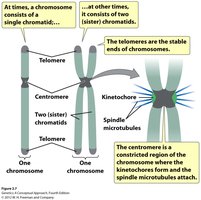
Chromosome Structure: Chromosomes consist of DNA and proteins, with regions called centromeres and telomeres.
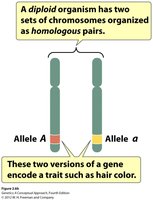
Homologous Chromosomes: Pairs of chromosomes (one maternal, one paternal) that carry the same genes but may have different alleles.
Sister Chromatids: Identical copies of a chromosome formed during DNA replication.
Cell Division: Mitosis and Meiosis
The Cell Cycle
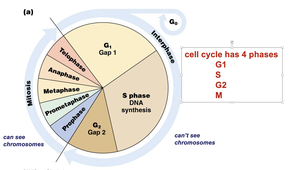
The cell cycle consists of interphase (G1, S, G2) and M phase (mitosis or meiosis). DNA replication occurs in S phase, while cell division occurs in M phase.
Mitosis
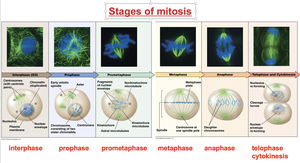
Mitosis produces two genetically identical diploid daughter cells, maintaining chromosome number. It is essential for growth and repair in multicellular organisms.
Stages: Prophase, metaphase, anaphase, telophase, and cytokinesis.
Outcome: Each daughter cell receives a complete set of chromosomes.
Meiosis
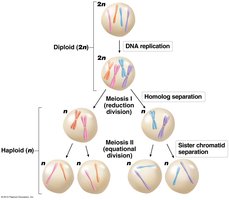
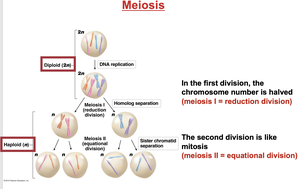
Meiosis produces four genetically distinct haploid gametes through two successive divisions (meiosis I and II) after one round of DNA replication. This process explains Mendel’s laws at the chromosomal level.
Meiosis I: Homologous chromosomes separate, reducing chromosome number by half (reduction division).
Meiosis II: Sister chromatids separate, similar to mitosis (equational division).
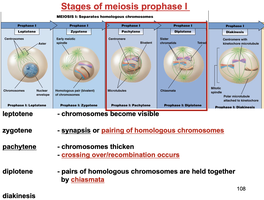
Genetic Variation: Crossing over during prophase I and independent assortment during metaphase I increase genetic diversity.
Modifications to Mendelian Genetics
Overview
Most traits do not follow simple Mendelian inheritance. Modifications include sex linkage, incomplete dominance, codominance, multiple alleles, lethal alleles, conditional alleles, sex modification, penetrance, expressivity, gene interaction, and genetic linkage.
Sex Linkage
Sex-linked traits are associated with genes located on sex chromosomes (e.g., X-linked traits). Thomas Hunt Morgan’s work with Drosophila melanogaster demonstrated X-linked inheritance of the white-eye mutation, providing evidence for the chromosome theory of inheritance.
X-linked Traits: Males (XY) express X-linked recessive traits if they inherit the mutant allele, while females (XX) require two copies.
Reciprocal Crosses: Crossing mutant males with wild-type females and vice versa yields different results, revealing sex linkage.
Incomplete Dominance
In incomplete dominance, the heterozygote phenotype is intermediate between the two homozygotes. The classic example is flower color in snapdragons or fruit color in eggplant, where crossing two true-breeding parents yields an intermediate F1 phenotype and a 1:2:1 ratio in the F2 generation.
Molecular Basis: One functional allele does not produce enough protein for the full phenotype.
Multiple Alleles
Many genes have more than two alleles in the population. Rabbit coat color and human blood type are classic examples.
Rabbit Coat Color: Four alleles (C, cch, ch, c) with a dominance hierarchy.
Human Blood Type: Three alleles (IA, IB, i) produce four phenotypes (A, B, AB, O).
Codominance
In codominance, both alleles in a heterozygote are fully expressed. The human ABO blood group system is a classic example, where IA and IB are codominant, and i is recessive.
Molecular Basis: Different alleles encode enzymes that add different sugars to red blood cell surfaces.
Lethal Alleles
Lethal alleles cause death when present in certain genotypes, altering expected Mendelian ratios. For example, the yellow coat color mutation in mice is dominant for color but recessive lethal (homozygotes die).
Pleiotropy
Pleiotropy occurs when one gene influences multiple phenotypic traits. For example, the agouti gene in mice affects both coat color and viability.
Conditional Alleles
Conditional alleles express mutant phenotypes only under specific environmental conditions, such as temperature-sensitive mutations in Siamese cats and Himalayan rabbits.
Sex-Influenced and Sex-Limited Traits
Sex-Limited Traits: Phenotype is expressed in only one sex (e.g., feathering in chickens).
Sex-Influenced Traits: Allele expression differs between sexes (e.g., bearded phenotype in goats).
Penetrance and Expressivity
Penetrance: The proportion of individuals with a genotype who display the expected phenotype. Complete penetrance means all individuals show the phenotype; incomplete penetrance means some do not.
Expressivity: The degree to which a phenotype is expressed among individuals with the same genotype. Variable expressivity means the phenotype varies in severity.
Example: Polydactyly in humans shows incomplete penetrance and variable expressivity.
Summary Table: Modifications to Mendelian Inheritance
Modification | Definition | Example |
|---|---|---|
Sex linkage | Gene located on a sex chromosome | White eyes in Drosophila |
Incomplete dominance | Heterozygote phenotype intermediate | Snapdragon flower color |
Codominance | Both alleles fully expressed | ABO blood group |
Multiple alleles | More than two alleles in population | Rabbit coat color, blood type |
Lethal alleles | Allele causes death in certain genotypes | Yellow coat in mice |
Pleiotropy | One gene affects multiple traits | Agouti gene in mice |
Conditional alleles | Phenotype depends on environment | Siamese cat coloration |
Sex-limited/influenced | Trait expression depends on sex | Feathering in chickens |
Penetrance/Expressivity | Variation in phenotype among same genotype | Polydactyly in humans |
