 Back
BackTransmission Genetics: Mendelian Inheritance, Probability, and Pedigree Analysis CH 2 NEW SEM
Study Guide - Smart Notes
 Tailored notes based on your materials, expanded with key definitions, examples, and context.
Transmission Genetics: Mendelian Inheritance
Monohybrid and Dihybrid Crosses
Mendelian genetics explores how traits are inherited from one generation to the next. The monohybrid cross involves a single gene, while the dihybrid cross examines two genes simultaneously, revealing the principle of independent assortment.
Monohybrid Cross: Involves one gene with two alleles (e.g., Yy x yy).
Dihybrid Cross: Involves two genes, each with two alleles (e.g., RrGg x RrGg).
Test Cross: Used to determine the genotype of an individual by crossing it with a homozygous recessive.
Gene vs. Allele: A gene is a DNA region coding for a product; an allele is a variant of that gene.
Genotype Example: A dihybrid that is yellow and round: Yy; Rr.
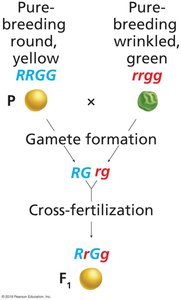
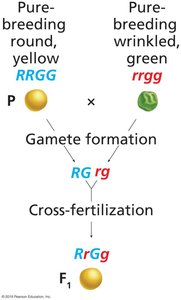
Dihybrid Cross: Gamete Formation and Probability
In a dihybrid cross, gametes are formed by the independent segregation of alleles. The probability of each gamete type is calculated by multiplying the probabilities for each gene.
Gamete Types: For RrGg, possible gametes are RG, Rg, rG, rg.
Probability Calculation: Each gamete has a probability of 1/4.
Forked-Line Method: Used to determine gamete genotype frequency by multiplying probabilities.
Punnett Square Analysis
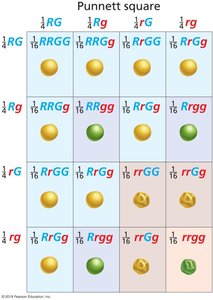
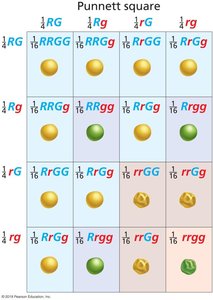
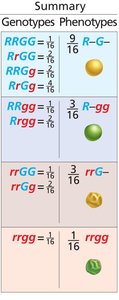
Punnett squares are used to visualize the outcome of genetic crosses. For a dihybrid cross, a 4x4 Punnett square shows all possible combinations of alleles.
F2 Generation: Results from self-crossing F1 heterozygotes (RrGg x RrGg).
Phenotypic Ratios: Classic dihybrid ratio is 9:3:3:1.
Genotypic and Phenotypic Frequencies: Calculated using product and sum rules.
Mendel's Law of Independent Assortment
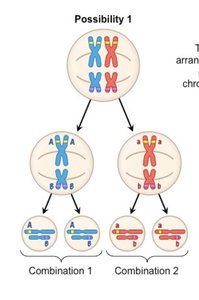
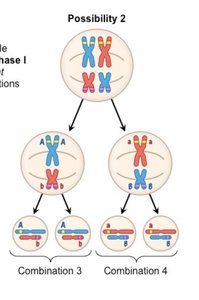
Mendel's second law states that alleles of different genes assort independently during gamete formation. This is illustrated by the 9:3:3:1 ratio in dihybrid crosses and is related to the random assortment of chromosomes during metaphase I of meiosis.
Product Rule: Probability of independent events occurring together is the product of their individual probabilities.
Sum Rule: Probability of mutually exclusive events is the sum of their individual probabilities.
Example: Probability of being yellow and round =
Trihybrid Crosses and Branch Diagrams
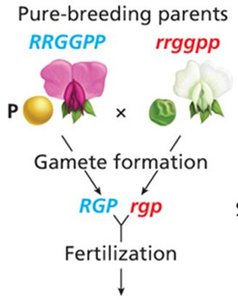
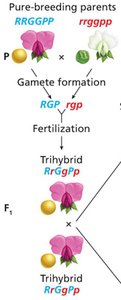
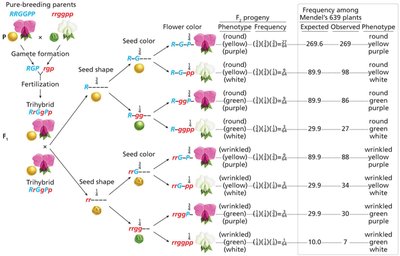
Trihybrid crosses involve three genes, each with two alleles. The branch diagram method is used to predict phenotypic frequencies by multiplying probabilities for each trait.
Number of Phenotypes: For n gene pairs, number of phenotypes = .
Number of Genotypes: For n gene pairs, number of genotypes = (number of genotypes per gene pair).
Example: RrGgWw x RrGgWw yields 8 phenotypes and 27 genotypes.
Probability Theory in Genetics
Rules of Probability
Probability theory is essential for predicting genetic outcomes. Four main rules are used:
Product Rule: Probability of independent events occurring together.
Sum Rule: Probability of mutually exclusive events.
Conditional Probability: Probability modified by additional information.
Binomial Probability: Used for events with two possible outcomes.
Example: For a cross Gg x Gg, the probability that a yellow-seeded progeny is heterozygous is .
Human Genetics and Pedigree Analysis
Pedigrees: Symbols and Interpretation
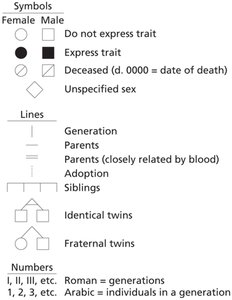
Pedigrees are diagrams used to trace the inheritance of traits in families. Standard symbols represent individuals, relationships, and trait expression.
Male: Square
Female: Circle
Expresses trait: Filled symbol
Does not express trait: Unfilled symbol
Generations: Roman numerals
Autosomal Dominant and Recessive Inheritance
Autosomal inheritance patterns parallel Mendel's principles. Dominant and recessive traits have distinct pedigree patterns.
Autosomal Dominant: Trait appears in every generation; affected individuals have at least one affected parent.
Autosomal Recessive: Trait often skips generations; affected individuals may have unaffected parents.
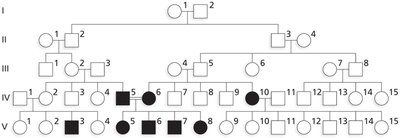
Pedigree Problem: Calculating Carrier Probability
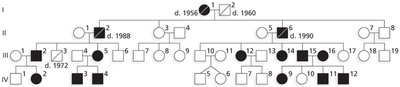
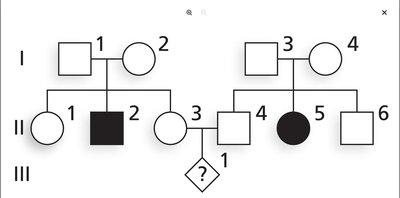
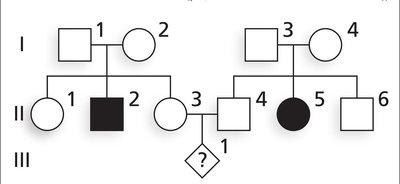
Pedigree analysis can be used to calculate the probability that a child will inherit a recessive condition, based on the genotypes of the parents and their family history.
Assign Genotypes: Use D for dominant and d for recessive alleles.
Carrier Probability: Calculate the chance that both parents are carriers and both pass the recessive allele to their child.
Example: If both parents are carriers, the probability their child will have the condition is .
Summary Table: Dihybrid Cross Genotypes and Phenotypes
Genotype | Phenotype | Frequency |
|---|---|---|
RRGG, RRGg, RrGG, RrGg | Round, Yellow (R-G-) | 9/16 |
RRgg, Rrgg | Round, Green (R-gg) | 3/16 |
rrGG, rrGg | Wrinkled, Yellow (rrG-) | 3/16 |
rrgg | Wrinkled, Green (rrgg) | 1/16 |
Key Equations
Product Rule:
Sum Rule:
Number of Phenotypes: (where n = number of gene pairs)
Number of Genotypes: (genotypes per gene pair)
Additional info: Probability theory and pedigree analysis are foundational for understanding inheritance patterns and predicting genetic outcomes in both plants and humans.
