 Back
BackTransmission Genetics: Mendelian Principles and Monohybrid Crosses
Study Guide - Smart Notes
 Tailored notes based on your materials, expanded with key definitions, examples, and context.
Transmission Genetics: Mendelian Genetics
Introduction to Transmission Genetics
Transmission genetics, also known as classical genetics, focuses on how genetic traits are passed from parents to offspring. The field was founded by Gregor Mendel, whose experiments with pea plants established the basic principles of heredity. Understanding these principles is essential for analyzing genetic variation and predicting inheritance patterns.
Genetics is the study of heredity and variation in organisms.
Applications include animal breeding, crop improvement, and understanding human genetic diseases.
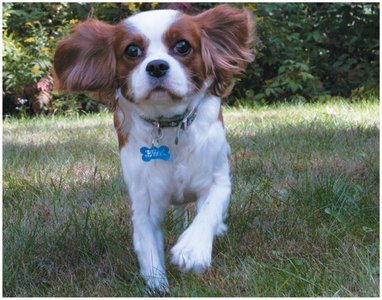
Dog breeding is a practical example of applying genetic principles to select for desired traits.
Gregor Mendel’s Experimental Approach
Gregor Mendel (1822–1884) used pea plants (Pisum sativum) to investigate how traits are inherited. His systematic experiments led to the formulation of the laws of inheritance.
Controlled crosses: Mendel controlled which plants mated, preventing random fertilization.
Pure-breeding strains: He started with plants that consistently produced the same trait, ensuring genetic homogeneity.
Dichotomous traits: Traits with only two possible forms (e.g., purple vs. white flowers) simplified analysis.
Quantification of results: Mendel counted offspring and analyzed ratios mathematically.
Replicate, reciprocal, and test crosses: Multiple types of crosses ensured robust conclusions.
The Seven Dichotomous Traits Studied by Mendel
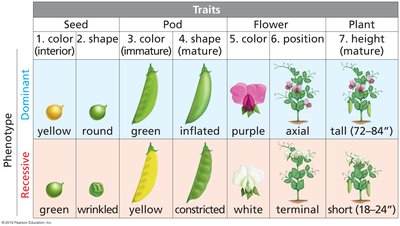
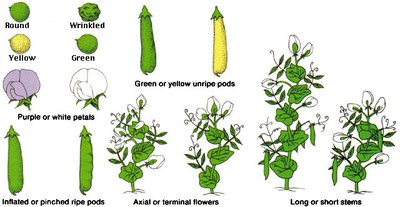
Mendel selected seven traits in pea plants, each with two distinct forms. These traits allowed him to observe clear inheritance patterns.
Seed color: Yellow (dominant) vs. green (recessive)
Seed shape: Round (dominant) vs. wrinkled (recessive)
Pod color: Green (dominant) vs. yellow (recessive)
Pod shape: Inflated (dominant) vs. constricted (recessive)
Flower color: Purple (dominant) vs. white (recessive)
Flower position: Axial (dominant) vs. terminal (recessive)
Plant height: Tall (dominant) vs. short (recessive)
Mendelian Inheritance: Monohybrid Crosses
Monohybrid Cross: Experimental Design
A monohybrid cross involves parents that differ in a single trait. Mendel’s classic experiments tracked flower color, stem length, and other traits to reveal inheritance patterns.
P Generation: Pure-breeding parents (e.g., purple × white flowers)
F1 Generation: All offspring display the dominant trait (e.g., all purple flowers)
F2 Generation: Offspring from F1 self-fertilization show a 3:1 ratio of dominant to recessive phenotype

Disproving Blended Inheritance
Mendel’s results contradicted the theory of blended inheritance, which predicted intermediate traits. Instead, traits were inherited as discrete units.
Dominant and recessive alleles determine trait expression.
Mathematical ratios (3:1 in F2) indicate discrete inheritance.
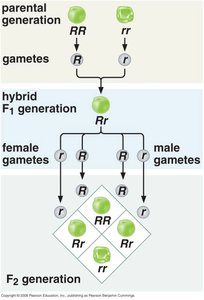
Punnett Square Analysis
Punnett squares are used to predict the genotypes and phenotypes of offspring from genetic crosses. For a monohybrid cross:
Parent genotypes: TT (tall) × tt (dwarf)
F1 genotype: All Tt (heterozygous, tall)
F2 genotypes: 1 TT : 2 Tt : 1 tt
F2 phenotypes: 3 tall : 1 dwarf
Genotypic ratio: 1:2:1 Phenotypic ratio: 3:1
Punnett Square Example:
Key Terms in Mendelian Genetics
Gene: A unit of heredity; segment of DNA encoding a trait.
Allele: Alternative forms of a gene (e.g., T and t).
Homozygous: Two identical alleles (TT or tt).
Heterozygous: Two different alleles (Tt).
Phenotype: Observable trait (e.g., tall or dwarf).
Genotype: Genetic makeup (e.g., TT, Tt, or tt).
Mendel’s Principles
Mendel’s experiments led to two fundamental principles:
Principle of Segregation: Each organism carries two alleles for each trait, which segregate during gamete formation so each gamete receives one allele.
Principle of Independent Assortment: Alleles for different traits segregate independently during gamete formation.
Example: In pea plants, the allele for tall stems (T) is dominant over dwarf (t). When crossing TT × tt, all F1 are Tt (tall). Self-fertilizing F1 (Tt × Tt) produces F2 with a 3:1 ratio of tall to dwarf.
Summary Table: Mendelian Ratios in Monohybrid Crosses
Generation | Genotype | Phenotype | Ratio |
|---|---|---|---|
P (parental) | TT × tt | Tall × dwarf | -- |
F1 | Tt | All tall | 100% tall |
F2 | TT, Tt, tt | 3 tall : 1 dwarf | Genotype 1:2:1 Phenotype 3:1 |
Visual Summary of Mendel's Traits
Conclusion
Mendel’s work established the foundation for modern genetics. His principles explain how traits are inherited and provide the basis for predicting genetic outcomes in breeding and research.
Additional info: Mendel’s principles are universally applicable to sexually reproducing organisms and form the basis for more complex genetic analyses, including dihybrid crosses and linkage studies.
