 Back
BackTransmission Genetics: Mendelian Principles, Probability, and Autosomal Inheritance
Study Guide - Smart Notes
 Tailored notes based on your materials, expanded with key definitions, examples, and context.
Transmission Genetics
Introduction to Transmission Genetics
Transmission genetics is the study of how genetic traits are passed from parents to offspring. This field was pioneered by Gregor Mendel, whose experiments with pea plants established foundational principles for inheritance. Mendel's work disproved the blending theory and introduced the concept of discrete hereditary units known as genes.
Transmission genetics focuses on the inheritance patterns of traits.
Mendelian principles form the basis for understanding genetic inheritance.
Genes are the units of heredity, and alleles are their different forms.
The Blending Theory of Inheritance
The blending theory proposed that offspring traits are a mixture of parental traits, and intermediate forms would persist. Mendel's experiments showed that traits are inherited as discrete units, not blended.
Blending theory: Offspring are intermediate between parents; traits do not reappear once blended.
Mendel's experiments: Demonstrated that traits can reappear in later generations, disproving blending.
Example: Crossing black and white cats would produce gray kittens, but Mendel showed parental traits could reappear.
Experimental Crosses and Generations
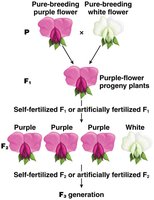
Mendel used pure-breeding strains to study inheritance. He defined generations as follows:
P generation: Parental generation, pure-breeding for a trait.
F1 generation: First filial generation, offspring of P cross, all have the same genotype and phenotype.
F2 generation: Second filial generation, produced by crossing F1 individuals.
F3 generation: Produced by crossing F2 individuals.
Types of Crosses: Replicate, Reciprocal, and Test Crosses
Different types of crosses are used to analyze inheritance patterns:
Replicate crosses: Repeating each cross several times to ensure reliability.
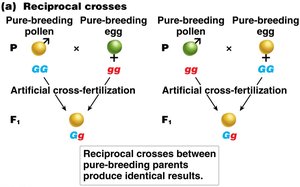
Reciprocal crosses: Crossing the same genotypes but reversing the sexes of the parents.
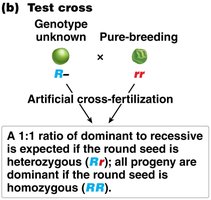
Test crosses: Crossing an organism with a dominant phenotype (unknown genotype) with a homozygous recessive organism to determine genotype.
Dominant and Recessive Traits
Mendel identified dominant and recessive traits based on their appearance in the F1 and F2 generations.
Dominant phenotype: Trait shown by F1 offspring.
Recessive phenotype: Trait not apparent in F1 but reappears in F2.
F2 ratio: 3:1 phenotypic ratio (dominant:recessive).
Alleles and Genotypes
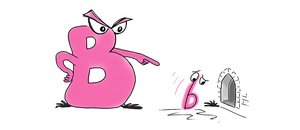
Alleles are different forms of a gene. The combination of alleles determines the genotype and phenotype.
Alleles: Variations of a gene (e.g., A for tall, a for short).
Genotype: The genetic makeup (e.g., AA, Aa, aa).
Phenotype: The observable trait.

Mendel’s Laws
Mendel established two fundamental laws:
Law of Segregation: Each individual has two alleles for each gene, which segregate during gamete formation.
Law of Independent Assortment: The segregation of alleles for one gene is independent of the segregation of alleles for another gene.
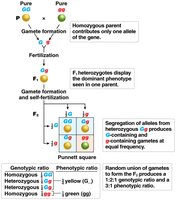
Monohybrid and Dihybrid Crosses
Monohybrid crosses involve one gene; dihybrid crosses involve two genes. Mendel predicted specific ratios for F2 generations.
Monohybrid cross: F2 phenotypic ratio is 3:1; genotypic ratio is 1:2:1.
Dihybrid cross: F2 phenotypic ratio is 9:3:3:1.
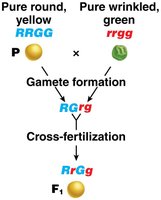
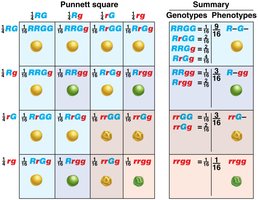
Trihybrid Crosses and Gamete Formation
Trihybrid crosses involve three genes. The number of possible gamete genotypes is , where n is the number of genes.
Trihybrid cross: 8 different gametes possible.
Phenotypic ratios: Calculated using expected frequencies for each trait.
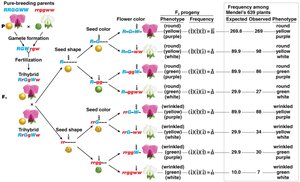
Probability Theory in Genetics
Probability theory is used to predict Mendelian ratios. Four rules are commonly applied:
Product rule: Probability of independent events occurring together is the product of their probabilities.
Sum rule: Probability of mutually exclusive events is the sum of their probabilities.
Conditional probability: Probability modified by additional information after a cross.
Binomial probability: Used for predicting the likelihood of a series of events.

Binomial Expansion and Pascal’s Triangle
The binomial expansion formula is used to calculate probabilities for multiple events. Pascal’s Triangle provides coefficients for binomial expansion.
Binomial expansion:
Pascal’s Triangle: Shortcut for binomial coefficients.
Chi-Square Analysis
Chi-square () analysis tests the fit between observed and expected outcomes. It is used to determine if deviations are due to chance.
Formula:
Degrees of freedom (df):
P value: Probability that observed deviations are due to chance; P > 0.05 means hypothesis is accepted.
Autosomal Inheritance
Autosomal inheritance refers to the transmission of genes located on autosomes (non-sex chromosomes). Both males and females are equally affected.
Autosomal dominant inheritance: Each affected individual has at least one affected parent; males and females are equally affected.
Autosomal recessive inheritance: Individuals with the disease are often born to unaffected parents; males and females are equally affected.
Pedigree Analysis
Pedigrees are diagrams that trace the inheritance of traits in families. They are used to determine the mode of inheritance (dominant, recessive, autosomal, or sex-linked).
Pedigree symbols: Standardized symbols represent individuals and relationships.
Pedigree analysis: Helps identify carriers and predict risk for offspring.
Summary Table: Autosomal Inheritance Patterns
Inheritance Type | Key Features |
|---|---|
Autosomal Dominant | At least one affected parent; equal sex ratio; can skip generations if heterozygous parents produce unaffected offspring |
Autosomal Recessive | Often born to unaffected parents; equal sex ratio; can skip generations; increased risk if parents are related |
Central Conclusions from Molecular Studies
Molecular studies confirm that inheritance of alleles parallels the transmission of morphological traits. DNA sequence differences between alleles lead to variation in protein products, which in turn produce phenotypic differences.
Molecular analysis: Identifies DNA sequence differences and their consequences.
Functional analysis: Explains the role of protein products in producing phenotypes.
