 Back
BackCH 2 transmission genetics & medel NEW SEM
Study Guide - Smart Notes
 Tailored notes based on your materials, expanded with key definitions, examples, and context.
Transmission Genetics: Mendel’s Principles and Experimental Foundations
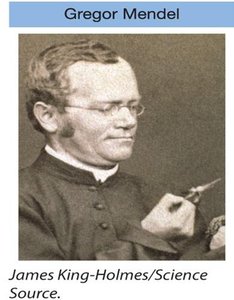
Introduction to Mendelian Genetics
Transmission genetics explores how traits are inherited from one generation to the next. Gregor Mendel’s experiments with pea plants established the foundational principles of heredity, including the concepts of dominant and recessive alleles, genotype and phenotype, and the laws of segregation and independent assortment.
Critical Features of Mendel’s Experiments
Selection of Model Organism: Mendel used garden peas (Pisum sativum) due to their distinct traits and ease of controlled breeding.
Pure-Breeding Lines: He established lines that consistently produced the same trait across generations.
Single Trait Analysis: Each experiment focused on traits with two easily distinguishable phenotypes.
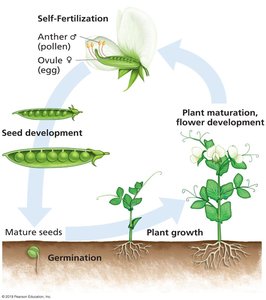
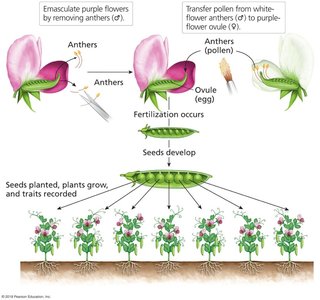
Controlled Crosses: Mendel performed both self-fertilization and cross-fertilization to track inheritance.
Quantitative Data Collection: He counted and analyzed large numbers of offspring to identify patterns.
Key Terminology in Mendelian Genetics
Parental Cross: Mating between two pure-breeding individuals.
Pure Breeding Line: Individuals that consistently produce offspring with the same phenotype.
F1 Generation: First filial generation, offspring of the parental cross.
F2 Generation: Second filial generation, offspring of F1 self-cross.
Test Cross: Crossing an individual with a homozygous recessive to determine genotype.
Monohybrid Cross: Cross involving one gene with two alleles.
Dihybrid Cross: Cross involving two genes, each with two alleles.
Dominant/Recessive Phenotype: Dominant allele masks the effect of the recessive allele in heterozygotes.
Mendel’s Experimental Approach
Mendel applied the scientific method: observation, hypothesis, controlled experiment, data collection, interpretation, and conclusion. He tested the blending theory of heredity and rejected it in favor of particulate inheritance.
Monohybrid Crosses and the Law of Segregation
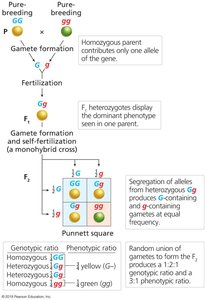
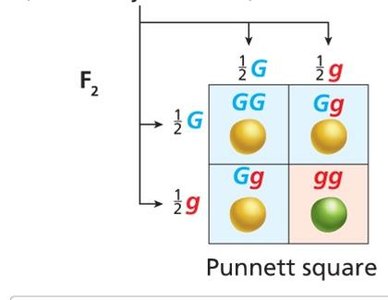
Monohybrid crosses reveal how alleles segregate during gamete formation. Mendel’s first law, the Law of Segregation, states that each individual has two alleles for each gene, which segregate during meiosis so that each gamete receives one allele.
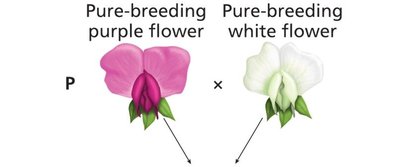
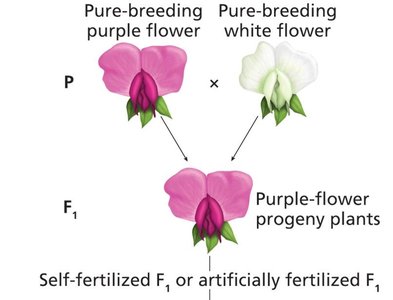
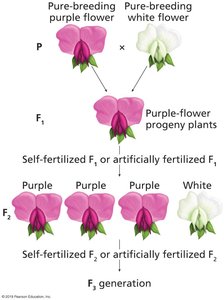
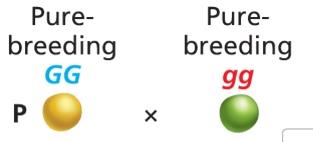
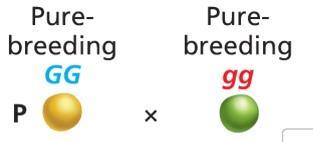
Example: Crossing pure-breeding purple and white flowers yields all purple F1 offspring. Self-crossing F1 produces a 3:1 ratio of purple to white in F2.
Punnett Square: Visual tool to predict genotypic and phenotypic ratios.

Summary of Mendel’s Seven Monohybrid Crosses
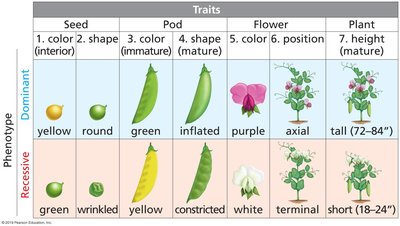
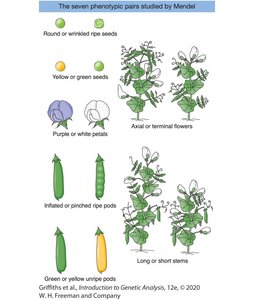
Mendel studied seven traits, each with two phenotypes. His results consistently showed a 3:1 phenotypic ratio in the F2 generation, supporting the law of segregation.
Trait | F1 Phenotype | F2 Phenotype Ratio |
|---|---|---|
Round x wrinkled seeds | All round | 2.96:1 |
Yellow x green seeds | All yellow | 3.01:1 |
Purple x white flowers | All purple | 3.15:1 |
Axial x terminal flowers | All axial | 3.14:1 |
Green x yellow pods | All green | 2.84:1 |
Inflated x constricted pods | All inflated | 2.96:1 |
Tall x short plants | All tall | 2.84:1 |
Particulate Inheritance and Alleles
Mendel proposed that traits are determined by discrete units called genes, which exist in different forms known as alleles. Each individual inherits one allele from each parent.
Dominant Allele: Expressed in heterozygotes.
Recessive Allele: Expressed only in homozygotes.
Law of Segregation and Meiosis
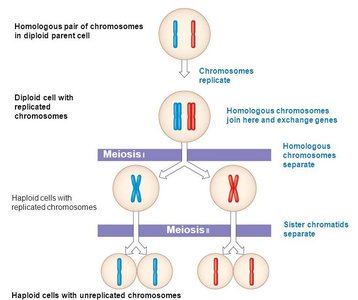
The law of equal segregation is explained by the behavior of chromosomes during meiosis. Each gamete receives one allele from each gene pair, and fertilization restores the diploid state.
Self-Cross vs Test-Cross
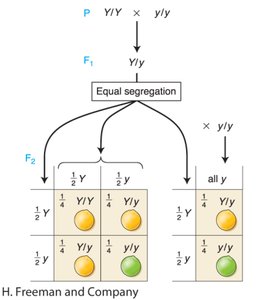
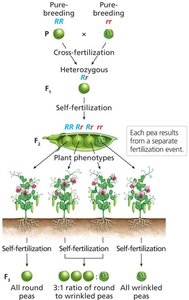
Self-Cross: Crossing F1 heterozygotes produces a 3:1 phenotypic ratio.
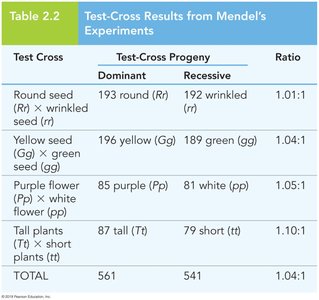
Test-Cross: Crossing F1 with homozygous recessive produces a 1:1 ratio, revealing the genotype of the F1.
Monohybrid Crosses in Other Organisms
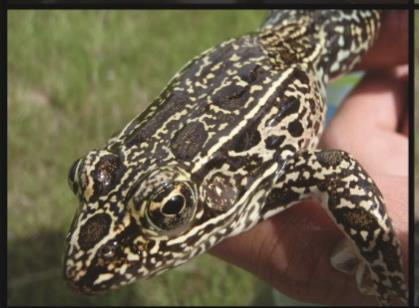
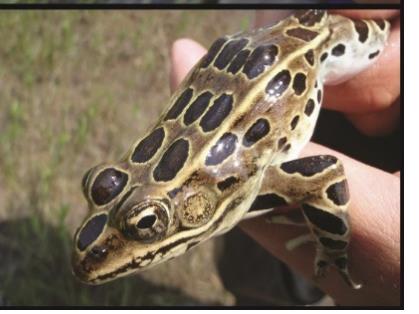
Similar principles apply to traits in other organisms, such as pigment patterns in frogs. Reciprocal crosses and analysis of F1 and F2 generations help determine dominance and genotype.
Genotype Verification in F2 Generation
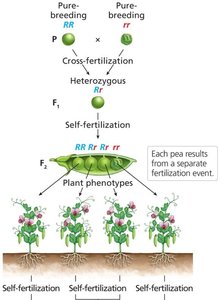
To distinguish between homozygous and heterozygous dominant F2 individuals, self-crosses are performed. Homozygous produce only dominant phenotype, while heterozygous produce both dominant and recessive phenotypes in a 3:1 ratio.
Dihybrid and Trihybrid Crosses: Law of Independent Assortment
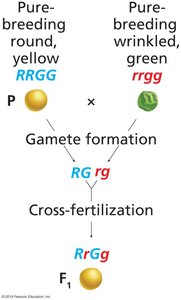
Dihybrid crosses involve two genes and reveal the law of independent assortment: alleles of different genes segregate independently during gamete formation. This produces a 9:3:3:1 phenotypic ratio in the F2 generation.
Product Rule: Probability of independent events occurring together is the product of their individual probabilities.
Sum Rule: Probability of mutually exclusive events is the sum of their individual probabilities.
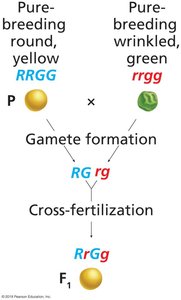
Trihybrid Crosses
Trihybrid crosses extend the principle of independent assortment to three genes, confirming that each gene pair segregates independently.
Summary Table: Mendel’s Laws and Experimental Results
Law | Description | Experimental Evidence |
|---|---|---|
Law of Segregation | Each individual has two alleles for each gene, which segregate during gamete formation. | 3:1 ratio in F2 generation of monohybrid crosses |
Law of Independent Assortment | Alleles of different genes segregate independently during gamete formation. | 9:3:3:1 ratio in F2 generation of dihybrid crosses |
Key Equations
Genotypic Ratio (Monohybrid F2):
Phenotypic Ratio (Monohybrid F2):
Phenotypic Ratio (Dihybrid F2):
Product Rule:
Sum Rule:
Conclusion
Mendel’s principles of segregation and independent assortment form the basis of classical genetics. His experimental approach and quantitative analysis established the framework for understanding inheritance patterns, which are fundamental to modern genetics.
