 Back
BackTransposable Elements and Chromosomal Abnormalities: Genetics Study Notes
Study Guide - Smart Notes
 Tailored notes based on your materials, expanded with key definitions, examples, and context.
Transposable Elements and Chromosomal Abnormalities
Introduction
This study guide covers the molecular mechanisms and consequences of transposable elements ("jumping genes") and chromosomal abnormalities, including their roles in mutation, gene regulation, and human disease. These topics are central to understanding genetic variation, genome evolution, and the molecular basis of hereditary disorders.
Mutations: Types and Mechanisms
Classification of Mutations
Base Substitution (Point Mutation): A single nucleotide is replaced by another.
Deletion: One or more bases are removed from the DNA sequence.
Insertion: Addition of one or more bases. Includes simple insertions, triplet expansions, and insertions of transposable elements.
Chromosomal Changes: Large-scale alterations such as deletions, duplications, inversions, and translocations.
Transposable Elements
Definition and General Properties
Transposable elements (TEs), also known as transposons or "jumping genes," are DNA sequences capable of moving from one location to another within the genome. They are found in prokaryotes, archaea, and eukaryotes, and are sometimes referred to as 'selfish' genetic elements due to their ability to propagate themselves.
Transposition can disrupt gene function if insertion occurs within or near a gene.
TEs can cause mutant phenotypes and contribute to genetic diversity.
Historical Perspective: Barbara McClintock's Discovery
Barbara McClintock first described transposable elements in the 1930s and 1940s while studying kernel color in corn (Zea mays). She observed unstable mutations in the Colorless gene (C) that could revert to wild-type, resulting in spotted kernels. This led to the concept of 'jumping genes.'
Wild-type C+: Purple kernels
Mutant c: Yellow (colorless) kernels
Spotted kernels: Result from excision of a transposable element (Ds) from the C gene in some cells, restoring function.
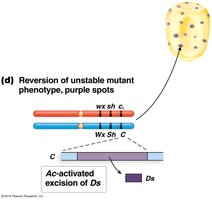
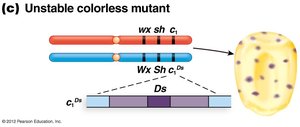
McClintock's work was initially met with skepticism but was later recognized with a Nobel Prize in 1983 for the discovery of mobile genetic elements.

Types of Transposable Elements
DNA Transposable Elements: Move directly as DNA, encode a transposase enzyme.
Retrotransposons: Move via an RNA intermediate, common in eukaryotes, similar to retroviruses.
Structure and Function in Bacteria
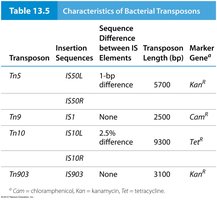
The simplest transposable elements are insertion sequences (IS), which contain only the gene for transposase and terminal inverted repeats (IRs). More complex elements, transposons (Tn), may carry additional genes, such as those conferring antibiotic resistance.
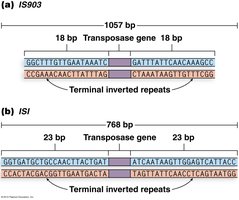
Transposon | Insertion Sequences | Sequence Difference | Transposon Length (bp) | Marker Gene |
|---|---|---|---|---|
Tn5 | IS50L/IS50R | 1-bp difference | 5700 | KanR |
Tn9 | IS1 | None | 2500 | CamR |
Tn10 | IS10L/IS10R | 2.5% difference | 9300 | TetR |
Tn903 | IS903 | None | 3100 | KanR |
Mechanisms of Transposition
Cut and Paste: The element is excised from one site and inserted into another.
Copy and Paste: The element is replicated, and the copy is inserted elsewhere, increasing copy number.
Both mechanisms can disrupt gene function if insertion occurs within an open reading frame.
Transposable Elements and Phenotypes
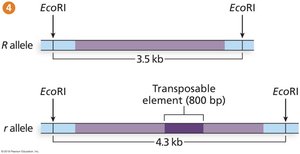
Mendel’s Wrinkled Seed Phenotype: Caused by a transposable element disrupting a gene involved in starch synthesis, resulting in a recessive phenotype.
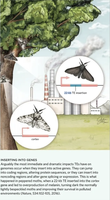
Dark Moth Phenotype: A transposable element insertion increases melanin expression, causing a dominant phenotype.
Evolutionary Impact
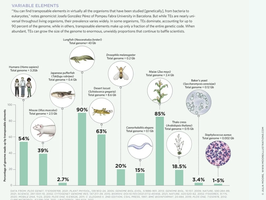
Transposable elements accumulate in genomes over time, as cells lack repair mechanisms to remove them.
Nearly half of the human genome consists of ancient transposable elements and viral sequences.
Chromosomal Abnormalities
Overview
Chromosomal abnormalities are a major cause of genetic disorders and spontaneous pregnancy loss. They are studied in the field of cytogenetics.
Structural defects: Deletion, duplication, inversion, translocation
Numerical defects: Aneuploidy (abnormal number of chromosomes), polyploidy (abnormal number of chromosome sets)
Structural Chromosomal Abnormalities
Deletion
Loss of a chromosome segment, which can remove one or more genes.
Caused by breaks due to viruses, chemicals, radiation, transposable elements, or errors in recombination.
Large deletions can affect multiple genes and cause severe phenotypes.
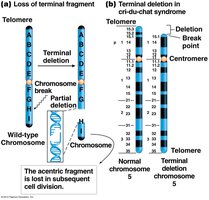
Cri-du-chat syndrome: Caused by a terminal deletion on the short arm of chromosome 5, leading to intellectual disability and a characteristic cat-like cry.
Duplication
Part of a chromosome is duplicated, resulting in extra copies of genes.
Can disrupt gene function or alter gene regulation, sometimes leading to disease (e.g., cancer).
Gene duplications are also a source of evolutionary innovation, as one copy can evolve new functions.
Inversion
A chromosome segment is reversed end to end.
Pericentric inversion: Includes the centromere.
Paracentric inversion: Does not include the centromere.
Homozygous inversions are usually benign, but heterozygous inversions can disrupt meiosis and cause embryo lethality.
Translocation
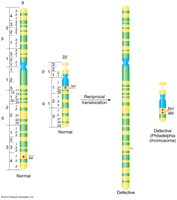
Part of a chromosome is moved to a new location, either within the same chromosome (intrachromosomal) or to a different chromosome (interchromosomal).
Reciprocal translocation: Two chromosomes exchange segments.
Can create fusion genes (e.g., Philadelphia chromosome in chronic myeloid leukemia).
Numerical Chromosomal Abnormalities
Definitions
Euploid: Normal chromosome number (46 in humans, 2N).
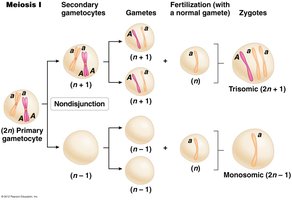
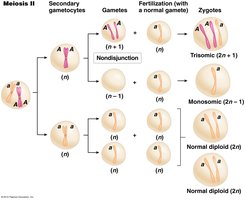
Aneuploid: Abnormal number of chromosomes (e.g., trisomy, monosomy).
Trisomic: Three copies of one chromosome (2N+1).
Monosomic: One copy of one chromosome (2N–1).
Polyploid: More than two complete sets of chromosomes (e.g., triploid 3N, tetraploid 4N).
Mechanism: Nondisjunction
Nondisjunction is the failure of homologous chromosomes or sister chromatids to separate properly during meiosis, resulting in gametes with abnormal chromosome numbers.
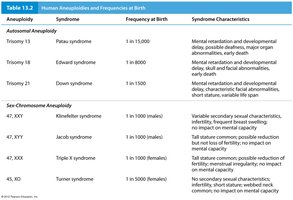
Common Human Aneuploidies
Most aneuploidies are lethal in utero; only a few trisomies are compatible with live birth.
Trisomy 21 (Down syndrome): Viable, causes intellectual disability and characteristic features.
Sex Chromosome Aneuploidies
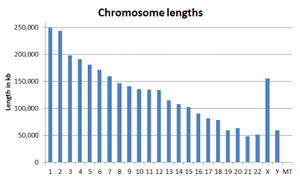
Klinefelter syndrome (47, XXY): Male, tall, sterile, mild intellectual impairment.
Jacob syndrome (47, XYY): Male, tall, otherwise normal.
Turner syndrome (45, X): Female, short, no sexual maturation, increased risk of health issues.
Triple X syndrome (47, XXX): Female, usually normal due to X inactivation.
Dosage Compensation and X Inactivation
Mechanism of Dosage Compensation
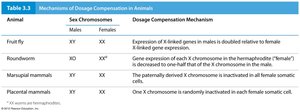
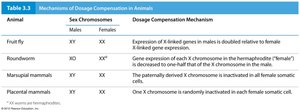
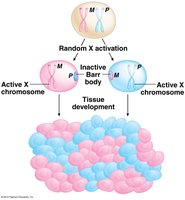
In mammals, dosage compensation equalizes the expression of X-linked genes between males (XY) and females (XX) by inactivating one X chromosome in females. The inactive X forms a Barr body.
Genetic Mosaicism
Females heterozygous for X-linked genes are genetic mosaics, with different cells expressing different alleles. This is visually evident in calico cats, where fur color patches correspond to X inactivation patterns.

Polyploidy
Definition and Significance
Polyploid: Organisms with more than two complete sets of chromosomes (e.g., triploid 3N, tetraploid 4N).
Rare in animals but common in plants; many domesticated plants are polyploid (e.g., wheat, cabbage).
Summary Table: Chromosomal Abnormalities
Type | Description | Example/Consequence |
|---|---|---|
Deletion | Loss of chromosome segment | Cri-du-chat syndrome |
Duplication | Extra copy of chromosome segment | Gene evolution, cancer |
Inversion | Segment reversed in orientation | Meiotic defects if heterozygous |
Translocation | Segment moved to new location | Philadelphia chromosome (CML) |
Aneuploidy | Abnormal chromosome number | Down syndrome, Turner syndrome |
Polyploidy | Extra chromosome sets | Common in plants |
Additional info: These notes integrate foundational concepts from chapters on gene mutation, DNA repair, chromosome structure, and transmission genetics, providing a comprehensive overview for exam preparation in a college genetics course.
