 Back
BackTransposable Genetic Elements: Structure, Mechanism, and Impact
Study Guide - Smart Notes
 Tailored notes based on your materials, expanded with key definitions, examples, and context.
Transposable Genetic Elements Move Throughout the Genome
Definition and General Properties
Transposable genetic elements are DNA sequences capable of moving within the genome via an enzyme-driven process called transposition. These elements vary in length, sequence composition, and copy number, and their movement can occur by excision and insertion or by duplication and insertion.
Transposition: The process by which a DNA segment moves from one location to another within the genome.
Two modes of movement:
Excision and insertion (cut-and-paste)
Duplication and insertion (copy-and-paste)
Structural Features of Transposable Elements
Despite their diversity, all transposable elements share two sequence features:
Terminal inverted repeats: Short, inverted sequences at each end of the element.
Flanking direct repeats: Short, repeated sequences that bracket the inserted element, generated during insertion.
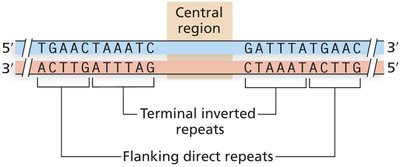
Mechanism of Transposition
Transposition involves a series of steps mediated by the enzyme transposase:
Staggered cuts are made in both DNA strands at the target site, leaving single-stranded overhangs.
The double-stranded transposable element is inserted into the new site.
DNA polymerase fills the gaps, producing flanking direct repeats.
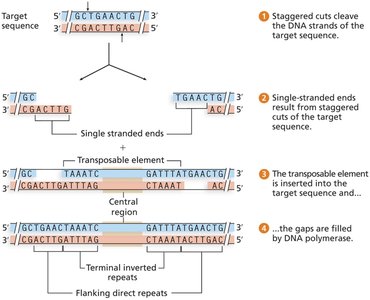
Categories of Transposable Elements
Transposable elements are classified based on their mechanism of movement:
DNA transposons (Class II): Move as DNA sequences; can be replicative (copy-and-paste) or nonreplicative (cut-and-paste).
Retrotransposons (Class I): Move via an RNA intermediate; RNA is reverse-transcribed into DNA and inserted into the genome.
Types of DNA Transposon Insertion
Replicative transposition: The transposon is copied and the copy is inserted elsewhere (copy-and-paste).
Nonreplicative transposition: The transposon is excised and inserted into a new site (cut-and-paste).
Mutagenic Effects of Transposition
Transposable elements can disrupt gene function by inserting into wild-type alleles, causing insertional inactivation and resulting in nonfunctional gene products. Examples include mutations causing hemophilia A and Coffin-Lowry syndrome in humans, and the round versus wrinkled pea phenotype in plants.
Transposable Elements in Bacterial and Eukaryotic Genomes
Bacterial Transposable Elements
Bacterial genomes, plasmids, and viruses contain three main types of transposable elements:
Insertion sequences (ISs): Simple elements with terminal inverted repeats and a transposase gene.
Composite transposons: Carry a transposase gene, two flanking IS elements, and additional genes.
Noncomposite transposons: Similar to composite transposons but lack IS elements.
Eukaryotic Transposable Elements
Eukaryotic genomes contain a wide variety of transposable elements:
Short sequences with inverted repeats: Examples include Ac/Ds elements in maize and P elements in Drosophila.
Retrotransposons: Examples include Alu sequences in humans, Ty elements in yeast, and copia elements in Drosophila.
Nearly half of the human genome is composed of transposable DNA.
Discovery and Analysis of Transposable Elements in Maize
Barbara McClintock's Experiments
Barbara McClintock discovered transposition in maize using crosses involving three linked genes: C, Sh, and Wx. She observed kernels with sectors lacking color, which were also shrunken and waxy, indicating chromosome breakage at the Ds gene when Ac was present.
Ds (dissociation): Control element causing chromosome breakage.
Ac (activator): Contains transposase gene, required for Ds movement.
Insertion of Ds into the C gene inactivates C, resulting in colorless kernels.
Excision of Ds restores purple color in otherwise colorless kernels.
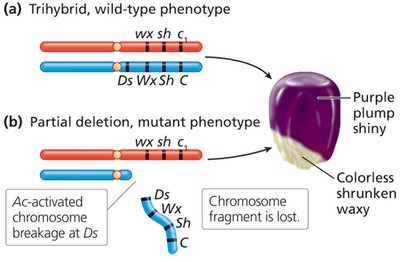
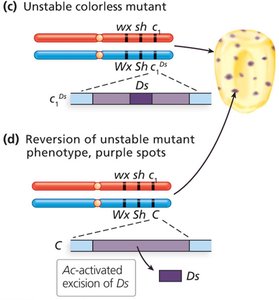
Transposable Elements in Drosophila and Other Eukaryotes
Drosophila P Elements
P elements are prominent transposable elements in Drosophila melanogaster, introduced into wild strains since the 1960s, and now present in all wild-caught flies.
Retrotransposons and Retroviruses
Retroviruses infect cells with single-stranded RNA genomes, which are reverse-transcribed into DNA by reverse transcriptase. Retrotransposons are related to retroviruses, carrying pol (reverse transcriptase) and sometimes gag genes, but lacking env, so they cannot produce viral particles. Retrotransposons are flanked by long terminal repeats (LTRs).
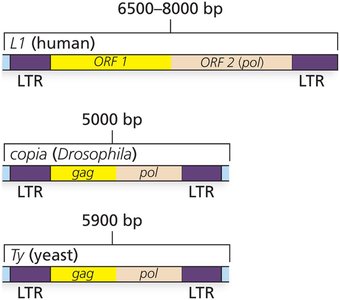
LINE, SINE, and Alu Elements in Humans
LINEs (Long Interspersed Nuclear Elements): Abundant, can cause mutations; L1 elements are common, 6.5–8.0 kb, encode nuclease and reverse transcriptase.
SINEs (Short Interspersed Nuclear Elements): Also abundant; Alu elements are the most common, 100–300 bp, flanked by 7–20 bp direct repeats, over 1 million copies in the human genome.
Ty Elements in Yeast and Copia Elements in Drosophila
Ty elements (yeast): Central element ~6 kb, flanked by 330 bp LTRs, contain promoters for transcription.
Copia elements (Drosophila): Central element 5–8.5 kb, contain gag and pol genes, flanked by 250–600 bp LTRs, >5% of genome.
Element | Length | Genes | Flanking Structure |
|---|---|---|---|
L1 (human) | 6500–8000 bp | ORF1, ORF2 (pol) | LTR |
copia (Drosophila) | 5000 bp | gag, pol | LTR |
Ty (yeast) | 5900 bp | gag, pol | LTR |
Summary: Transposable elements are a major source of genetic variation and mutation in both prokaryotic and eukaryotic genomes. Their movement and insertion can disrupt gene function, contribute to genome evolution, and are important tools in genetic analysis.
