 Back
BackTrihybrid Mapping and Three-Point Testcrosses in Chromosome Mapping
Study Guide - Smart Notes
 Tailored notes based on your materials, expanded with key definitions, examples, and context.
Trihybrid Mapping and Chromosome Mapping in Eukaryotes
Introduction to Gene Mapping
Gene mapping is a fundamental technique in genetics used to determine the relative positions of genes on a chromosome. By analyzing recombination frequencies in offspring, geneticists can construct linkage maps that reveal the order and distances between genes. This process is essential for understanding inheritance patterns and for identifying genes associated with specific traits or diseases.
Gene Order and Two-Gene Crosses
Limitations of Two-Gene Crosses
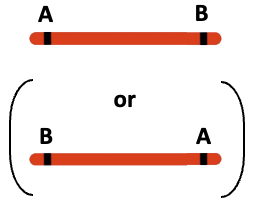
Two-gene crosses can measure the genetic distance between two loci but cannot determine their orientation or order on the chromosome. This is because recombination frequency only provides information about the separation between genes, not their linear arrangement.
Key Point: Two-gene crosses yield one (or two, mirror-image) possible maps, but do not resolve gene order.
Key Point: The physical arrangement (left-to-right) of two genes cannot be distinguished by recombination data alone.
Three-Gene Crosses and Gene Order
Why Use Three-Point Testcrosses?
Three-point testcrosses are designed to determine both the order and the distances between three linked genes. By analyzing the frequencies of various recombinant offspring, geneticists can deduce the most likely sequence of genes on a chromosome.
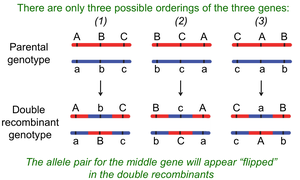
Key Point: Three genes can be arranged in three possible orders, and only a three-point cross can distinguish among them.
Key Point: The double recombinant classes are critical for identifying the gene in the middle.
Design of a Three-Point Testcross
A three-point testcross involves crossing a trihybrid (heterozygous for three genes) with a tester (homozygous recessive for all three genes). This allows for the detection of all possible recombinant types in the offspring.
Purpose: To determine if the genes are linked, their order, and the distances between them.
Tester: Always provides the same alleles, so only the gametes from the trihybrid parent are informative.
Classification of Offspring Types
Offspring from a three-point testcross can be classified into:
Parental (Non-recombinant) Types: Most frequent; represent the original arrangement of alleles.
Single Recombinants: Result from a crossover between one pair of genes.
Double Recombinants: Least frequent; result from two crossovers, one between each pair of genes.
Determining Gene Order
Using Double Recombinants
The gene order is revealed by comparing the double recombinant genotypes to the parental genotypes. The allele that is 'flipped' in the double recombinants (relative to the parental types) is the gene in the middle.
Key Point: Double recombinants are rare and indicate two crossover events.
Key Point: The middle gene is the one that differs between the parental and double recombinant classes.
Calculating Recombination Frequencies and Map Distances
Pairwise and Regional Mapping
Recombination frequency is used to estimate the distance between genes. One map unit (centimorgan, cM) corresponds to a 1% recombination frequency.
Pairwise Mapping: Only includes offspring recombinant for the two genes being compared.
Three-Point (Regional) Mapping: Includes all offspring recombinant between the two genes, including double crossovers.
Formula:
Worked Example: Three-Point Testcross Data Interpretation
Sample Data Table
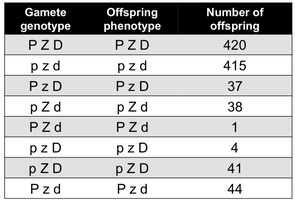
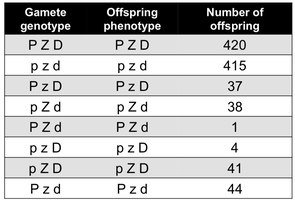
The following table shows the results of a three-point testcross between a fly heterozygous for the genes P, Z, and D and a homozygous tester. The table lists the gamete genotype, offspring phenotype, and number of offspring for each class.
Gamete genotype | Offspring phenotype | Number of offspring |
|---|---|---|
P Z D | P Z D | 420 |
p z d | p z d | 415 |
p Z D | p Z D | 37 |
P z d | P z d | 38 |
P z D | P z D | 1 |
p Z d | p Z d | 4 |
P Z d | P Z d | 41 |
p z D | p z D | 44 |
Steps to Analyze Three-Point Testcross Data
Identify the two most frequent classes (parental types).
Identify the two least frequent classes (double recombinants).
Compare parental and double recombinant genotypes to determine the gene order.
Classify the remaining classes as single recombinants.
Calculate recombination frequencies and map distances between each pair of genes, including double recombinants in the calculation.
Calculating Map Distances
To calculate the distance between two genes (e.g., P and D):
Add the number of single recombinants between P and D and the number of double recombinants.
Divide by the total number of offspring and multiply by 100 to get the distance in centimorgans (cM).
Formula:
Summary Table: Three-Point Testcross Data
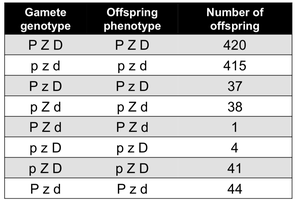
Gamete genotype | Offspring phenotype | Number of offspring |
|---|---|---|
P Z D | P Z D | 420 |
p z d | p z d | 415 |
p Z D | p Z D | 37 |
P z d | P z d | 38 |
P z D | P z D | 1 |
p Z d | p Z d | 4 |
P Z d | P Z d | 41 |
p z D | p z D | 44 |
Key Concepts and Applications
Three-point testcrosses are essential for determining gene order and distances on chromosomes.
Double recombinants are crucial for identifying the middle gene in a set of three linked genes.
Map distances are calculated using recombination frequencies, with 1% recombination equivalent to 1 cM.
These techniques are foundational for constructing genetic linkage maps and for understanding the genetic basis of inheritance.
