 Back
BackViruses: Structure, Classification, and Life Cycles in Genetics
Study Guide - Smart Notes
 Tailored notes based on your materials, expanded with key definitions, examples, and context.
Virus Structure and Morphology
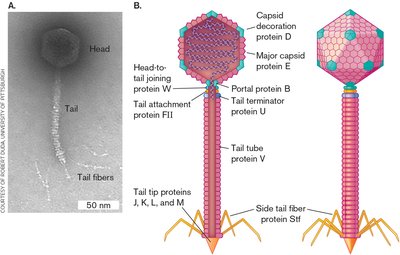
Bacteriophage Structure
Bacteriophages are viruses that infect bacteria, exhibiting complex structures with distinct head and tail regions. The head contains the viral genome, while the tail facilitates attachment and genome injection into the host.
Capsid: Protein shell protecting the viral genome.
Tail fibers: Structures used for host recognition and attachment.
Genome: Can be DNA or RNA, single- or double-stranded.
Example: Phage T4 and Lambda are well-studied bacteriophages.
Virus Morphology and Symmetry
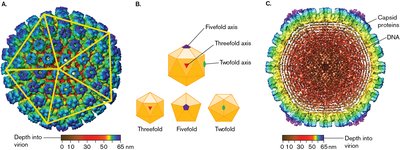
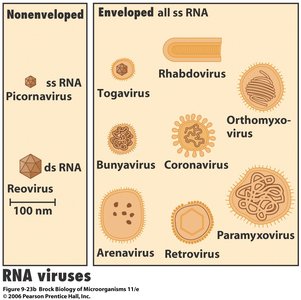
Viruses display a variety of shapes and symmetries, including icosahedral, helical, and complex forms. Symmetry is determined by the arrangement of capsid proteins.
Icosahedral symmetry: 20-sided structure, common in many animal viruses.
Helical symmetry: Rod-shaped viruses, such as tobacco mosaic virus.
Complex symmetry: Seen in bacteriophages with both icosahedral heads and helical tails.
Virus Life Cycles
Phage Lambda Life Cycle
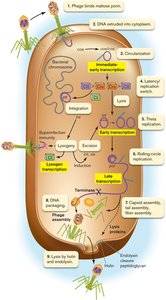
Phage Lambda can undergo both lytic and lysogenic cycles. The lytic cycle results in host cell lysis and release of new virions, while the lysogenic cycle involves integration of the phage genome into the host DNA.
Lytic cycle: Viral replication leads to cell destruction.
Lysogenic cycle: Viral genome integrates and replicates with host DNA, remaining dormant until induction.
Decision between cycles: Controlled by regulatory proteins and environmental signals.
Rolling Circle Replication and Headful Packaging
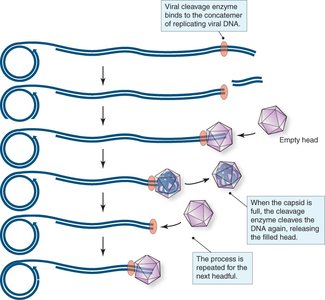
Many bacteriophages replicate their genomes via rolling circle replication, producing long concatemers of DNA. Packaging into capsids often follows a headful mechanism, where DNA is cleaved and packed until the capsid is full.
Rolling circle replication: Produces multiple genome copies in a continuous strand.
Headful packaging: DNA is cut and packed into capsids, with each capsid receiving a 'headful' of DNA.
Virus Classification
ICTV Classification Criteria
The International Committee on Taxonomy of Viruses (ICTV) classifies viruses based on several key criteria:
Genome composition: DNA or RNA, single- or double-stranded.
Capsid symmetry: Icosahedral, helical, or complex.
Envelope presence: Enveloped or non-enveloped.
Virion size: Measured in nanometers.
Host range: Specificity for certain organisms.
Baltimore Classification System
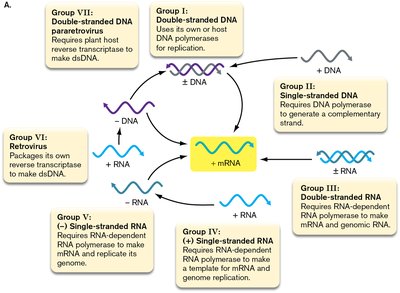
The Baltimore system groups viruses based on genome type and replication strategy, defining seven fundamental groups:
Group I: Double-stranded DNA viruses
Group II: Single-stranded DNA viruses
Group III: Double-stranded RNA viruses
Group IV: (+) sense single-stranded RNA viruses
Group V: (–) sense single-stranded RNA viruses
Group VI: Retroviruses (RNA reverse-transcribing viruses)
Group VII: Pararetroviruses (DNA reverse-transcribing viruses)
Viral Genomes
Genome Diversity
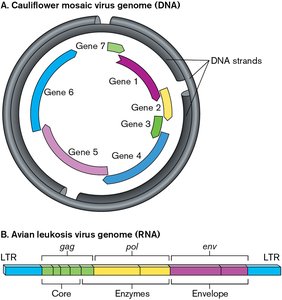
Viral genomes vary widely in size, structure, and composition, influencing their replication and infection strategies.
DNA or RNA: Viruses may have either type of nucleic acid.
Single- or double-stranded: Both forms are found among viruses.
Linear, circular, or segmented: Genome structure affects replication and packaging.
Viroids and Prions
Viroids
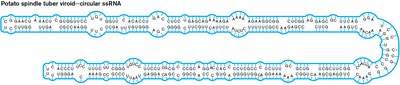
Viroids are infectious agents composed solely of a short strand of circular, single-stranded RNA. They lack a protein coat and infect plants, causing various diseases.
No protein coat: Unlike viruses, viroids are naked RNA.
Plant pathogens: Cause diseases such as potato spindle tuber.
Prions
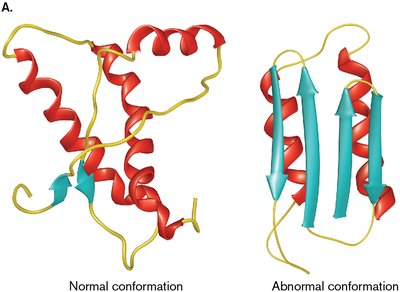
Prions are infectious proteins that cause neurodegenerative diseases by inducing abnormal folding of normal cellular proteins.
Protein-only: No nucleic acid component.
Diseases: Includes Creutzfeldt-Jakob disease and mad cow disease.
Abnormal conformation: Prions convert normal proteins into misfolded forms.
Ecological Roles of Viruses
Viruses in Ecosystems
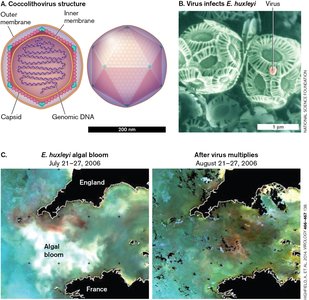
Viruses play crucial roles in ecological systems, influencing population dynamics, nutrient cycling, and evolution.
Regulation of populations: Viruses control host populations, such as bacteria and algae.
Nutrient cycling: Viral lysis releases nutrients back into the environment.
Evolutionary impact: Viruses drive genetic diversity through horizontal gene transfer.
Host Range and Viral Disease
Host Range
The host range of a virus refers to the spectrum of species it can infect. Some viruses are highly specific, while others infect multiple species.
Specificity: HIV infects only humans; West Nile virus infects birds and mammals.
Chronic vs. acute infections: Chronic infections are more common than acute diseases.
Antiviral drugs: Fewer available compared to antibiotics for bacteria.
Animal and Plant Viruses
Complexity of Eukaryotic Virus Life Cycles
Animal and plant viruses face challenges similar to bacteriophages but must navigate the more complex structure of eukaryotic cells. This results in greater diversity in replication cycles.
Host attachment: Viruses must recognize and bind to specific cell receptors.
Genome entry: Mechanisms include membrane fusion and endocytosis.
Gene expression: Strategies vary depending on genome type.
Virion assembly and release: May involve budding or cell lysis.
Tissue Tropism
Tissue tropism refers to the preference of animal viruses for specific tissues or cell types within a host.
Example: Influenza virus targets respiratory epithelium; hepatitis viruses target liver cells.
Are Viruses Alive?
Debate on Viral Life
Virologists debate whether viruses are alive, as they lack cellular organization and metabolism but possess heredity and the ability to evolve.
Noncellular: Viruses are not cells.
Dependence: Require host machinery for reproduction.
Evolution: Capable of evolving and adapting.
Summary Table: Baltimore Virus Classification
Group | Genome Type | Replication Strategy | Example Virus |
|---|---|---|---|
I | dsDNA | Uses host or viral DNA polymerase | Herpesvirus |
II | ssDNA | DNA polymerase generates complementary strand | Parvovirus |
III | dsRNA | RNA-dependent RNA polymerase | Reovirus |
IV | (+) ssRNA | Genome serves as mRNA | Poliovirus |
V | (–) ssRNA | RNA-dependent RNA polymerase | Influenza virus |
VI | ssRNA (RT) | Reverse transcription to DNA | HIV |
VII | dsDNA (RT) | Reverse transcription | Hepadnavirus |
Key Equations and Concepts
Rolling Circle Replication:
Virus Classification:
Additional info: Academic context was added to clarify virus structure, classification, and life cycles, as well as the ecological and evolutionary roles of viruses.
