
Pearson+ LogoPearson+ Logo
Ch. 10 - DNA Replication
Klug - Essentials of Genetics 10th Edition
Klug10th EditionEssentials of GeneticsISBN: 9780135588789Not the one you use?Change textbook
Chapter 10, Problem 21b

Many of the gene products involved in DNA synthesis were initially defined by studying mutant E. coli strains that could not synthesize DNA.
The dnaQ gene encodes the ε subunit of DNA polymerase. What effect is expected from a mutation in this gene?

Verified step by step guidance
1
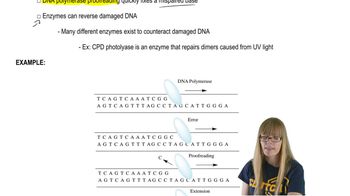
Understand the role of the dnaQ gene: It encodes the ε (epsilon) subunit of DNA polymerase III in E. coli, which is responsible for the proofreading activity during DNA replication.
Recall that the ε subunit has 3' to 5' exonuclease activity, which means it can remove incorrectly incorporated nucleotides, ensuring high fidelity of DNA synthesis.
Predict the effect of a mutation in the dnaQ gene: If the ε subunit is defective or missing, the proofreading function will be impaired, leading to an increase in replication errors.
Consider the biological consequence: Without proper proofreading, the mutation rate during DNA replication will increase, potentially causing accumulation of mutations in the bacterial genome.
Summarize that a mutation in dnaQ is expected to reduce the accuracy of DNA synthesis by compromising the proofreading ability of DNA polymerase III.

Verified video answer for a similar problem:

This video solution was recommended by our tutors as helpful for the problem above.
Video duration:
1m
Was this helpful?

Key Concepts

Here are the essential concepts you must grasp in order to answer the question correctly.

Role of DNA Polymerase in DNA Synthesis

DNA polymerase is the enzyme responsible for synthesizing new DNA strands by adding nucleotides complementary to the template strand. It ensures accurate replication of the genome during cell division, with multiple subunits contributing to its function.
Recommended video:
Guided course
01:45
DNA Proofreading

Function of the ε Subunit (dnaQ Gene Product)

The ε subunit of DNA polymerase, encoded by the dnaQ gene, provides 3' to 5' exonuclease proofreading activity. This function corrects errors by removing incorrectly incorporated nucleotides, thereby increasing the fidelity of DNA replication.
Recommended video:
Guided course
08:26
Functional Genomics

Effects of Mutations in dnaQ on DNA Replication

Mutations in the dnaQ gene impair the proofreading ability of DNA polymerase, leading to increased replication errors and higher mutation rates. Such defects can cause genomic instability and affect cell viability or function.
Recommended video:
Guided course
11:59
Steps to DNA Replication
Related Practice
Textbook Question

Several temperature-sensitive mutant strains of E. coli display the following characteristics. Predict what enzyme or function is being affected by each mutation.

Synthesis is very slow.

651
views
Textbook Question

Several temperature-sensitive mutant strains of E. coli display the following characteristics. Predict what enzyme or function is being affected by each mutation.

Supercoiled strands remain after replication, which is never completed.

705
views
Textbook Question

Many of the gene products involved in DNA synthesis were initially defined by studying mutant E. coli strains that could not synthesize DNA.

The dnaE gene encodes the α subunit of DNA polymerase III. What effect is expected from a mutation in this gene? How could the mutant strain be maintained?

613
views
Textbook Question

Assume a hypothetical organism in which DNA replication is conservative. Design an experiment similar to that of Taylor, Woods, and Hughes that will unequivocally establish this fact. Using the format established in Figure 11.5, draw sister chromatids and illustrate the expected results establishing this mode of replication.

803
views
Textbook Question

In 1994, telomerase activity was discovered in human cancer cell lines. Although telomerase is not active in most human adult cells, all cells do contain the genes for telomerase proteins and telomerase RNA. Since inappropriate activation of telomerase may contribute to cancer, why do you think the genes coding for this enzyme have been maintained in the human genome throughout evolution? Are there any types of human body cells where telomerase activation would be advantageous or even necessary? Explain.

739
views