Pearson+ LogoPearson+ Logo
Ch. 19 - The Genetics of Cancer
Klug - Essentials of Genetics 10th Edition
Klug10th EditionEssentials of GeneticsISBN: 9780135588789Not the one you use?Change textbook
Chapter 19, Problem 15

How do translocations such as the Philadelphia chromosome contribute to cancer?

Verified step by step guidance
1
Understand that a translocation is a chromosomal abnormality where a segment of one chromosome breaks off and attaches to another chromosome, potentially disrupting normal gene function.
Recognize that the Philadelphia chromosome is a specific translocation between chromosomes 9 and 22, denoted as t(9;22)(q34;q11), which fuses parts of two genes: BCR from chromosome 22 and ABL from chromosome 9.
Learn that this fusion creates a novel BCR-ABL gene that encodes a constitutively active tyrosine kinase enzyme, which means it is always 'on' and continuously signals cells to divide.
Understand that this uncontrolled signaling leads to increased cell proliferation and reduced apoptosis (programmed cell death), contributing to the development of cancer, specifically chronic myelogenous leukemia (CML).
Summarize that translocations like the Philadelphia chromosome contribute to cancer by creating abnormal fusion genes that produce proteins disrupting normal cell cycle regulation and promoting malignant transformation.

Verified video answer for a similar problem:

This video solution was recommended by our tutors as helpful for the problem above.
Video duration:
1m
Was this helpful?

Key Concepts

Here are the essential concepts you must grasp in order to answer the question correctly.

Chromosomal Translocations

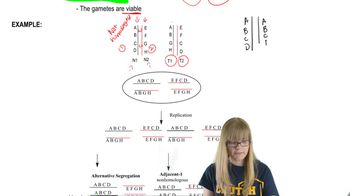
Chromosomal translocations occur when segments from two different chromosomes break and reattach to each other. This rearrangement can disrupt normal gene function or create novel gene fusions, which may alter cellular behavior. Translocations are a common genetic abnormality in various cancers.
Recommended video:
Guided course
12:42
Reciprocal Translocation

Philadelphia Chromosome

The Philadelphia chromosome is a specific translocation between chromosomes 9 and 22, producing the BCR-ABL fusion gene. This abnormal gene encodes a constitutively active tyrosine kinase that drives uncontrolled cell division, primarily associated with chronic myeloid leukemia (CML).
Recommended video:
Guided course
07:10
Chromosome Structure

Oncogene Activation and Cancer Development

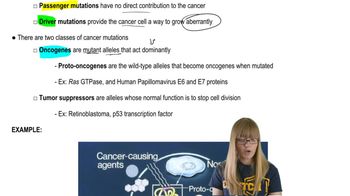
Oncogenes are mutated or abnormally expressed genes that promote cancer. Translocations can activate oncogenes by creating fusion proteins or misregulating gene expression, leading to increased cell proliferation and survival. This process is a key mechanism by which genetic changes contribute to cancer.
Recommended video:
Guided course
04:46
Cancer Mutations
Related Practice
Textbook Question

If a cell suffers damage to its DNA while in S phase, how can this damage be repaired before the cell enters mitosis?

557
views
Textbook Question

Distinguish between oncogenes and proto-oncogenes. In what ways can proto-oncogenes be converted to oncogenes?

890
views
Textbook Question

Of the two classes of genes associated with cancer, tumor-suppressor genes and oncogenes, mutations in which group can be considered gain-of-function mutations? In which group are the loss-of-function mutations? Explain.

580
views
Textbook Question

How do normal cells protect themselves from accumulating mutations in genes that could lead to cancer? How do cancer cells differ from normal cells in these processes?

406
views
Textbook Question

Radiotherapy (treatment with ionizing radiation) is one of the most effective current cancer treatments. It works by damaging DNA and other cellular components. In which ways could radiotherapy control or cure cancer, and why does radiotherapy often have significant side effects?

513
views
Textbook Question

Genetic tests that detect mutations in the BRCA1 and BRCA2 tumor-suppressor genes are widely available. These tests reveal a number of mutations in these genes—mutations that have been linked to familial breast cancer. Assume that a young woman in a suspected breast cancer family takes the BRCA1 and BRCA2 genetic tests and receives negative results. That is, she does not test positive for the mutant alleles of BRCA1 or BRCA2. Can she consider herself free of risk for breast cancer?

1082
views