Pearson+ LogoPearson+ Logo
Ch. 4 - Modification of Mendelian Ratios
Klug - Essentials of Genetics 10th Edition
Klug10th EditionEssentials of GeneticsISBN: 9780135588789Not the one you use?Change textbook
Chapter 4, Problem 10

A husband and wife have normal vision, although both of their fathers are red–green color-blind, an inherited X-linked recessive condition. What is the probability that their first child will be (a) a normal son, (b) a normal daughter, (c) a color-blind son, (d) a color-blind daughter?

Verified step by step guidance
1
Identify the inheritance pattern: Red-green color blindness is an X-linked recessive trait. This means the gene causing the condition is located on the X chromosome, and the trait manifests in males who have only one X chromosome carrying the mutation, or in females who have two mutated X chromosomes.
Determine the genotypes of the parents: Both husband and wife have normal vision, but both of their fathers are color-blind. Since fathers pass their X chromosome to their daughters, the wife must be a carrier (X\^N X\^c), where X\^N is the normal allele and X\^c is the color-blind allele. The husband has normal vision and a color-blind father, so he must have inherited his Y chromosome from his father and a normal X chromosome from his mother (X\^N Y).
Set up the possible gametes: The wife can produce eggs with either X\^N or X\^c, each with a probability of 1/2. The husband can produce sperm with either X\^N or Y, each with a probability of 1/2.
Construct a Punnett square to combine the gametes and determine the genotypes of the children: The four possible combinations are X\^N X\^N (normal daughter), X\^c X\^N (carrier daughter), X\^N Y (normal son), and X\^c Y (color-blind son).
Calculate the probabilities for each child type: (a) normal son corresponds to X\^N Y, (b) normal daughter corresponds to X\^N X\^N, (c) color-blind son corresponds to X\^c Y, and (d) color-blind daughter corresponds to X\^c X\^c (which is not possible here since the mother is a carrier, not affected). Use the Punnett square ratios to find each probability.

Verified video answer for a similar problem:

This video solution was recommended by our tutors as helpful for the problem above.
Video duration:
2m
Was this helpful?

Key Concepts

Here are the essential concepts you must grasp in order to answer the question correctly.

X-linked Recessive Inheritance

X-linked recessive traits are caused by mutations on the X chromosome. Males (XY) express the trait if they inherit the affected X, while females (XX) must inherit two affected X chromosomes to express the trait. Females with one affected X are carriers and usually phenotypically normal.
Recommended video:
Guided course
09:30
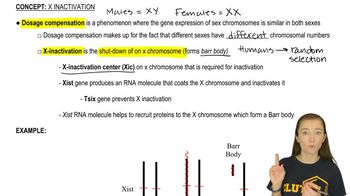
X-Inactivation

Carrier Status and Phenotype in X-linked Traits

A female carrier has one normal and one mutated X chromosome, typically showing no symptoms but able to pass the mutation to offspring. Sons of carrier mothers have a 50% chance of being affected, while daughters have a 50% chance of being carriers.
Recommended video:
Guided course
09:30
X-Inactivation

Probability Calculation in Genetic Crosses

Genetic probabilities are calculated by considering parental genotypes and possible gametes. For X-linked traits, the sex of the child affects inheritance patterns, so probabilities differ for sons and daughters based on the mother’s carrier status and father’s genotype.
Recommended video: