Pearson+ LogoPearson+ Logo
Ch. 4 - Modification of Mendelian Ratios
Klug - Essentials of Genetics 10th Edition
Klug10th EditionEssentials of GeneticsISBN: 9780135588789Not the one you use?Change textbook
Chapter 4, Problem 9a

Given the inheritance pattern of coat color in rats described in Problem 17, predict the genotype and phenotype of the parents who produced the following offspring:
9/16 gray: 3/16 yellow: 3/16 black: 1/16 cream

Verified step by step guidance
1
Identify the inheritance pattern described in Problem 17, which likely involves two genes with epistatic interactions affecting coat color in rats. Typically, such ratios suggest a dihybrid cross with epistasis.
Assign symbols to the genes involved. For example, let gene A control pigment production (A = pigment, a = no pigment) and gene B control pigment color (B = black, b = yellow). The cream phenotype might result from a double recessive or interaction between these genes.
Write down the expected phenotypic ratios for a dihybrid cross with epistasis. The given offspring ratio (9/16 gray, 3/16 yellow, 3/16 black, 1/16 cream) suggests a 9:3:3:1 ratio, typical of independent assortment without epistasis, but with different phenotypes assigned to each genotype combination.
Determine the genotypes corresponding to each phenotype based on the gene symbols. For example, gray might be A_B_, yellow A_bb, black aaB_, and cream aabb. This helps to map phenotypes to genotypes.
Use the offspring phenotypic ratio to infer the parental genotypes. Since the ratio matches a 9:3:3:1 ratio, the parents are likely heterozygous for both genes (AaBb x AaBb). Confirm this by setting up a Punnett square and verifying the offspring ratios.

Verified video answer for a similar problem:

This video solution was recommended by our tutors as helpful for the problem above.
Video duration:
1m
Was this helpful?

Key Concepts

Here are the essential concepts you must grasp in order to answer the question correctly.

Mendelian Inheritance and Dihybrid Crosses

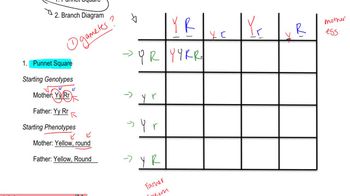
Mendelian inheritance explains how traits are passed from parents to offspring through dominant and recessive alleles. A dihybrid cross involves two genes, each with two alleles, producing a 9:3:3:1 phenotypic ratio in the F2 generation when both parents are heterozygous for both traits.
Recommended video:
Guided course
15:24
Punnet Square

Epistasis and Coat Color Genetics

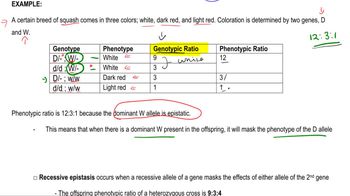
Epistasis occurs when one gene masks or modifies the expression of another gene. In coat color genetics, interactions between multiple genes can produce complex phenotypic ratios different from classic Mendelian ratios, such as the presence of cream or yellow colors influenced by gene interactions.
Recommended video:
Guided course
13:08
Epistatic Genes

Genotype to Phenotype Prediction

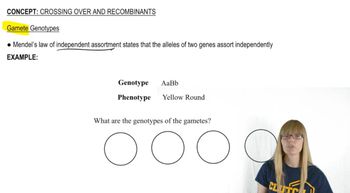
Predicting genotype and phenotype involves using observed offspring ratios to infer parental genotypes. By comparing expected Mendelian ratios to observed data, one can deduce which alleles parents carry and how they combine to produce specific phenotypes in offspring.
Recommended video:
Guided course
07:52
Gamete Genotypes
Related Practice
Textbook Question

Flower color may be red, white, or pink, and flower shape may be personate or peloric. For the following crosses, determine the P₁ and F₁ genotypes:

549
views
Textbook Question

In rats, the following genotypes of two independently assorting autosomal genes determine coat color:

A third gene pair on a separate autosome determines whether or not any color will be produced. The CC and Cc genotypes allow color according to the expression of the A and B alleles. However, the cc genotype results in albino rats regardless of the A and B alleles present. Determine the F₁ phenotypic ratio of the following crosses:

AAbbCC×aaBBcc

592
views
Textbook Question

In rats, the following genotypes of two independently assorting autosomal genes determine coat color:

A third gene pair on a separate autosome determines whether or not any color will be produced. The CC and Cc genotypes allow color according to the expression of the A and B alleles. However, the cc genotype results in albino rats regardless of the A and B alleles present. Determine the F₁ phenotypic ratio of the following crosses:

AaBbCc×AaBbcc

472
views
Textbook Question

Given the inheritance pattern of coat color in rats described in Problem 17, predict the genotype and phenotype of the parents who produced the following offspring:

9/16 gray: 3/16 yellow: 4/16 albino

559
views
Textbook Question

Given the inheritance pattern of coat color in rats described in Problem 17, predict the genotype and phenotype of the parents who produced the following offspring: 27/64 gray:

16/64 albino: 9/64 yellow: 9/64 black: 3/64 cream

457
views
Textbook Question

A husband and wife have normal vision, although both of their fathers are red–green color-blind, an inherited X-linked recessive condition. What is the probability that their first child will be (a) a normal son, (b) a normal daughter, (c) a color-blind son, (d) a color-blind daughter?

863
views