
Pearson+ LogoPearson+ Logo
Ch. 4 - Modification of Mendelian Ratios
Klug - Essentials of Genetics 10th Edition
Klug10th EditionEssentials of GeneticsISBN: 9780135588789Not the one you use?Change textbook
Chapter 4, Problem 14

In Drosophila, an X-linked recessive mutation, scalloped (sd), causes irregular wing margins. Diagram the F₁ and F₂ results if (a) a scalloped female is crossed with a normal male; (b) a scalloped male is crossed with a normal female. Compare these results with those that would be obtained if the scalloped gene were autosomal.

Verified step by step guidance
1
Step 1: Define the alleles and their inheritance pattern. Since the mutation 'scalloped (sd)' is X-linked recessive, denote the normal allele as X\^SD and the mutant allele as X\^sd. Males have one X and one Y chromosome (XY), females have two X chromosomes (XX). The mutant phenotype appears only when the recessive allele is present on all X chromosomes in females (X\^sd X\^sd) or on the single X chromosome in males (X\^sd Y).
Step 2: For cross (a), a scalloped female (X\^sd X\^sd) is crossed with a normal male (X\^SD Y). Set up the Punnett square for the F₁ generation by combining the female gametes (X\^sd) with the male gametes (X\^SD and Y). Determine the genotypes and phenotypes of the F₁ offspring, noting which are males and females and their wing phenotypes.
Step 3: For the F₂ generation in cross (a), cross the F₁ individuals among themselves (considering their genotypes from step 2). Set up Punnett squares for female and male offspring separately, and determine the expected genotypic and phenotypic ratios for both sexes.
Step 4: For cross (b), a scalloped male (X\^sd Y) is crossed with a normal female (X\^SD X\^SD). Set up the Punnett square for the F₁ generation by combining the male gametes (X\^sd and Y) with the female gametes (X\^SD). Determine the genotypes and phenotypes of the F₁ offspring.
Step 5: Compare the results from crosses (a) and (b) with the scenario where the scalloped gene is autosomal recessive. For autosomal inheritance, both males and females have two copies of the gene, so set up Punnett squares accordingly for each cross and note differences in phenotypic ratios and sex-specific expression.

Verified video answer for a similar problem:

This video solution was recommended by our tutors as helpful for the problem above.
Video duration:
2m
Was this helpful?

Key Concepts

Here are the essential concepts you must grasp in order to answer the question correctly.

X-linked Recessive Inheritance

X-linked recessive traits are caused by mutations on the X chromosome and typically affect males more than females because males have only one X chromosome. Females must inherit two copies of the recessive allele to express the trait, while males express it if they inherit one mutated X. This pattern influences the phenotypic ratios in crosses involving sex chromosomes.
Recommended video:
Guided course
09:30
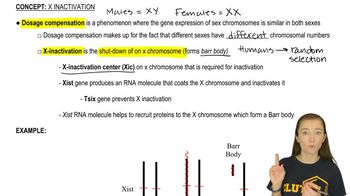
X-Inactivation

Sex Chromosome Inheritance in Drosophila

In Drosophila, females have two X chromosomes (XX) and males have one X and one Y chromosome (XY). Males inherit their X chromosome from their mother and Y from their father, while females inherit one X from each parent. This inheritance pattern affects how X-linked traits are passed and expressed in offspring.
Recommended video:
Guided course
10:35
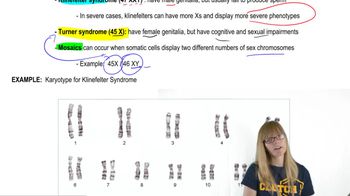
Human Sex Chromosomes

Autosomal vs. Sex-linked Gene Inheritance

Autosomal genes are located on non-sex chromosomes and follow Mendelian inheritance with equal expression in both sexes. In contrast, sex-linked genes, like X-linked ones, show different inheritance patterns and phenotypic ratios between males and females. Comparing these patterns helps distinguish the chromosomal location of a gene.
Recommended video:
Guided course
07:56
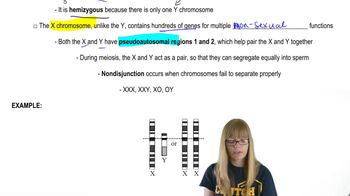
Sex-Linked Genes