Pearson+ LogoPearson+ Logo
Ch. 4 - Modification of Mendelian Ratios
Klug - Essentials of Genetics 10th Edition
Klug10th EditionEssentials of GeneticsISBN: 9780135588789Not the one you use?Change textbook
Chapter 4, Problem 16b

While vermilion is X-linked in Drosophila and causes the eye color to be bright red, brown is an autosomal recessive mutation that causes the eye to be brown. Flies carrying both mutations lose all pigmentation and are white-eyed. Predict the F₁ and F₂ results of the following crosses:
brown females x vermilion males

Verified step by step guidance
1
Step 1: Define the alleles and their inheritance patterns. Vermilion (v) is an X-linked mutation causing bright red eyes, with the wild-type allele (V) being dominant. Brown (b) is an autosomal recessive mutation causing brown eyes, with the wild-type allele (B) being dominant. The white-eyed phenotype occurs when both mutations are present together (v and b homozygous recessive).
Step 2: Determine the genotypes of the parental flies. Since the female is brown, she must be homozygous recessive for brown (bb) but wild-type for vermilion (X^V X^V or X^V X^V). The male is vermilion, so his genotype is X^v Y and likely wild-type for brown (B_).
Step 3: Predict the F₁ genotypes by crossing the parental genotypes. For the X-linked vermilion gene, females contribute one X chromosome and males contribute either X or Y. For the autosomal brown gene, both parents contribute one allele each. Write out the possible gametes and combine them to find the F₁ genotypes.
Step 4: Determine the F₁ phenotypes based on the genotypes. Remember that vermilion is X-linked recessive, so males with X^v will show the vermilion phenotype, and females need two copies of v to show vermilion. Brown is autosomal recessive, so only bb individuals show brown eyes. Also, flies with both mutations (v and bb) are white-eyed.
Step 5: Predict the F₂ generation by crossing F₁ individuals. Use a Punnett square for both the X-linked vermilion gene and the autosomal brown gene to find all possible genotype combinations. Then, determine the phenotypes considering the interaction that double mutants are white-eyed.

Verified video answer for a similar problem:

This video solution was recommended by our tutors as helpful for the problem above.
Video duration:
3m
Was this helpful?

Key Concepts

Here are the essential concepts you must grasp in order to answer the question correctly.

X-linked Inheritance

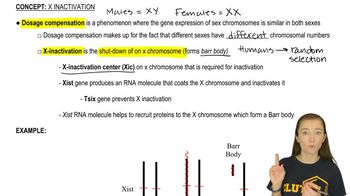
X-linked inheritance refers to genes located on the X chromosome. In Drosophila, males have one X and one Y chromosome, so a single recessive or mutant allele on the X chromosome will be expressed in males. Females have two X chromosomes, so they can be carriers if heterozygous. This pattern affects the inheritance and expression of traits like the vermilion eye color mutation.
Recommended video:
Guided course
09:30
X-Inactivation

Autosomal Recessive Inheritance

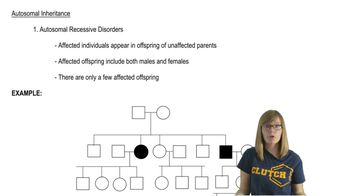
Autosomal recessive inheritance involves genes located on non-sex chromosomes. For a recessive trait like brown eye color to be expressed, an individual must inherit two copies of the mutant allele. Heterozygous individuals are carriers without showing the phenotype. This concept is essential to predict offspring phenotypes when crossing brown-eyed flies.
Recommended video:
Guided course
09:08
Autosomal Pedigrees

Epistasis and Interaction of Multiple Genes

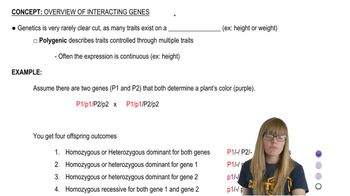
Epistasis occurs when one gene masks or modifies the expression of another gene. In this case, the combination of vermilion (X-linked) and brown (autosomal recessive) mutations results in white eyes due to loss of pigmentation. Understanding how these genes interact helps predict phenotypic ratios in F₁ and F₂ generations from the given crosses.
Recommended video:
Guided course
07:56
Interacting Genes Overview
Related Practice
Textbook Question

In Drosophila, an X-linked recessive mutation, scalloped (sd), causes irregular wing margins. Diagram the F₁ and F₂ results if (a) a scalloped female is crossed with a normal male; (b) a scalloped male is crossed with a normal female. Compare these results with those that would be obtained if the scalloped gene were autosomal.

1656
views
Textbook Question

Another recessive mutation in Drosophila, ebony (e), is on an autosome (chromosome 3) and causes darkening of the body compared with wild-type flies. What phenotypic F₁ and F₂ male and female ratios will result if a scalloped-winged female with normal body color is crossed with a normal-winged ebony male?

Work out this problem by both the Punnett square method and the forked-line method.

884
views
Textbook Question

While vermilion is X-linked in Drosophila and causes the eye color to be bright red, brown is an autosomal recessive mutation that causes the eye to be brown. Flies carrying both mutations lose all pigmentation and are white-eyed. Predict the F₁ and F₂ results of the following crosses:

vermilion females x brown males

470
views
Textbook Question

While vermilion is X-linked in Drosophila and causes the eye color to be bright red, brown is an autosomal recessive mutation that causes the eye to be brown. Flies carrying both mutations lose all pigmentation and are white-eyed. Predict the F₁ and F₂ results of the following crosses:

white females x wild-type males

1884
views
Textbook Question

A geneticist from an alien planet that prohibits genetic research brought with him to Earth two pure-breeding lines of frogs. One line croaks by uttering 'rib-it rib-it' and has purple eyes. The other line croaks more softly by muttering 'knee-deep knee-deep' and has green eyes. With a newfound freedom of inquiry, the geneticist mated the two types of frogs, producing F₁ frogs that were all utterers and had blue eyes. A large F₂ generation then yielded the following ratios:

27/64 blue-eyed, 'rib-it' utterer

12/64 green-eyed, 'rib-it' utterer

9/64 blue-eyed, 'knee-deep' mutterer

9/64 purple-eyed, 'rib-it' utterer

4/64 green-eyed, 'knee-deep' mutterer

3/64 purple-eyed, 'knee-deep' mutterer

How many total gene pairs are involved in the inheritance of both traits? Support your answer.
490
views