Distinguish between the concepts of sexual differentiation and sex determination.
Ch. 5 - Sex Determination and Sex Chromosomes
Chapter 5, Problem 7
How do mammals, including humans, solve the 'dosage problem' caused by the presence of an X and Y chromosome in one sex and two X chromosomes in the other sex?
Verified step by step guidance1
Understand the 'dosage problem': In mammals, females have two X chromosomes (XX) while males have one X and one Y chromosome (XY). Since the X chromosome carries many genes, having two copies in females could lead to double the gene expression compared to males, which would disrupt cellular balance.
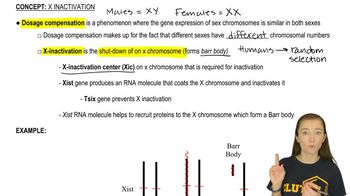
Recognize the mechanism mammals use to balance gene expression: To solve this dosage imbalance, mammals employ a process called X-chromosome inactivation (XCI), where one of the two X chromosomes in females is largely silenced.
Learn how X-chromosome inactivation occurs: Early in embryonic development, one X chromosome in each female cell is randomly chosen to be inactivated. This inactivation is stable and passed on to daughter cells, ensuring consistent gene expression levels.
Explore the molecular basis of XCI: The inactivated X chromosome condenses into a structure called a Barr body. This process involves the expression of the XIST gene, which produces RNA that coats the X chromosome and triggers its silencing.
Summarize the outcome: Through X-chromosome inactivation, females effectively have one functional X chromosome per cell, equalizing the dosage of X-linked genes between males and females and maintaining genetic balance.

Verified video answer for a similar problem:
This video solution was recommended by our tutors as helpful for the problem above.
Video duration:
1mWas this helpful?
Key Concepts
Here are the essential concepts you must grasp in order to answer the question correctly.
Sex Chromosomes and Dosage Imbalance
In mammals, females have two X chromosomes while males have one X and one Y chromosome. This difference creates a potential imbalance in the expression of genes located on the X chromosome, known as the dosage problem, because females could produce twice the amount of X-linked gene products compared to males.
Recommended video:
Guided course
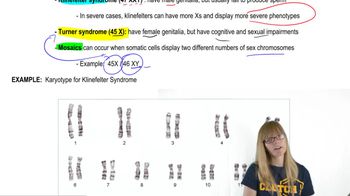
Human Sex Chromosomes
X-Chromosome Inactivation
To address the dosage problem, female mammals undergo X-chromosome inactivation, where one of the two X chromosomes is largely silenced in each cell. This process equalizes gene expression between males and females by ensuring that only one functional X chromosome is active per cell.
Recommended video:
Guided course
X-Inactivation
Role of the Y Chromosome
The Y chromosome is much smaller and contains fewer genes, many related to male sex determination and spermatogenesis. It does not compensate for the dosage of X-linked genes, so dosage compensation mechanisms like X-inactivation are essential to balance gene expression between sexes.
Recommended video:
Guided course
Human Sex Chromosomes
Related Practice
Textbook Question
3913
views
Textbook Question
Contrast the XX/XY and XX/X0 modes of sex determination.
365744
views
Textbook Question
Describe the major difference between sex determination in Drosophila and in humans.
5268
views
Textbook Question
What specific observations (evidence) support the conclusions about sex determination in Drosophila and humans?
791
views
Textbook Question
Describe how nondisjunction in human female gametes can give rise to Klinefelter and Turner syndrome offspring following fertilization by a normal male gamete.
645
views
Textbook Question
An insect species is discovered in which the heterogametic sex is unknown. An X-linked recessive mutation for reduced wing (rw) is discovered. Contrast the F1 and F2 generations from a cross between a female with reduced wings and a male with normal-sized wings when the female is the heterogametic sex.
636
views