A plaque assay is performed beginning with 1 mL of a solution containing bacteriophages. This solution is serially diluted three times by combining 0.1 mL of each sequential dilution with 9.9 mL of liquid medium. Then 0.1 mL of the final dilution is plated in the plaque assay and yields 17 plaques. What is the initial density of bacteriophages in the original 1 mL?
Verified step by step guidance
1
Understand the dilution process: Each dilution step involves taking 0.1 mL of the previous solution and adding it to 9.9 mL of liquid medium. This creates a dilution factor of \(\frac{0.1}{0.1 + 9.9} = \frac{0.1}{10} = 0.01\) for each step.
Calculate the total dilution factor after three serial dilutions by multiplying the dilution factors of each step: \$0.01 \times 0.01 \times 0.01 = (0.01)^3$.
Determine the dilution factor for the plated volume: Since 0.1 mL of the final dilution is plated, the number of plaques corresponds to the number of phages in that 0.1 mL volume of the diluted solution.
Use the plaque count to find the concentration of phages in the final diluted solution by dividing the number of plaques by the plated volume: \(\text{phage concentration in final dilution} = \frac{17}{0.1 \text{ mL}}\).
Calculate the initial phage concentration in the original 1 mL by dividing the concentration in the final dilution by the total dilution factor: \(\text{initial concentration} = \frac{\text{phage concentration in final dilution}}{(0.01)^3}\).
Verified video answer for a similar problem:
This video solution was recommended by our tutors as helpful for the problem above.
Video duration:
40s
Play a video:
Was this helpful?
Key Concepts
Here are the essential concepts you must grasp in order to answer the question correctly.
Serial Dilution
Serial dilution is a stepwise dilution of a substance in solution, where a fixed volume is transferred and diluted repeatedly. Each dilution reduces the concentration by a known factor, allowing for easier quantification of particles like bacteriophages in a sample.
Plaque Assay
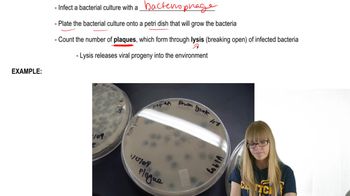
A plaque assay is a method used to quantify the number of infectious virus particles (bacteriophages) in a sample. Each plaque represents an area where a single phage infected and lysed bacterial cells, so counting plaques helps estimate the phage concentration.
To find the original concentration, multiply the number of plaques by the inverse of the dilution factor and the plated volume factor. This calculation accounts for the dilution steps and the volume plated, converting plaque counts back to the initial phage density.