A plaque assay is performed beginning with 1 mL of a solution containing bacteriophages. This solution is serially diluted three times by combining 0.1 mL of each sequential dilution with 9.9 mL of liquid medium. Then 0.1 mL of the final dilution is plated in the plaque assay and yields 17 plaques. What is the initial density of bacteriophages in the original 1 mL?
Ch. 8 - Genetic Analysis and Mapping in Bacteria and Bacteriophages
All textbooks
Klug 10th Edition
Ch. 8 - Genetic Analysis and Mapping in Bacteria and Bacteriophages
Problem 17
Klug 10th Edition
Ch. 8 - Genetic Analysis and Mapping in Bacteria and Bacteriophages
Problem 17Chapter 8, Problem 17
Explain the observations that led Zinder and Lederberg to conclude that the prototrophs recovered in their transduction experiments were not the result of F⁺ mediated conjugation.
Verified step by step guidance1
Understand the context: Zinder and Lederberg were studying genetic exchange in bacteria, specifically looking at how prototrophic bacteria (those able to grow without added nutrients) appeared after mixing auxotrophic strains (those requiring supplements). They wanted to determine whether this exchange was due to conjugation (F⁺ mediated) or another mechanism.
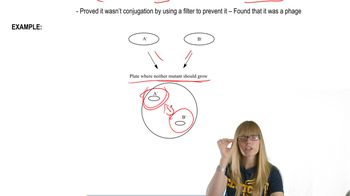
Recall the key observation: In their experiments, prototrophs appeared even when the donor and recipient bacteria were separated by a filter that prevented direct cell-to-cell contact but allowed passage of phage particles or small molecules.
Analyze the implication of the filter experiment: Since F⁺ mediated conjugation requires direct contact between bacterial cells to transfer genetic material, the appearance of prototrophs despite the physical barrier suggested that conjugation was not responsible for the genetic exchange.
Consider the role of bacteriophages: Zinder and Lederberg proposed that a virus (a bacteriophage) was mediating the transfer of genetic material between bacteria, a process now known as transduction. This explained how genetic material could move without direct cell contact.
Summarize the conclusion: The key evidence was that prototrophs were recovered even when conjugation was physically blocked, leading to the conclusion that the genetic exchange was mediated by a phage, not by F⁺ mediated conjugation.

Verified video answer for a similar problem:
This video solution was recommended by our tutors as helpful for the problem above.
Video duration:
1mWas this helpful?
Key Concepts
Here are the essential concepts you must grasp in order to answer the question correctly.
Bacterial Conjugation and F⁺ Factor
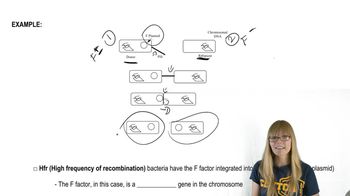
Bacterial conjugation is a process where genetic material is transferred between bacteria through direct contact, often mediated by the F⁺ plasmid. The F⁺ factor enables the donor cell to form a pilus and transfer DNA to an F⁻ recipient, typically resulting in specific gene transfer patterns. Understanding this mechanism is essential to distinguish conjugation from other gene transfer methods.
Recommended video:
Guided course
F Factor and Hfr
Transduction as a Mechanism of Gene Transfer
Transduction involves the transfer of bacterial DNA from one cell to another via bacteriophages (viruses that infect bacteria). Unlike conjugation, transduction does not require cell-to-cell contact and can transfer chromosomal genes accidentally packaged into phage particles. Recognizing transduction helps explain gene transfer events that occur independently of the F⁺ factor.
Recommended video:
Guided course
Transduction
Experimental Evidence Differentiating Transduction from Conjugation
Zinder and Lederberg observed that prototrophs appeared even when physical contact between donor and recipient cells was prevented, ruling out conjugation. Additionally, the transfer was sensitive to treatments affecting phages but not conjugation machinery. These observations indicated that gene transfer occurred via transduction, not F⁺ mediated conjugation.
Recommended video:
Guided course
Transduction
Related Practice
Textbook Question
889
views
Textbook Question
Define plaque, lysogeny, and prophage.
921
views
Textbook Question
If a single bacteriophage infects one E. coli cell present on a lawn of bacteria and, upon lysis, yields 200 viable viruses, how many phages will exist in a single plaque if three more lytic cycles occur?
1131
views
Textbook Question
If a single bacteriophage infects one E. coli cell present on a lawn of bacteria and, upon lysis, yields 200 viable viruses, how many phages will exist in a single plaque if three more lytic cycles occur?
650
views