Pearson+ LogoPearson+ Logo
Ch.20 Carbohydrates
McMurry - Fundamentals of GOB 8th Edition
McMurry8th EditionFundamentals of GOBISBN: 9780134015187Not the one you use?Change textbook
Chapter 20, Problem 2b

Draw the structures of a ketohexose.

Verified step by step guidance
1
Understand the terms: An aldopentose is a monosaccharide with five carbon atoms (pentose) and an aldehyde functional group (-CHO). A ketohexose is a monosaccharide with six carbon atoms (hexose) and a ketone functional group (C=O).
For the aldopentose, start by drawing a chain of five carbon atoms. Place the aldehyde group (-CHO) at the first carbon (C1) and hydroxyl groups (-OH) on the remaining carbons, ensuring the correct stereochemistry for a specific aldopentose (e.g., D-ribose or D-arabinose).
For the ketohexose, draw a chain of six carbon atoms. Place the ketone group (C=O) at the second carbon (C2) and hydroxyl groups (-OH) on the remaining carbons, ensuring the correct stereochemistry for a specific ketohexose (e.g., D-fructose).
Label the carbons in both structures sequentially, starting from the carbon with the functional group (aldehyde or ketone). This helps in identifying the positions of the functional groups and hydroxyl groups.
Verify the structures by checking that the aldopentose has five carbons with an aldehyde group and the ketohexose has six carbons with a ketone group. Ensure the stereochemistry matches the specific sugar you are drawing.

Verified video answer for a similar problem:

This video solution was recommended by our tutors as helpful for the problem above.
Video duration:
1m
Was this helpful?

Key Concepts

Here are the essential concepts you must grasp in order to answer the question correctly.

Aldopentose

An aldopentose is a five-carbon sugar (pentose) that contains an aldehyde group (-CHO) at one end. This structure is characterized by the presence of four hydroxyl groups (-OH) attached to the carbon atoms, which can exist in linear and cyclic forms. Common examples include ribose and arabinose, which play crucial roles in biological processes such as RNA structure.

Ketohexose

A ketohexose is a six-carbon sugar (hexose) that features a ketone group (C=O) typically located at the second carbon atom. This structure includes five hydroxyl groups and can also exist in both linear and cyclic forms. Fructose is a well-known example of a ketohexose, and it is significant in metabolism and energy production.

Structural Representation

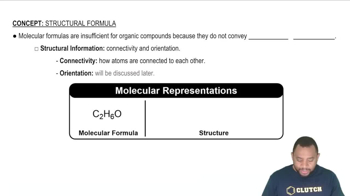
Structural representation refers to the way chemical compounds are depicted, illustrating the arrangement of atoms and the bonds between them. For carbohydrates like aldopentoses and ketohexoses, this can include Fischer projections for linear forms and Haworth projections for cyclic forms. Understanding these representations is essential for visualizing molecular interactions and reactivity.
Recommended video:
Guided course
2:08
Molecular Representations Concept 1