Pearson+ LogoPearson+ Logo
Ch.20 Carbohydrates
McMurry - Fundamentals of GOB 8th Edition
McMurry8th EditionFundamentals of GOBISBN: 9780134015187Not the one you use?Change textbook
Chapter 20, Problem 6a

Draw the enantiomer of the following monosaccharides, and in each pair identify the D sugar and the L sugar.
a. Structural diagram of a monosaccharide showing its enantiomer pairs, with labels for D and L sugars.

Verified step by step guidance
1
Step 1: Understand the concept of enantiomers. Enantiomers are stereoisomers that are non-superimposable mirror images of each other. In the context of monosaccharides, this involves flipping the configuration of all chiral centers in the molecule.
Step 2: Analyze the given monosaccharide structure. Identify all the chiral centers (carbon atoms bonded to four different groups) in the molecule. Note the orientation (D or L) of each chiral center based on the Fischer projection.
Step 3: To draw the enantiomer, reverse the configuration of each chiral center. For example, if a hydroxyl group (-OH) is on the right side of a chiral carbon in the Fischer projection, place it on the left side in the enantiomer, and vice versa.
Step 4: Determine the D or L designation for each sugar. In Fischer projections, the D or L designation is based on the position of the hydroxyl group on the chiral carbon furthest from the carbonyl group (C=O). If the hydroxyl group is on the right, it is a D-sugar; if it is on the left, it is an L-sugar.
Step 5: Compare the original monosaccharide and its enantiomer. Label the original structure and its enantiomer as D or L sugars based on the criteria in Step 4. Ensure the mirror-image relationship is clear in your drawings.

Verified video answer for a similar problem:

This video solution was recommended by our tutors as helpful for the problem above.
Video duration:
2m
Was this helpful?

Key Concepts

Here are the essential concepts you must grasp in order to answer the question correctly.

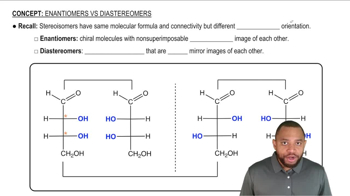
Enantiomers

Enantiomers are a type of stereoisomer that are non-superimposable mirror images of each other. They occur in molecules that have chiral centers, which are carbon atoms bonded to four different groups. In the context of monosaccharides, enantiomers can differ in the configuration around one or more chiral centers, leading to distinct biological properties.
Recommended video:
Guided course
3:33
Enantiomers vs Diastereomers Concept 1

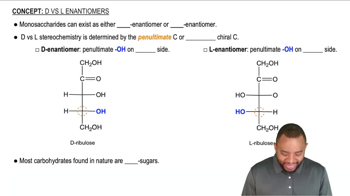
D and L Configuration

The D and L notation is used to designate the configuration of monosaccharides based on the orientation of the hydroxyl (-OH) group on the penultimate carbon (the second to last carbon). If the -OH group is on the right in a Fischer projection, the sugar is classified as D; if it is on the left, it is classified as L. This classification is crucial for understanding the sugar's reactivity and biological function.
Recommended video:
Guided course
1:30
D vs L Enantiomers Concept 1

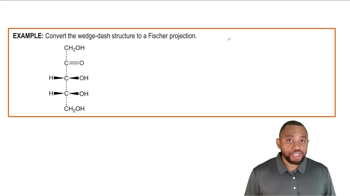
Fischer Projection

A Fischer projection is a two-dimensional representation of a three-dimensional organic molecule, particularly useful for depicting the stereochemistry of sugars and amino acids. In this format, vertical lines represent bonds that go back into the plane, while horizontal lines represent bonds that come out of the plane. Understanding Fischer projections is essential for visualizing the spatial arrangement of atoms in monosaccharides and determining their enantiomers.
Recommended video:
Guided course
0:48
Fischer Projections Example 1