Pearson+ LogoPearson+ Logo
Ch.20 Carbohydrates
McMurry - Fundamentals of GOB 8th Edition
McMurry8th EditionFundamentals of GOBISBN: 9780134015187Not the one you use?Change textbook
Chapter 20, Problem 5

Aldoheptoses have five chiral carbon atoms. What is the maximum possible number of aldoheptose stereoisomers? Draw all of the aldoheptose stereoisomers.

Verified step by step guidance
1
Step 1: Recall that the number of stereoisomers for a molecule with chiral centers can be determined using the formula 2^n, where n is the number of chiral carbon atoms. In this case, there are 5 chiral carbons in aldoheptoses.
Step 2: Apply the formula 2^n to calculate the maximum number of stereoisomers. Substitute n = 5 into the formula: 2^5.
Step 3: Understand that the result from the formula represents the total number of stereoisomers, which includes both D- and L- configurations for each stereoisomer.
Step 4: To draw all stereoisomers, systematically vary the configuration (R or S) of each of the 5 chiral carbons. Start with one configuration (e.g., all R) and then change one chiral center at a time to generate all possible combinations.
Step 5: Organize the stereoisomers into two groups: D-aldoheptoses and L-aldoheptoses, based on the configuration of the highest numbered chiral carbon (D if the hydroxyl group is on the right in a Fischer projection, L if it is on the left).

Verified video answer for a similar problem:

This video solution was recommended by our tutors as helpful for the problem above.
Video duration:
5m
Was this helpful?

Key Concepts

Here are the essential concepts you must grasp in order to answer the question correctly.

Chirality

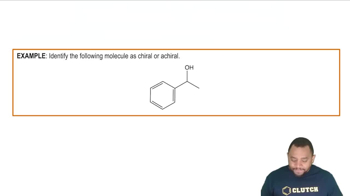
Chirality refers to the geometric property of a molecule having non-superimposable mirror images, much like left and right hands. In organic chemistry, chiral centers are typically carbon atoms bonded to four different substituents. The presence of chiral centers in a molecule leads to the existence of stereoisomers, which are compounds that differ in the spatial arrangement of atoms.
Recommended video:
Guided course
1:39
Chirality Example 1

Stereoisomers

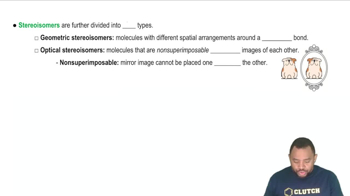
Stereoisomers are compounds that have the same molecular formula and connectivity of atoms but differ in the arrangement of their atoms in space. The number of stereoisomers for a compound can be calculated using the formula 2^n, where n is the number of chiral centers. For aldoheptoses, with five chiral centers, this results in a maximum of 32 stereoisomers.
Recommended video:
Guided course
1:56
Stereoisomers Concept 2

Aldoheptose Structure

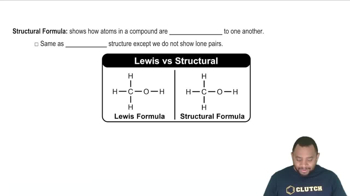
Aldoheptoses are a type of monosaccharide with seven carbon atoms and an aldehyde group at one end. The structure of aldoheptoses includes a chain of carbon atoms, with hydroxyl groups (-OH) attached to several of them. Understanding the basic structure of aldoheptoses is essential for visualizing and drawing their stereoisomers, as the arrangement of hydroxyl groups around the chiral centers determines the specific stereoisomer.
Recommended video:
Guided course
1:01
Structural Formula Concept 2