GOB Chemistry
My Course
Learn
Exam Prep
AI Tutor
Study Guides
Textbook Solutions
Flashcards
Explore
Try the app
My Course
Learn
Exam Prep
AI Tutor
Study Guides
Textbook Solutions
Flashcards
Explore
Try the app
Back
Acid-Base Equivalents quiz
You can tap to flip the card.
What does one equivalent represent in acids and bases?
You can tap to flip the card.
👆
What does one equivalent represent in acids and bases?
One equivalent represents 1 mole of H+ ions for acids or 1 mole of OH- ions for bases.
Track progress
Control buttons has been changed to "navigation" mode.
1/15
Related flashcards
Related practice
Recommended videos
Acid-Base Equivalents definitions
Acid-Base Equivalents
13 Terms
Acid-Base Equivalents
10. Acids and Bases
3 problems
Topic

Jules
Acid-Base Reactions
10. Acids and Bases
5 problems
Topic
Jules
10. Acids and Bases - Part 1 of 2
6 topics
13 problems
Chapter
Jules
10. Acids and Bases - Part 2 of 2
8 topics
13 problems
Chapter
Jules
Guided course
00:23
Acid-Base Equivalents Concept 3
2676
views
1
rank
Guided course
02:23
Acid-Base Equivalents Example 3
2135
views
Guided course
00:57
Acid-Base Equivalents Concept 1
2887
views
2
rank
Terms in this set (15)
Hide definitions
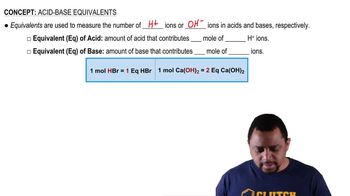
What does one equivalent represent in acids and bases?
One equivalent represents 1 mole of H+ ions for acids or 1 mole of OH- ions for bases.
How do you calculate the number of equivalents for an acid or base?
Multiply the number of moles of the acid or base by the number of H+ or OH- ions it contributes.
What is the equivalent of 1 mole of hydrobromic acid (HBr)?
It is 1 equivalent because HBr provides 1 H+ ion per molecule.
How many equivalents are in 1 mole of calcium hydroxide (Ca(OH)2)?
There are 2 equivalents because Ca(OH)2 provides 2 OH- ions per molecule.
What is the formula for calculating equivalents in acids?
Equivalents = n (number of H+ ions) × moles of acid.
What is the formula for calculating equivalents in bases?
Equivalents = n (number of OH- ions) × moles of base.
How many milliequivalents are in one equivalent?
One equivalent equals 1,000 milliequivalents.
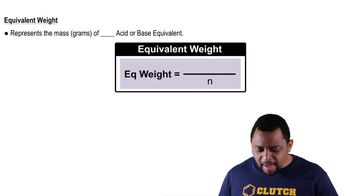
What does equivalent weight represent?
Equivalent weight is the mass in grams of one acid or base equivalent.
How do you calculate equivalent weight?
Equivalent weight = molar mass of acid or base divided by n (number of H+ or OH- ions).
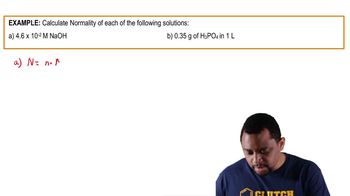
What is normality in the context of acid-base solutions?
Normality is the concentration of acid or base, measured as the number of equivalents per liter of solution.
How is molarity defined?
Molarity is the number of moles of solute per liter of solution.
What is the formula for normality?
Normality = n (number of H+ or OH- ions) × molarity (M).
For acids, what does 'n' represent in calculations?
'n' represents the number of H+ ions contributed by the acid.
For bases, what does 'n' represent in calculations?
'n' represents the number of OH- ions contributed by the base.
Why is the concept of equivalents important in acid-base chemistry?
It allows for accurate measurement and comparison of acid and base strength based on the number of reactive ions they provide.