GOB Chemistry
My Course
Learn
Exam Prep
AI Tutor
Study Guides
Textbook Solutions
Flashcards
Explore
My Course
Learn
Exam Prep
AI Tutor
Study Guides
Textbook Solutions
Flashcards
Explore
Back
Acid-Base Introduction quiz
You can tap to flip the card.
Define:
What type of compounds are acids typically, and what do they contain?
You can tap to flip the card.
👆
What type of compounds are acids typically, and what do they contain?
Acids are covalent compounds that contain a hydrogen ion connected to a nonmetal or a polyatomic ion.
Track progress
Control buttons has been changed to "navigation" mode.
1/15
Related flashcards
Related practice
Recommended videos
Acid-Base Introduction definitions
Acid-Base Introduction
15 Terms
Acid-Base Introduction
10. Acids and Bases
7 problems
Topic

Jules
Arrhenius Acid and Base
10. Acids and Bases
3 problems
Topic
Jules
10. Acids and Bases - Part 1 of 2
6 topics
13 problems
Chapter
Jules
10. Acids and Bases - Part 2 of 2
8 topics
13 problems
Chapter
Jules
Guided course
00:40
Acid-Base Introduction Concept 1
Jules
4511
views
29
rank
Guided course
00:54
Acid-Base Introduction Example 1
Jules
4091
views
23
rank
Guided course
01:59
Acid-Base Introduction Concept 2
Jules
4093
views
12
rank
Terms in this set (15)
Hide definitions
What type of compounds are acids typically, and what do they contain?
Acids are covalent compounds that contain a hydrogen ion connected to a nonmetal or a polyatomic ion.
Where is the hydrogen ion usually found in acid formulas, and what is the exception?
The hydrogen ion is usually at the beginning of the acid formula, except in acetic acid where it is at the end.
What happens to acids when they are placed in water?
Acids ionize in water, breaking up into hydrogen ions (H+) and their corresponding anions.
What taste is characteristic of acids, and what causes it?
Acids have a sour taste, which is due to the presence of H+ ions.
How do acids react with metals?
Acids react with metals to produce hydrogen gas (H2).
What color change occurs when blue litmus paper is dipped in an acid?
Blue litmus paper turns red when dipped in an acidic solution.
What are bases primarily composed of?
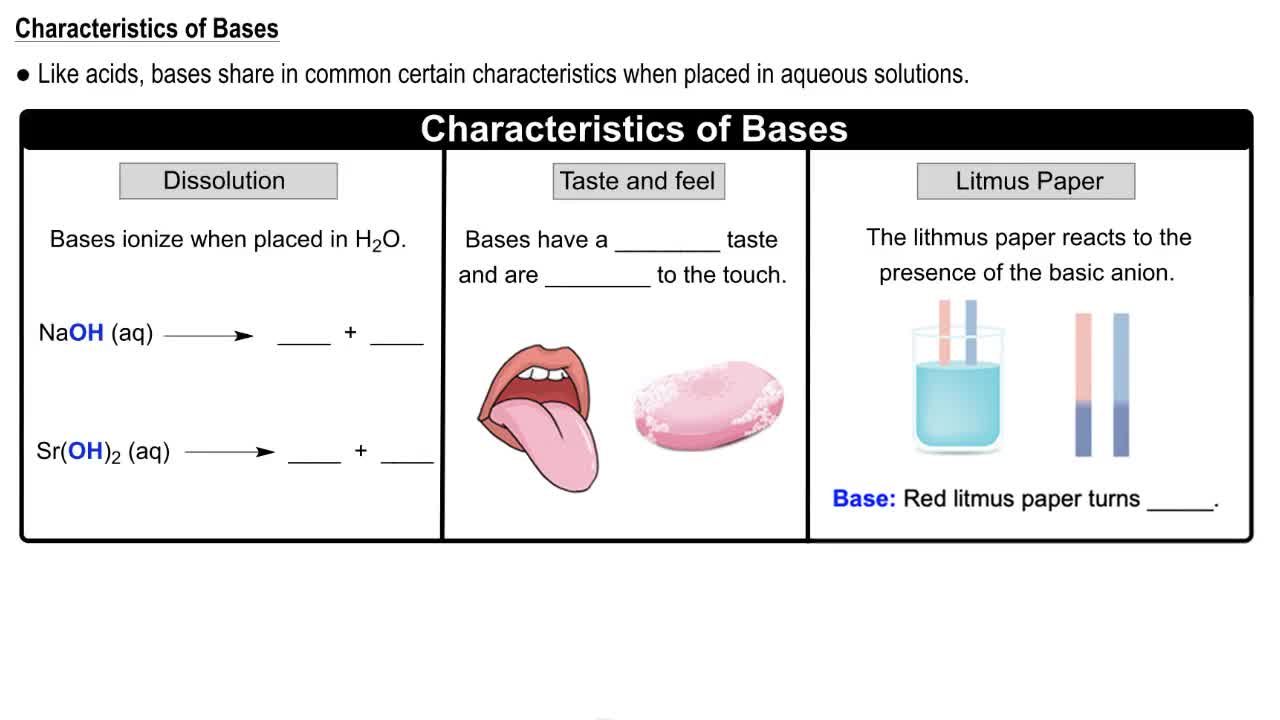
Bases are primarily ionic compounds containing a metal cation and a hydroxide ion (OH-).
What is another type of base besides those with metal cations and hydroxide ions?
Bases can also be nitrogen-containing covalent compounds called amines.
What happens to bases when they are placed in water?
Bases ionize in water, producing metal cations and hydroxide ions (OH-).
What taste and feel are characteristic of bases?
Bases have a bitter taste and feel slippery to the touch.
What common household product demonstrates the slippery feel of bases?
Soaps, which are often basic, feel slippery when wet.
What color change occurs when red litmus paper is dipped in a base?
Red litmus paper turns blue when dipped in a basic solution.
What is a simple way to identify a base from its chemical formula?
A base often has a metal ion connected to a hydroxide ion (OH-).
What is the relationship between the presence of H+ ions and the taste of acids?
The presence of H+ ions in acids gives them their characteristic sour taste.
How can you remember the color change for bases with litmus paper?
Both 'base' and 'blue' start with 'b', so bases turn red litmus paper blue.