Back

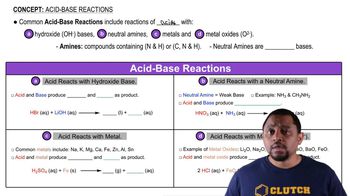
Acid-Base Reactions definitions

Control buttons has been changed to "navigation" mode.
1/15
  • Hydroxide Base

    A substance containing OH− ions that reacts with acids to form water and an ionic compound.
  • Neutral Amine

    A weak base composed of nitrogen and hydrogen, or carbon, nitrogen, and hydrogen, that forms salts with acids.
  • Salt

    An ionic compound produced when acids react with bases, amines, metals, or metal oxides.
  • Ionic Compound

    A substance formed from the electrostatic attraction between cations and anions, often as a product in acid-base reactions.
  • Ammonia

    A neutral amine with the formula NH3, consisting of nitrogen and hydrogen, that forms salts with acids.
  • Methylamine

    A neutral amine containing carbon, nitrogen, and hydrogen, capable of reacting with acids to yield salts.
  • Hydrogen Gas

    A diatomic molecule (H2) released when acids react with certain metals, often observed as bubbles.
  • Metal Oxide

    A compound composed of metal and oxygen that reacts with acids to produce water and a salt.
  • Pattern Recognition

    A skill involving identification of reaction types based on the compounds involved and the products formed.
  • Cation

    A positively charged ion, often derived from metals or bases, that combines with anions to form salts.
  • Anion

    A negatively charged ion, typically from acids or bases, that pairs with cations to create ionic compounds.
  • Water

    A liquid product formed when H+ from an acid combines with OH− from a base or metal oxide.
  • Ammonium Nitrate

    A salt formed from the reaction of nitric acid with ammonia, consisting of ammonium and nitrate ions.
  • Iron(II) Sulfate

    A salt produced when sulfuric acid reacts with iron, containing iron(II) and sulfate ions.
  • Iron(II) Chloride

    A salt generated from the reaction of an acid with iron(II) oxide, composed of iron(II) and chloride ions.