GOB Chemistry
My Course
Learn
Exam Prep
AI Tutor
Study Guides
Textbook Solutions
Flashcards
Explore
My Course
Learn
Exam Prep
AI Tutor
Study Guides
Textbook Solutions
Flashcards
Explore
Back
Alkane Reactions definitions
You can tap to flip the card.
Define:
Alkane
You can tap to
flip the card.
👆
Alkane
A hydrocarbon with only single bonds, known for its low reactivity and saturated structure.
Track progress
Control buttons has been changed to "navigation" mode.
1/13
Related practice
Recommended videos
Guided course
2:25
Common Types of Alkane Reactions Concept 1
Jules
1977
views
7
rank
Guided course
2:15
Alkane Reactions Example 1
Jules
1810
views
6
rank
Terms in this set (13)
Hide definitions
Alkane
A hydrocarbon with only single bonds, known for its low reactivity and saturated structure.
Hydrocarbon
A compound composed solely of hydrogen and carbon atoms, forming the basis of organic chemistry.
Combustion
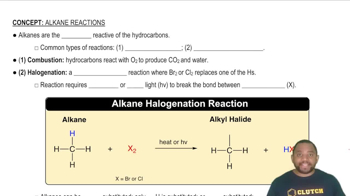
A reaction with oxygen producing carbon dioxide and water, releasing energy as heat and light.
Halogenation
A substitution process where a halogen atom replaces a hydrogen atom on a saturated hydrocarbon.
Substitution Reaction
A chemical process where one atom or group in a molecule is replaced by another atom or group.
Halogen
An element from Group 17, such as chlorine or bromine, capable of replacing hydrogen in organic molecules.
Ultraviolet Light
A form of electromagnetic radiation used to initiate certain chemical reactions, often abbreviated as HV.
Alkyl Halide
A compound formed when a halogen atom is bonded to an alkyl group, resulting from halogenation.
Mono-substitution
A process where only one hydrogen atom in a molecule is replaced by another atom or group.
Poly-substitution
A process where multiple hydrogen atoms in a molecule are replaced by other atoms or groups.
Diatomic Molecule
A molecule consisting of two atoms, such as Cl2 or Br2, often involved in halogenation.
Methane
The simplest alkane, consisting of one carbon atom bonded to four hydrogens.
Product
A substance formed as a result of a chemical reaction, such as carbon dioxide, water, or alkyl halide.