Back

Amide Hydrolysis quiz

Control buttons has been changed to "navigation" mode.
1/15
  • What are the products of acidic hydrolysis of an amide?

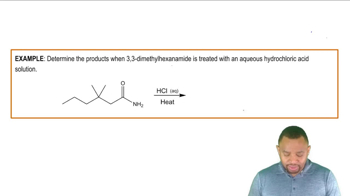
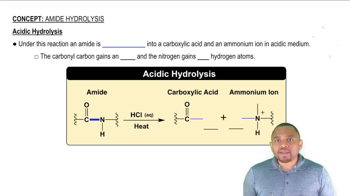
    Acidic hydrolysis produces a carboxylic acid and an ammonium ion.
  • What reagent is commonly used for acidic hydrolysis of amides?

    Aqueous acid, such as hydrochloric acid dissolved in water, is used.
  • What happens to the carbonyl carbon during acidic hydrolysis of an amide?

    The carbonyl carbon gains an OH group, transforming into a carboxylic acid.
  • How does the nitrogen atom change during acidic hydrolysis of an amide?

    The nitrogen gains two hydrogen atoms and becomes an ammonium ion with a positive charge.
  • What is the charge on the nitrogen after acidic hydrolysis?

    The nitrogen becomes positively charged as an ammonium ion.
  • What is the role of heat in amide hydrolysis reactions?

    Heat is used to facilitate the hydrolysis reaction, whether acidic or basic.
  • What are the products of basic hydrolysis of an amide?

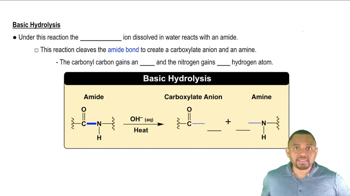
    Basic hydrolysis produces a carboxylate anion and a neutral amine.
  • What reagent is used for basic hydrolysis of amides?

    Aqueous hydroxide ions (OH-) dissolved in water are used.
  • What happens to the carbonyl carbon during basic hydrolysis of an amide?

    The carbonyl carbon gains an O- group, forming a carboxylate anion.
  • How does the nitrogen atom change during basic hydrolysis of an amide?

    The nitrogen gains one hydrogen atom, resulting in a neutral amine.
  • What is the difference in the nitrogen product between acidic and basic hydrolysis?

    Acidic hydrolysis forms an ammonium ion, while basic hydrolysis forms a neutral amine.
  • What is a carboxylate anion in the context of amide hydrolysis?

    It is the conjugate base of a carboxylic acid, formed in basic hydrolysis.
  • Why does the carboxylate anion have an O- group instead of an OH group?

    Because it is the conjugate base, the OH group loses a proton, resulting in O-.
  • What bond is cleaved during both acidic and basic hydrolysis of amides?

    The amide bond connecting the nitrogen to the carbonyl group is cleaved.
  • What is the main difference in products between acidic and basic hydrolysis of amides?

    Acidic hydrolysis yields a carboxylic acid and ammonium ion, while basic hydrolysis yields a carboxylate anion and neutral amine.