Back

Amino Acid One Letter Codes quiz

Control buttons has been changed to "navigation" mode.
1/15
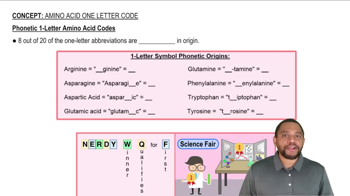
  • How many amino acids have phonetic one-letter codes, and what does 'phonetic' mean in this context?

    Eight amino acids have phonetic one-letter codes, meaning the code is based on how the amino acid's name sounds when pronounced.
  • What is the one-letter code for Arginine and why?

    The one-letter code for Arginine is 'R' because the pronunciation of 'Arginine' emphasizes the 'R' sound.
  • Which amino acid uses 'N' as its one-letter code and what is the reasoning?

    Asparagine uses 'N' as its one-letter code because the 'n' sound in 'gene' is prominent in its pronunciation.
  • Why is 'D' the one-letter code for Aspartic acid?

    'D' is used because some pronunciations of Aspartic acid sound like 'aspar-dic,' emphasizing the 'd' sound.
  • What mnemonic helps remember the 8 phonetic one-letter codes?

    The mnemonic is 'nerdy wqforf,' which stands for 'nerdy winner qualifies for first.'
  • Which amino acid has 'Q' as its one-letter code and what is the phonetic link?

    Glutamine has 'Q' as its code because 'Glutamine' sounds similar to 'cutamine,' linking to the letter 'Q.'
  • How is the one-letter code for Tryptophan ('W') remembered?

    It's remembered by imagining Bugs Bunny pronouncing 'Tryptophan' as 'Twiptophan,' emphasizing the 'W' sound.
  • What is the one-letter code for Tyrosine and what is the mnemonic connection?

    Tyrosine's code is 'Y,' remembered by associating 'tie' with 'Y.'
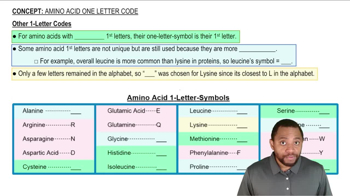
  • What rule is used for amino acids with unique first letters?

    Amino acids with unique first letters use that letter as their one-letter code.
  • Give two examples of amino acids that use their unique first letter as their one-letter code.

    Cysteine uses 'C' and Histidine uses 'H' as their one-letter codes.
  • How is the one-letter code determined when two amino acids share the same initial letter?

    The more common amino acid in proteins keeps the letter; for example, Leucine gets 'L' over Lysine.
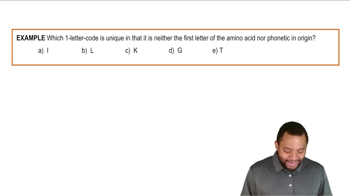
  • What is the one-letter code for Lysine and why was it chosen?

    Lysine's code is 'K' because 'L' is taken by Leucine and 'M' is used for Methionine, so 'K' is the next available letter.
  • Which amino acids use their first letter as their one-letter code due to being the most common with that letter?

    Alanine ('A'), Glycine ('G'), Proline ('P'), and Threonine ('T') use their first letter because they are the most common with that initial.
  • How many total amino acids are there, and how are their one-letter codes generally assigned?

    There are 20 amino acids; 8 use phonetic codes, some use their unique first letter, some use the most common initial, and Lysine uses 'K.'
  • What are the three main categories for assigning one-letter codes to amino acids (excluding phonetic ones)?

    The categories are: unique first letter, most common with that letter, and special assignment (like Lysine's 'K').