Back

Atomic Mass (Conceptual) quiz

Control buttons has been changed to "navigation" mode.
1/15
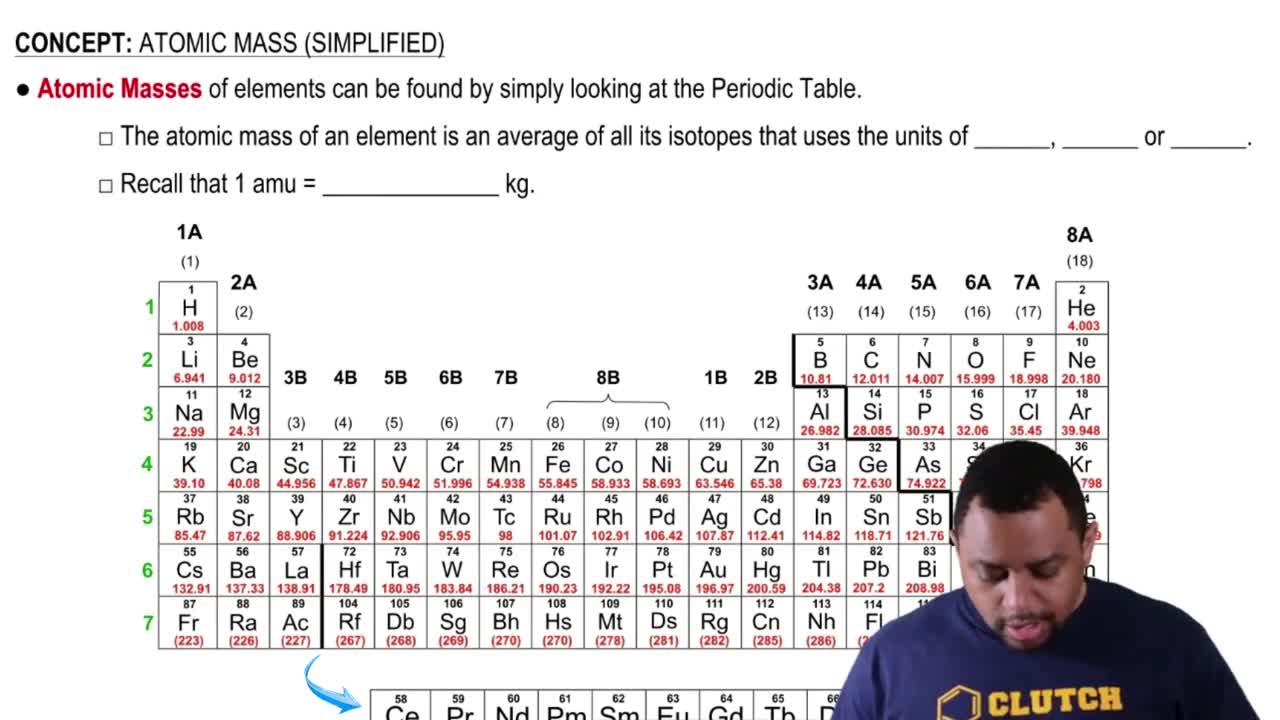
  • What does the atomic mass listed on the periodic table represent?

    It represents the average mass of all the isotopes of an element.
  • Why are atomic masses on the periodic table usually not whole numbers?

    Because they are weighted averages of the masses of all naturally occurring isotopes of the element.
  • What is the unit commonly used for atomic mass?

    Atomic mass is commonly measured in atomic mass units (AMU), grams per mole, or Daltons.
  • How much does 1 AMU weigh in kilograms?

    1 AMU is equal to 1.66 x 10^-27 kilograms.
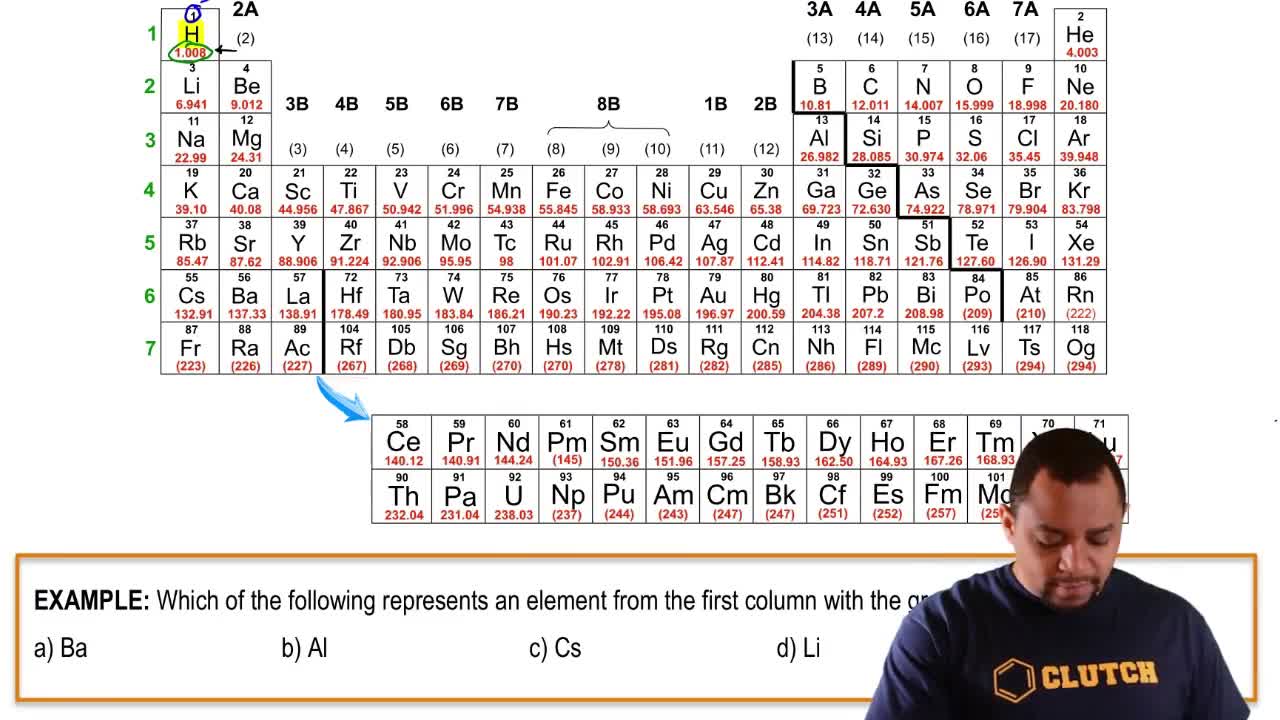
  • How can you find the atomic mass of an element?

    You can find it by looking it up on the periodic table.
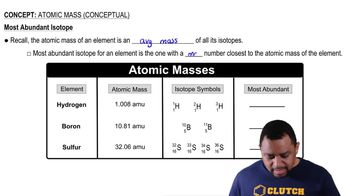
  • What is the most abundant isotope of an element?

    It is the isotope whose mass number is closest to the atomic mass of the element.
  • What does the mass number of an isotope represent?

    It represents the total number of protons and neutrons in the isotope.
  • Which isotope of hydrogen is the most abundant?

    Hydrogen-1 is the most abundant isotope because its mass number (1) is closest to the atomic mass of 1.008 amu.
  • What are the names of hydrogen isotopes with mass numbers 2 and 3?

    Hydrogen-2 is called deuterium, and hydrogen-3 is called tritium.
  • What is the atomic mass of boron according to the periodic table?

    The atomic mass of boron is 10.81 amu.
  • Which isotope of boron is the most abundant and why?

    Boron-11 is the most abundant because its mass number (11) is closest to the atomic mass of 10.81 amu.
  • What is the atomic mass of sulfur as listed on the periodic table?

    The atomic mass of sulfur is about 32.06 or 32.07 amu, depending on the periodic table.
  • Which isotope of sulfur is the most abundant?

    Sulfur-32 is the most abundant isotope because its mass number (32) is closest to the atomic mass.
  • How do you determine the most abundant isotope of an element?

    Compare the atomic mass of the element to the mass numbers of its isotopes; the closest one is the most abundant.
  • Why might the atomic mass of an element differ slightly between periodic tables?

    Because different tables may round the average atomic mass slightly differently, such as 32.06 or 32.07 for sulfur.