Back

Balancing Chemical Equations (Simplified) quiz

Control buttons has been changed to "navigation" mode.
1/15
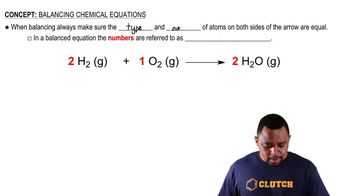
  • What must be equal on both sides of a chemical equation for it to be balanced?

    The type and number of atoms must be equal on both sides of the equation.
  • What are the numbers in red called in a balanced chemical equation?

    They are called coefficients.
  • How do coefficients affect the number of atoms in a chemical equation?

    Coefficients are multiplied by the number of atoms in each molecule to adjust the total count.
  • What is the coefficient for hydrogen in the example provided?

    The coefficient for hydrogen is 2.
  • How many hydrogens are there after distributing the coefficient in the example?

    There are 4 hydrogens after distributing the coefficient.
  • What is the coefficient for oxygen in the example equation?

    The coefficient for oxygen is 1.
  • How many oxygens are there after distributing the coefficient in the example?

    There are 2 oxygens after distributing the coefficient.
  • What operation is used to distribute coefficients to atoms?

    Multiplication is used to distribute coefficients to atoms.
  • Why is it important to match both the type and number of atoms on each side?

    Matching both ensures the chemical equation is balanced and follows the law of conservation of mass.
  • What does the arrow in a chemical equation represent?

    The arrow separates the reactants from the products.
  • What happens if the numbers of atoms are not equal on both sides of the equation?

    The equation is not balanced and does not accurately represent the reaction.
  • How do you check if a chemical equation is balanced?

    Count the type and number of atoms on both sides and ensure they are equal.
  • What is the result of multiplying the coefficient 2 by the 2 hydrogens in the example?

    Multiplying gives 4 hydrogens.
  • What is the result of multiplying the coefficient 2 by the 1 oxygen in the example?

    Multiplying gives 2 oxygens.
  • What will the next video in the series focus on?

    It will refine the approach to balancing chemical equations further.