Skip to main content
GOB Chemistry
My Course
Learn
Exam Prep
AI Tutor
Study Guides
Textbook Solutions
Flashcards
Explore
Try the app
My Course
Learn
Exam Prep
AI Tutor
Study Guides
Textbook Solutions
Flashcards
Explore
Try the app
Back
Benzene Reaction: Nitration definitions
You can tap to flip the card.
Benzene
You can tap to flip the card.
👆
Benzene
A six-carbon aromatic ring with alternating double bonds, serving as the starting material in nitration reactions.
Track progress
Control buttons has been changed to "navigation" mode.
1/13
Related flashcards
Related practice
Recommended videos
Benzene Reaction: Nitration quiz
Benzene Reaction: Nitration
15 Terms
13. Alkenes, Alkynes, and Aromatic Compounds - Part 1 of 3
6 topics
15 problems
Chapter
Jules
13. Alkenes, Alkynes, and Aromatic Compounds - Part 2 of 3
7 topics
15 problems
Chapter
Jules
13. Alkenes, Alkynes, and Aromatic Compounds - Part 3 of 3
2 topics
1 problem
Chapter
Guided course
3:19
Benzene Reaction: Nitration Example 1
57
views
Guided course
1:35
Benzene Reaction: Nitration Concept 1
59
views
Terms in this set (13)
Hide definitions
Benzene
A six-carbon aromatic ring with alternating double bonds, serving as the starting material in nitration reactions.
Nitration
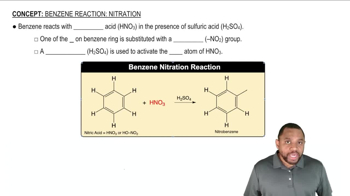
A process where an aromatic ring undergoes substitution, introducing a nitro group in place of a hydrogen atom.
Nitro Group
A functional group consisting of NO2, commonly attached to aromatic rings during substitution reactions.
Nitrobenzene
An aromatic compound formed when a nitro group replaces a hydrogen atom on benzene.
Nitric Acid
A reagent with the formula HNO3, providing the nitro group for aromatic substitution.
Sulfuric Acid
A strong acid used as a catalyst to activate nitric acid and facilitate the formation of the nitronium ion.
Catalyst
A substance that increases reaction rate by lowering activation energy, without being consumed in the process.
Electrophile
A species attracted to electron-rich regions, such as the nitronium ion in aromatic substitution.
Nitronium Ion
A highly reactive NO2+ species generated from nitric acid, responsible for attacking the benzene ring.
Aromatic Ring
A cyclic structure with delocalized electrons, characteristic of benzene and its derivatives.
Substitution Reaction
A chemical process where one atom or group on a molecule is replaced by another, as seen in benzene nitration.
Activation Energy
The minimum energy required for a chemical reaction to proceed, reduced by catalysts in nitration.
Functional Group
A specific group of atoms within a molecule that determines its chemical properties, such as the nitro group.
 BackBack
 3:19
3:19