Back

Bohr Model (Simplified) definitions

Control buttons has been changed to "navigation" mode.
1/15
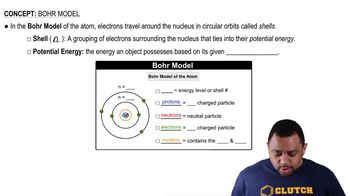
  • Bohr Model

    A representation of the atom where electrons occupy fixed circular paths, each linked to specific energy levels.
  • Electron

    A negatively charged subatomic particle found in shells around the nucleus, responsible for energy transitions.
  • Nucleus

    The dense central region of an atom containing protons and neutrons, around which electrons orbit.
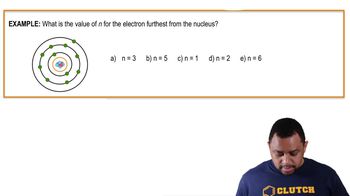
  • Shell

    A circular path or energy level where electrons are grouped, each identified by a quantum number.
  • Quantum Number

    A value, often denoted as 'n', that specifies the shell or energy level an electron occupies.
  • Potential Energy

    The stored energy of an electron determined by its position within a specific shell.
  • Proton

    A positively charged particle located in the nucleus, contributing to the atom's identity.
  • Neutron

    An uncharged particle found in the nucleus, adding to atomic mass but not affecting charge.
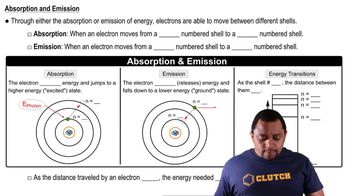
  • Absorption

    A process where an electron gains energy, allowing it to move to a higher shell or excited state.
  • Emission

    A process where an electron releases energy, causing it to return to a lower shell or ground state.
  • Photon

    A packet of energy that can be absorbed by an electron, enabling transitions between shells.
  • Excited State

    A condition where an electron occupies a higher shell after absorbing energy.
  • Ground State

    The lowest energy configuration of an electron, typically in the closest shell to the nucleus.
  • Energy Transition

    A change in an electron's energy level, involving movement between shells and exchange of energy.
  • Energy Level

    A discrete value of potential energy associated with a specific shell in the atom.