Back

Bohr Model (Simplified) quiz

Control buttons has been changed to "navigation" mode.
1/15
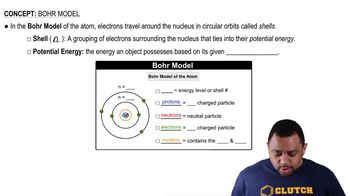
  • What does the Bohr model describe about electron movement in an atom?

    The Bohr model describes electrons traveling in circular orbits, called shells, around the nucleus.
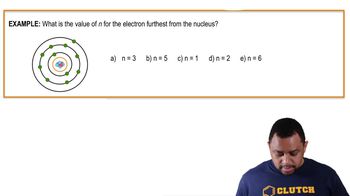
  • What variable is used to represent the shell number in the Bohr model?

    The variable 'n' is used to represent the shell number in the Bohr model.
  • How many electrons can the first shell (n=1) hold according to the Bohr model?

    The first shell (n=1) can hold 2 electrons.
  • How many electrons are found in the second shell (n=2) in the example given?

    The second shell (n=2) contains 3 electrons in the example.
  • What particles are found in the nucleus of an atom?

    Protons and neutrons are found in the nucleus of an atom.
  • What is the charge of an electron?

    An electron has a negative charge.
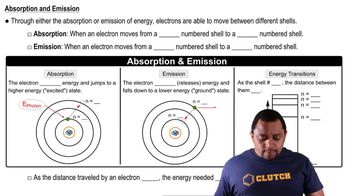
  • What happens during absorption in the Bohr model?

    During absorption, an electron absorbs energy and moves from a lower shell to a higher shell.
  • What is emission in the context of the Bohr model?

    Emission is when an electron releases energy and moves from a higher shell to a lower shell.
  • What is the ground state of an electron?

    The ground state is the original, lowest energy shell where the electron is normally found.
  • What is an excited state for an electron?

    An excited state is when an electron is in a higher energy shell after absorbing energy.
  • How does the energy required for an electron to move between shells change with distance?

    The energy required increases with the distance between the shells; greater distance means more energy is needed.
  • As the shell number increases, what happens to the distance between successive shells?

    As the shell number increases, the distance between successive shells decreases.
  • Is it easier for an electron to move from shell 6 to 7 or from shell 1 to 2?

    It is easier for an electron to move from shell 6 to 7 because the distance and energy required are less.
  • What is the relationship between distance traveled by an electron and energy required?

    The greater the distance an electron travels between shells, the more energy is required.
  • What external source can provide energy for electron absorption?

    An energetic photon can provide the energy needed for electron absorption.