GOB Chemistry
My Course
Learn
Exam Prep
AI Tutor
Study Guides
Textbook Solutions
Flashcards
Explore
My Course
Learn
Exam Prep
AI Tutor
Study Guides
Textbook Solutions
Flashcards
Explore
Back
Cyclic Hemiacetals definitions
You can tap to flip the card.
Define:
Aldehyde
You can tap to
flip the card.
👆
Aldehyde
A molecule featuring a carbonyl group bonded to at least one hydrogen, serving as a key reactant in hemiacetal formation.
Track progress
Control buttons has been changed to "navigation" mode.
1/15
Related practice
Recommended videos
Guided course
2:10
Cyclic Hemiacetals Concept 1
Jules
1459
views
2
rank
Guided course
2:55
Cyclic Hemiacetals Concept 2
Jules
1191
views
2
rank
Guided course
1:21
Cyclic Hemiacetals Example 1
Jules
1279
views
4
rank
Terms in this set (15)
Hide definitions
Aldehyde
A molecule featuring a carbonyl group bonded to at least one hydrogen, serving as a key reactant in hemiacetal formation.
Ketone
A molecule with a carbonyl group bonded to two carbons, acting as a reactant in hemiketal and hemiacetal formation.
Alcohol
A compound containing a hydroxyl group, which reacts with carbonyl compounds to produce hemiacetals or hemiketals.
Hemiacetal
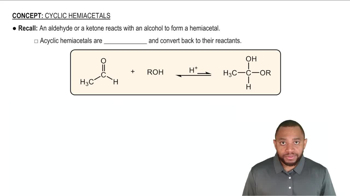
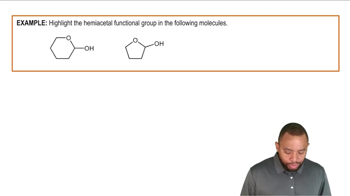
A structure where a former carbonyl carbon is bonded to both a hydroxyl and an alkoxy group, often formed from aldehydes.
Hemiketal
A structure similar to a hemiacetal but derived from a ketone, featuring a carbon bonded to a hydroxyl and an alkoxy group.
Acyclic Hemiacetal
A non-ring structure formed from an aldehyde and alcohol, typically unstable and favoring reversion to reactants.
Cyclic Hemiacetal
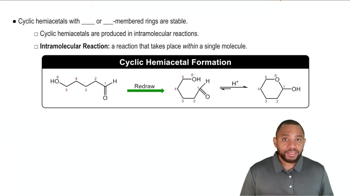
A stable ring structure, usually five or six-membered, formed by an intramolecular reaction within a single molecule.
Intramolecular Reaction
A process where reactive groups within the same molecule interact, often leading to ring formation in cyclic hemiacetals.
Carbonyl Carbon
A central atom in aldehydes and ketones, initially double-bonded to oxygen, which becomes a key site in hemiacetal formation.
Hydroxyl Group
An -OH functional group that attaches to the carbonyl carbon during hemiacetal or hemiketal formation.
Alkoxy Group
An -OR group, originating from alcohol, that bonds to the carbonyl carbon in hemiacetals and hemiketals.
Ring Structure
A closed molecular arrangement, often five or six atoms, that enhances the stability of cyclic hemiacetals.
Stability
A property indicating the tendency of cyclic hemiacetals to persist over their acyclic counterparts due to ring formation.
Equilibrium
A state in chemical reactions where the formation and breakdown of hemiacetals balance, influenced by structural stability.
Reaction Arrow
A diagrammatic symbol indicating the favored direction of a chemical process, with larger arrows showing preferred product formation.