GOB Chemistry
My Course
Learn
Exam Prep
AI Tutor
Study Guides
Textbook Solutions
Flashcards
Explore
My Course
Learn
Exam Prep
AI Tutor
Study Guides
Textbook Solutions
Flashcards
Explore
Back
Cyclic Hemiacetals quiz
You can tap to flip the card.
Define:
What is formed when an aldehyde or ketone reacts with one mole of alcohol?
You can tap to flip the card.
👆
What is formed when an aldehyde or ketone reacts with one mole of alcohol?
A hemiacetal or hemiketal is formed when an aldehyde or ketone reacts with one mole of alcohol.
Track progress
Control buttons has been changed to "navigation" mode.
1/15
Related flashcards
Related practice
Recommended videos
Cyclic Hemiacetals definitions
Cyclic Hemiacetals
15 Terms
20. Carbohydrates - Part 1 of 3
4 topics
11 problems
Chapter
Ernest
20. Carbohydrates - Part 2 of 3
6 topics
11 problems
Chapter
Ernest
20. Carbohydrates - Part 3 of 3
4 topics
11 problems
Chapter
Ernest
Guided course
2:10
Cyclic Hemiacetals Concept 1
Jules
1925
views
3
rank
Guided course
2:55
Cyclic Hemiacetals Concept 2
Jules
1675
views
3
rank
Guided course
1:21
Cyclic Hemiacetals Example 1
Jules
1784
views
4
rank
Terms in this set (15)
Hide definitions
What is formed when an aldehyde or ketone reacts with one mole of alcohol?
A hemiacetal or hemiketal is formed when an aldehyde or ketone reacts with one mole of alcohol.
Why are acyclic hemiacetals considered unstable?
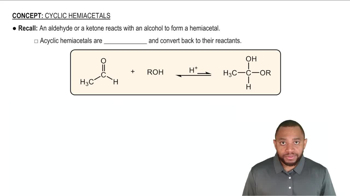
Acyclic hemiacetals are unstable because the equilibrium favors the reactants, causing them to revert back to the original aldehyde and alcohol.
What structural feature defines a hemiacetal?
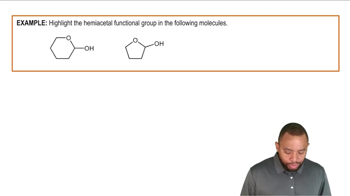
A hemiacetal has a carbon that was once a carbonyl carbon, now bonded to an OH group and an OR group.
How do reaction arrows indicate the stability of acyclic hemiacetals?
In diagrams, a small arrow points toward the product and a larger arrow points back to the reactants, showing the reaction favors the reactants.
What is the main difference between acyclic and cyclic hemiacetals?
Cyclic hemiacetals are more stable due to intramolecular reactions, while acyclic hemiacetals are unstable and revert to reactants.
What type of reaction produces cyclic hemiacetals?
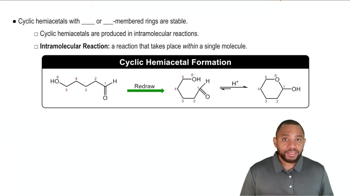
Cyclic hemiacetals are produced by intramolecular reactions, where the aldehyde or ketone and alcohol are within the same molecule.
Why are five or six-membered cyclic hemiacetals particularly stable?
Five or six-membered rings are stable because their ring size allows favorable bonding and minimizes strain.
What happens to the hydrogen atom on the alcohol group during cyclic hemiacetal formation?
The hydrogen is eliminated to allow proper bonding between the oxygen and the carbonyl carbon.
How does the bonding of oxygen change during cyclic hemiacetal formation?
Oxygen forms a new bond with the carbonyl carbon and picks up an H to maintain two bonds, becoming part of the ring.
What does a larger reaction arrow pointing toward the product indicate in cyclic hemiacetal formation?
It indicates that the cyclic hemiacetal is more stable and the reaction favors the product.
What is the preferred form for a molecule capable of forming a five or six-membered cyclic hemiacetal?
The preferred form is the cyclic hemiacetal, due to its greater stability.
What happens to the double bond of the carbonyl carbon during cyclic hemiacetal formation?
The double bond to oxygen disappears, and the carbon forms a single bond with the oxygen in the ring.
What is the role of intramolecular reactions in cyclic hemiacetal formation?
Intramolecular reactions allow the aldehyde or ketone and alcohol groups within the same molecule to react and form a stable ring.
How does the stability of cyclic hemiacetals compare to acyclic hemiacetals?
Cyclic hemiacetals are much more stable than acyclic hemiacetals, which tend to revert to their reactants.
What is the significance of the oxygen atom in the ring structure of cyclic hemiacetals?
The oxygen atom becomes part of the ring, helping to stabilize the structure and maintain proper bonding.