Back

Density of Non-Geometric Objects quiz

Control buttons has been changed to "navigation" mode.
1/15
  • What method is used to calculate the volume of non-geometric objects?

    Water displacement is used to calculate the volume of non-geometric objects.
  • What does water displacement measure?

    Water displacement measures the amount of water moved when an object is submerged.
  • How do you determine the volume of a non-geometric object using water displacement?

    Subtract the initial water volume from the final water volume after submerging the object.
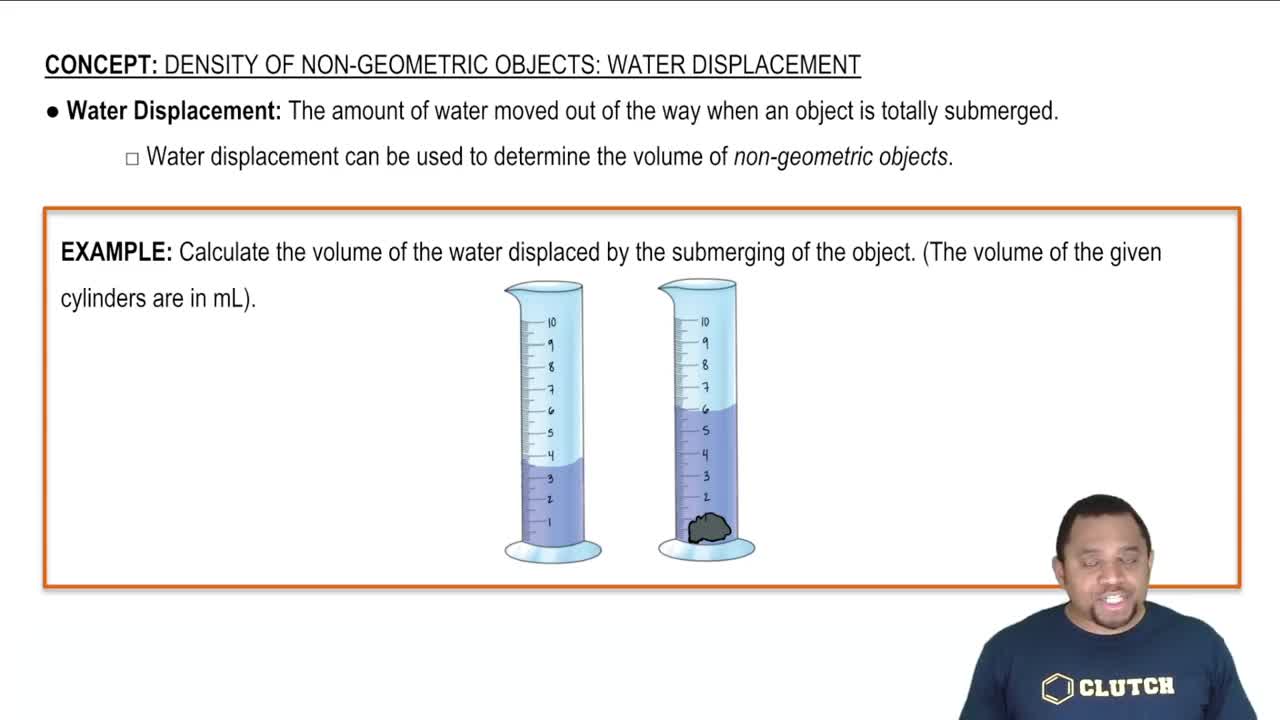
  • What was the initial water volume in the example provided?

    The initial water volume was approximately 3.5 milliliters.
  • What was the final water volume after submerging the object in the example?

    The final water volume was approximately 5.8 milliliters.
  • How do you calculate the volume of the object in the example?

    Subtract 3.5 ml from 5.8 ml to get 2.3 ml.
  • What is the volume of the non-geometric object in the example?

    The volume is 2.3 milliliters.
  • Why is water displacement useful for non-geometric objects?

    Because their irregular shapes make it difficult to use standard volume formulas.
  • What units were used to measure the water volume in the example?

    Milliliters were used to measure the water volume.
  • What happens to the water level when an object is submerged?

    The water level rises by an amount equal to the object's volume.
  • If the initial water volume is 4 ml and the final is 6 ml, what is the object's volume?

    The object's volume is 2 milliliters.
  • What is the formula for finding the volume of a submerged object?

    Volume of object = Final water volume - Initial water volume.
  • Why do we approximate the water levels in the example?

    Because the water levels may not align exactly with the measurement lines.
  • What is the significance of the difference between the final and initial water volumes?

    It represents the volume of the object that was submerged.
  • Can water displacement be used for geometric objects as well?

    Yes, but it is especially useful for non-geometric objects where formulas are hard to apply.