Back

Electronic Structure quiz

Control buttons has been changed to "navigation" mode.
1/15
  • What is the shell in the electronic structure of an atom?

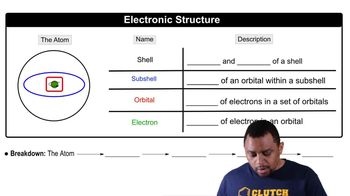
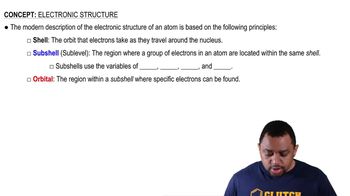
    The shell is the orbit that electrons take as they travel around the nucleus, indicating the atom's size and energy.
  • What are subshells and how are they represented?

    Subshells are regions within a shell where groups of electrons are located, and they are represented by the letters s, p, d, and f.
  • What is an orbital in the context of electronic structure?

    An orbital is a specific region within a subshell where particular electrons can be found.
  • What is the main goal of studying electronic structure?

    The main goal is to locate specific electrons within an atom and examine their spin.
  • How do electrons spin within their orbitals?

    Electrons can spin either clockwise or counterclockwise within their orbitals.
  • What does the shell of an atom represent?

    The shell represents the size and energy of the atom.
  • What does the subshell provide in terms of orbital characteristics?

    The subshell gives the shape of the orbital within it.
  • What does the orbital provide in terms of electron arrangement?

    The orbital gives the orientation of electrons in a set of orbitals.
  • What is the order of breakdown when examining electronic structure?

    The order is atom → shell → subshell → orbital → electron.
  • Why do we examine the spin of electrons?

    We examine the spin to understand how electrons behave within a particular orbital.
  • What variable letters are used to denote subshells?

    The letters s, p, d, and f are used to denote subshells.
  • What is found within an orbital?

    Within an orbital, we find a particular electron.
  • How does the electronic structure help us understand atoms?

    It helps us locate electrons and analyze their properties, such as spin.
  • What does the orientation of electrons refer to?

    It refers to the specific arrangement of electrons within a set of orbitals.
  • What is the relationship between shells, subshells, and orbitals?

    Shells contain subshells, subshells contain orbitals, and orbitals contain electrons.