Skip to main content
GOB Chemistry
My Course
Learn
Exam Prep
AI Tutor
Study Guides
Textbook Solutions
Flashcards
Explore
Try the app
My Course
Learn
Exam Prep
AI Tutor
Study Guides
Textbook Solutions
Flashcards
Explore
Try the app
Back
Enzyme Classification definitions
You can tap to flip the card.
Oxidoreductases
You can tap to flip the card.
👆
Oxidoreductases
Catalyze redox reactions by transferring electrons between molecules, often involving changes in hydrogen or oxygen content.
Track progress
Control buttons has been changed to "navigation" mode.
1/15
Related flashcards
Related practice
Recommended videos
Enzyme Classification quiz
Enzyme Classification
15 Terms
Enzyme Classification
19. Enzymes
7 problems
Topic
KeyshawnDavis
Enzyme-Substrate Complex
19. Enzymes
4 problems
Topic
Nicole
19. Enzymes
9 topics
15 problems
Chapter
Laura
Guided course
1:06
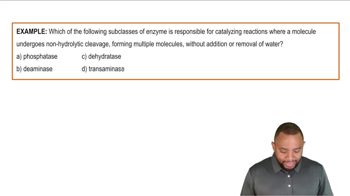
Lyases Example 7
3128
views
3
rank
Guided course
0:39
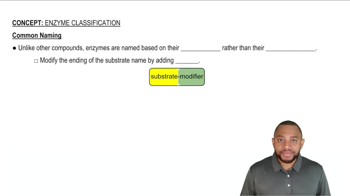
Common Naming Concept 1
3512
views
5
rank
Guided course
1:26
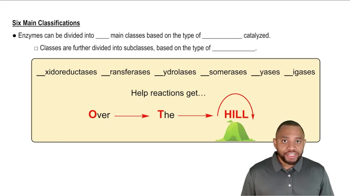
Six Main Classifications Concept 3
3465
views
6
rank
Terms in this set (15)
Hide definitions
Oxidoreductases
Catalyze redox reactions by transferring electrons between molecules, often involving changes in hydrogen or oxygen content.
Transferases
Facilitate the movement of functional groups, such as amino or phosphate groups, from one molecule to another.
Hydrolases
Break chemical bonds by adding water, with subclasses targeting lipids, proteins, nucleic acids, or phosphate esters.
Isomerases
Rearrange atoms within a molecule, shifting functional groups to create isomers without changing molecular formula.
Lyases
Add or remove groups to form or break double bonds, without using water or involving redox reactions.
Ligases
Join two molecules together using ATP, forming new covalent bonds and often creating larger molecules.
Oxidases
Subclasses of oxidoreductases that facilitate the oxidation of substrates, typically by transferring oxygen.
Reductases
Subclasses of oxidoreductases that promote reduction by adding hydrogen or removing oxygen from substrates.
Kinases
Subclasses of transferases that transfer phosphate groups, commonly from ATP, to other molecules.
Transaminases
Subclasses of transferases responsible for moving amino groups, especially nitrogen-containing groups, between molecules.
Lipases
Subclasses of hydrolases that break ester bonds in lipids, aiding in fat digestion and metabolism.
Proteases
Subclasses of hydrolases that cleave proteins into peptides and amino acids by hydrolyzing peptide bonds.
Nucleases
Subclasses of hydrolases that degrade DNA and RNA into nucleic acids by hydrolyzing phosphodiester bonds.
Phosphatases
Subclasses of hydrolases that remove phosphate groups by hydrolyzing phosphate ester bonds.
Carboxylases
Subclasses of ligases that catalyze the attachment of carbon dioxide to other molecules, often using ATP.
 BackBack
 1:06
1:06