Back

Ester Reactions: Saponification definitions

Control buttons has been changed to "navigation" mode.
1/12
  • Saponification

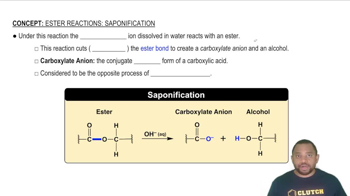
    A reaction where a hydroxide ion breaks an ester bond, yielding a carboxylate anion and an alcohol.
  • Ester

    A compound featuring a linkage between a carbonyl group and an oxygen atom bonded to another carbon.
  • Hydroxide Ion

    A negatively charged ion, OH-, that acts as a nucleophile in breaking ester bonds during saponification.
  • Carboxylate Anion

    A negatively charged species formed when a carboxylic acid loses a proton, resulting in a negative charge on oxygen.
  • Alcohol

    A product of saponification, formed when the ester linkage is cleaved and an H is added to the oxygen.
  • Ester Linkage

    A bond connecting a carbonyl carbon to an oxygen atom, which is targeted and broken during saponification.
  • Aqueous Solution

    A medium where substances like hydroxide ions are dissolved in water, enabling reactions such as saponification.
  • Carboxylic Acid

    A molecule containing a carbonyl and hydroxyl group, which upon losing a proton forms a carboxylate anion.
  • Conjugate Base

    A species formed when an acid donates a proton, often carrying a negative charge as seen in carboxylate anions.
  • Esterification

    A process considered the reverse of saponification, where an ester is formed from an acid and an alcohol.
  • Carbonyl Group

    A functional group consisting of a carbon atom double-bonded to an oxygen, present in esters and acids.
  • Negative Charge

    An excess of electrons, as seen on the oxygen atom in a carboxylate anion after saponification.