Back

Ester Reactions: Saponification quiz

Control buttons has been changed to "navigation" mode.
1/15
  • What is saponification in the context of ester reactions?

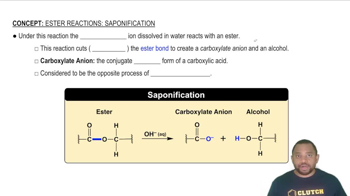
    Saponification is a reaction where an ester reacts with hydroxide ion (OH-) in water, resulting in the cleavage of the ester bond to form a carboxylate anion and an alcohol.
  • What ion is responsible for cleaving the ester bond in saponification?

    The hydroxide ion (OH-) is responsible for cleaving the ester bond during saponification.
  • What are the two main products of saponification?

    The two main products are a carboxylate anion and an alcohol.
  • What is a carboxylate anion?

    A carboxylate anion is the conjugate base form of a carboxylic acid, formed by the loss of an H+ ion.
  • How does the carboxylate anion acquire its negative charge?

    It acquires a negative charge by losing an H+ ion from the carboxylic acid group.
  • What happens to the ester linkage during saponification?

    The ester linkage is cleaved by the hydroxide ion, breaking the bond and forming new products.
  • What does the oxygen in the alcohol product gain during saponification?

    The oxygen in the alcohol product gains a hydrogen atom (H) during saponification.
  • What does the carbonyl group become after saponification?

    The carbonyl group becomes a carboxylate anion with a negatively charged oxygen.
  • What is the relationship between saponification and esterification?

    Saponification is considered the opposite process of esterification.
  • What is required for saponification to occur?

    An ester and aqueous hydroxide ion (OH-) are required for saponification to occur.
  • What does 'conjugate base' mean in the context of carboxylate anion formation?

    It means the molecule has lost an H+ ion, resulting in a negatively charged oxygen.
  • What is the role of water in saponification?

    Water dissolves the hydroxide ion, allowing it to react with the ester.
  • What type of bond is broken during saponification?

    The ester bond (linkage) is broken during saponification.
  • What happens to the carbonyl oxygen after the ester bond is cleaved?

    The carbonyl oxygen gains a negative charge, forming the carboxylate anion.
  • Why is the oxygen in the carboxylate anion negatively charged after saponification?

    Because it has lost an H+ ion, leaving the oxygen with an extra electron and a negative charge.