GOB Chemistry
My Course
Learn
Exam Prep
AI Tutor
Study Guides
Textbook Solutions
Flashcards
Explore
My Course
Learn
Exam Prep
AI Tutor
Study Guides
Textbook Solutions
Flashcards
Explore
Back
Functional Groups in Chemistry definitions
You can tap to flip the card.
Define:
Functional Group
You can tap to
flip the card.
👆
Functional Group
A recognizable part of a molecule responsible for its chemical reactivity and properties.
Track progress
Control buttons has been changed to "navigation" mode.
1/17
Related practice
Recommended videos
Guided course
2:14
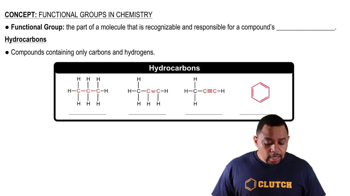
Hydrocarbons Concept 1
Jules
2070
views
11
rank
Guided course
1:10
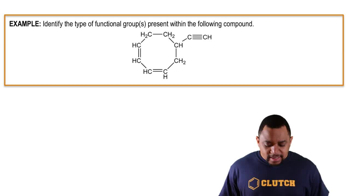
Functional Groups In Chemistry Example 1
Jules
1936
views
12
rank
Guided course
2:23
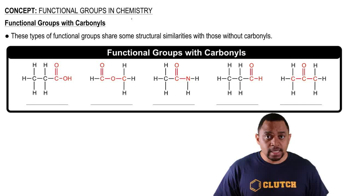
Functional Groups without Carbonyls Concept 2
Jules
1921
views
9
rank
Terms in this set (17)
Hide definitions
Functional Group
A recognizable part of a molecule responsible for its chemical reactivity and properties.
Hydrocarbon
A compound containing only carbon and hydrogen atoms, forming the simplest organic structures.
Alkane
A chain of carbon atoms single bonded to each other and to hydrogens, forming saturated molecules.
Alkene
A structure with at least two carbon atoms double bonded to each other, introducing unsaturation.
Alkyne
A molecule featuring a triple bond between two carbon atoms, resulting in high reactivity.
Benzene Ring
A six-carbon ring with alternating double bonds, also known as an aromatic ring.
Alcohol
A group where a single bonded carbon is attached to an OH group, influencing solubility and reactivity.
Ether
A structure where an oxygen atom connects two single bonded carbon atoms, forming a C-O-C linkage.
Amine
A group with a nitrogen atom single bonded to one or more hydrogens, often basic in nature.
Alkyl Halide
A compound where a single bonded carbon is attached to a halogen such as fluorine, chlorine, bromine, or iodine.
Thiol
A group with a single bonded carbon attached to an SH group, imparting strong odors.
Carbonyl Group
A functional group consisting of a carbon atom double bonded to an oxygen atom, key to many organic compounds.
Carboxylic Acid
A group with a carbonyl bonded to an OH group, known for acidic properties.
Ester
A group where a carbonyl is bonded to an oxygen, which is further bonded to another carbon, often with pleasant scents.
Amide
A group featuring a carbonyl directly bonded to a nitrogen atom, common in proteins.
Aldehyde
A group with a carbonyl bonded directly to a hydrogen, often found at the end of carbon chains.
Ketone
A group where a carbonyl is flanked by two carbon atoms, central to many metabolic pathways.