Back

Gibbs Free Energy (Simplified) definitions

Control buttons has been changed to "navigation" mode.
1/12
  • Gibbs Free Energy

    A measure of usable energy change in a process, indicating the potential to perform work and determine reaction spontaneity.
  • Delta G

    A value representing the change in usable energy during a reaction, used to assess if a process is spontaneous, non-spontaneous, or at equilibrium.
  • Spontaneity

    A property describing whether a reaction proceeds on its own without external input, based on energy changes.
  • Equilibrium

    A state where the forward and reverse reactions occur at equal rates, resulting in no net energy change.
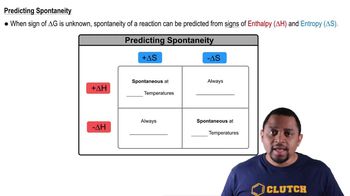
  • Enthalpy

    A quantity reflecting the total heat content of a system, influencing reaction spontaneity when combined with entropy.
  • Delta H

    A value indicating the heat change in a reaction, typically measured in kilojoules, affecting spontaneity predictions.
  • Entropy

    A measure of disorder or randomness in a system, impacting whether a reaction is favored under certain conditions.
  • Delta S

    A value representing the change in system disorder during a reaction, usually given in joules per Kelvin.
  • Temperature

    A factor, measured in Kelvin, that influences the effect of enthalpy and entropy on reaction spontaneity.
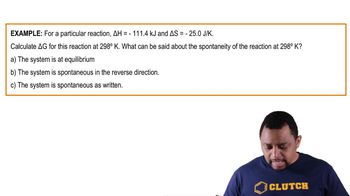
  • Kilojoules

    A unit of energy commonly used for enthalpy and Gibbs free energy calculations to maintain consistency.
  • Joules

    A unit of energy often used for entropy values, requiring conversion for consistent calculations.
  • Gibbs Free Energy Formula

    An equation, delta g = delta h - t delta s, used to calculate the energy available for work in a reaction.